Hitler's 'Mein Kampf' may return to Bavarian schools
German state owns copyright to the book outlining Nazi vision of racial supremacy, but copyright will expire in two years.
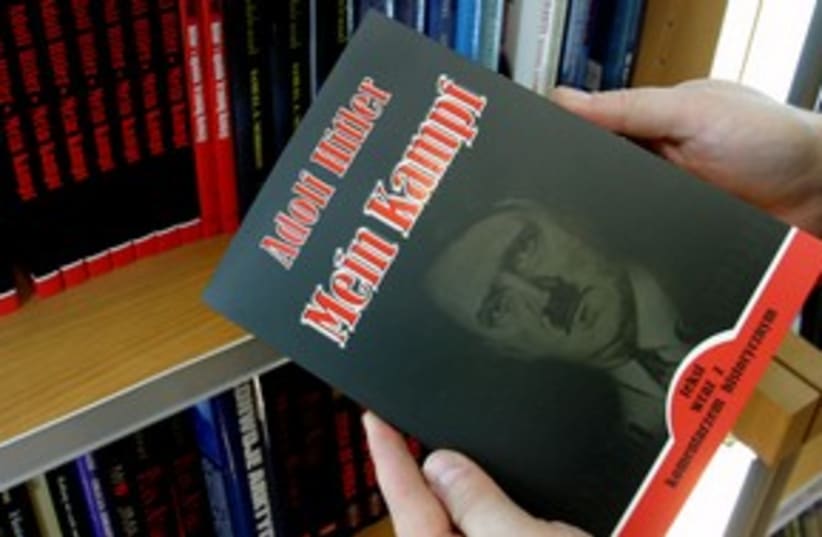
By REUTERSMein Kampf sells in Poland_311(photo credit: Reuters)
BERLIN - The German state of Bavaria is considering publishing a book with excerpts from Hitler's Mein Kampf for use in schools after its legal power to ban the book expires in 2016.The Bavarian state finance ministry in southern Germany owns the copyright to the book, which sets out the Nazi vision of Aryan racial supremacy, and has long threatened legal action against anybody who tries to publish it.But the copyright expires on December 31, 2015, forcing Bavaria, where Hitler first shot to national prominence with a failed coup attempt in 1923, to wrestle with how to handle the publication of a book that remains highly sensitive in Germany."We discussed a copy for schools. It wouldn't be a whole book but excerpts that were presented in a particularly didactic way so they were suited for use in schools - that is conceivable," Thomas Neumann, a spokesman for the Bavarian state finance ministry, told Reuters.He said the ministry was also considering a separate edition with an academic commentary provided by the Munich-based Institute for Contemporary History (IfZ)."We have a responsibility, a collective responsibility, (for the book) even after the copyright runs out. With an academic commentary we want to demystify the book and we are facing up to this responsibility," Neumann said.The finance ministry would provide 200,000 euros ($264,100) and the state's economy ministry a further 300,000 euros for the projects, he said.Earlier this year, Bavaria's finance ministry forced the removal of Mein Kampf excerpts from a magazine supplement that went on sale in Germany after threatening legal action.British publisher Peter McGee said he had wanted Germans to have access to the book to be able to judge it for themselves."Once exposed it can then be consigned to the dustbin of history," McGee told Reuters at the time.Critics of the German ban say it is anachronistic in an age when the book's contents are easily available over the Internet and when it is also readily available in other countries."Germany is democratic and mature enough to form its own picture of Hitler's book," Rafael Seligmann, publisher of the Jewish Voice from Germany newspaper, told "Welt Online".Austrian-born Hitler wrote the autobiographical Mein Kampf (My Struggle) in prison after his failed Munich coup, which is known as the Beer Hall Putsch. He became chancellor of Germany in 1933.
if(catID != 151){
var cont = `Take Israel home with the new Jerusalem Post Store