Argentine court strikes down 'truth commission' deal with Iran over 1994 bombings
Prosecutor who oversaw probe of the AMIA center bombing argued in his appeal that the executive branch had overstepped into areas reserved for the judiciary.
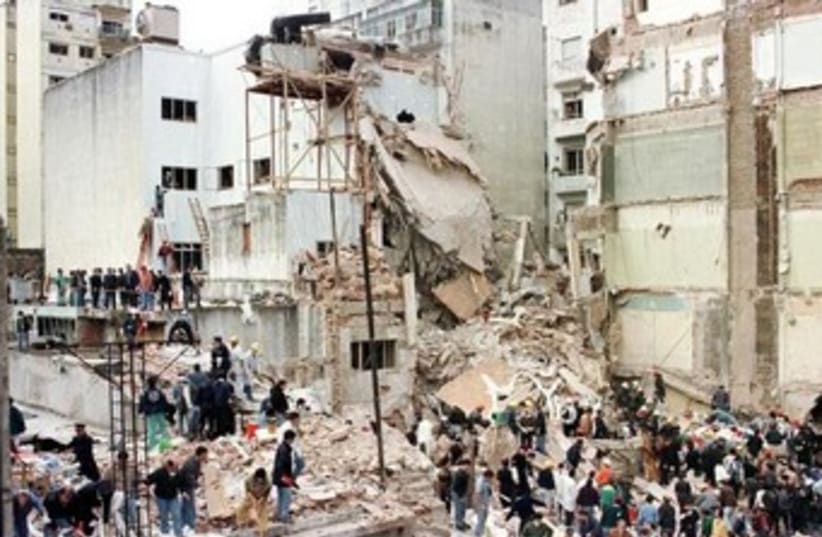
By REUTERSSite of the 1994 boming of the Argentine Israeli Mutual Association (AMIA), in Buenos Aires.(photo credit: REUTERS)
An Argentine Federal court on Thursday struck down an agreement between the South American country and Iran to jointly investigate the deadly 1994 bombing of a Buenos Aires Jewish community center that local courts blamed on Tehran.Alberto Nisman, a prosecutor who oversaw an investigation of the AMIA center explosion that killed 85 people, had argued in his appeal to the court that in negotiating the 2013 deal with Iran, the executive branch had overstepped into areas reserved for the judiciary.Thursday's ruling declared the agreement unconstitutional and ordered Argentina not to go ahead with it. The deal had been delayed anyway by Iranian reluctance to move forward in implementing it.The government said it will appeal the ruling to Argentina's Supreme Court."We have notified the government of Iran of our decision to appeal," said Argentine Foreign Minister Hector Timerman. "If the lower court's ruling is allowed to stand, it would close a concrete possibility of making the inquiries that could lead to a trial."Israel and world Jewish groups had denounced the "truth commission" deal with Iran, calling it a diplomatic win for Tehran that offered no benefit to Argentina. The deal would have let Iran review Argentina's investigation into the bombing.AMIA Acting President Thomas Saieg welcomed the federal court ruling, but added: "We still have nothing to celebrate while those who carried out the attack against the AMIA go unpunished."The AMIA bombing came two years after a group linked to Iran and the Lebanese militant group Hezbollah claimed responsibility for an attack on the Israeli embassy in Buenos Aires, which killed 29. Tehran has denied links to either attack.In 2007, Argentine authorities secured Interpol arrest warrants for five Iranians and a Lebanese in the 1994 bombing. The court ruling reiterated Argentina's extradition requests.News of the decision, released late Thursday night, was the latest blow suffered by President Cristina Fernandez. With a year and half to go before the end of her second and final term, Fernandez's popularity has been hurt by a weakening economy and one of the world's highest inflation rates.
if(catID != 151){
var cont = `Take Israel home with the new Jerusalem Post Store