New talks set for Spring; Tehran suggests willingness to discuss fuel enrichment; Ashton: EU awaiting response to proposal.
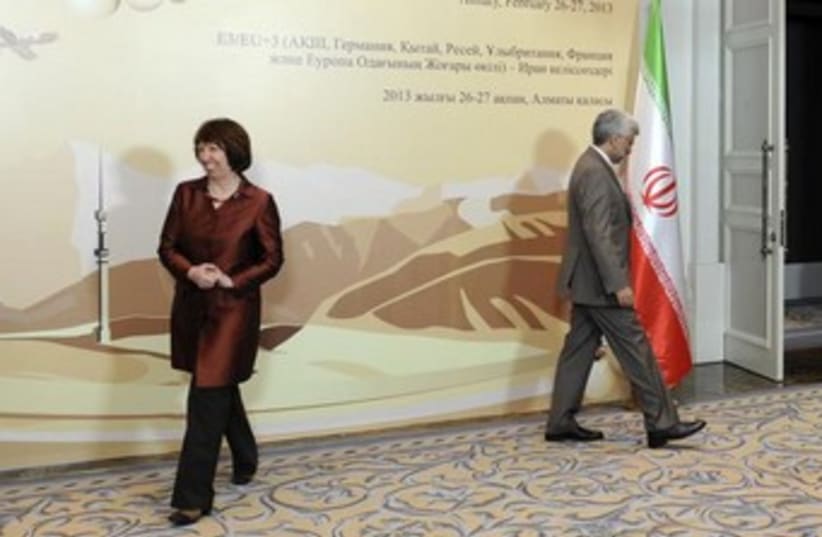
By REUTERSJalili and Ashton at Iran talks in Kazakhstan 370(photo credit: REUTERS)
ALMATY - World powers ended two days of talks with Iran on Wednesday with no sign of a breakthrough, and Iran appearing to rule out closing the underground Fordow enrichment plant. However, the two sides have agreed to meet at expert level in Istanbul next month and to hold further high-level negotiations in Kazakhstan in April. Iran said the nuclear talks were a "positive step."In their latest attempt to break years of stalemate in the dispute, the powers are offering Iran a relaxation of some of the sanctions that are taking a heavy toll on its economy.Western officials have confirmed the offer includes some limited sanctions easing if Iran closes the Fordow nuclear facility, an underground site where it carries out its most controversial uranium enrichment work.Iran showed no flexibility on the closure of Fordow, but Saeed Jalili, Iran's chief nuclear negotiator, suggested Iran could discuss its production of nuclear fuel enriched to a fissile concentration of 20 percent - which greatly worries the West.In comments in Persian translated into English, Jalili told a news conference Fordow was under the supervision of the UN nuclear agency and there was "no justification" to shut it down.Click here for full Jpost coverage of the Iranian threatAsked about the production of 20 percent enriched fuel - a relatively short technical step away from weapons-grade material - he reiterated Iran's position that it needed this for a research reactor and had a right to produce it.But Jalili indicated that Iran may be prepared to discuss the issue: "This can be discussed in the negotiations ... in a view of confidence building."Iran has also previously suggested that 20 percent enrichment was up for negotiations if it received the fuel from abroad instead. It also wants sanctions lifted.Jalili said the six powers - the United States, France, Germany, Britain, Russia and China - at Almaty had tried to "get closer to our viewpoint", which he said was positive.The Iranian statement said: "We consider these talks a positive step which could be completed by taking a positive and constructive approach and taking reciprocal steps."Iran said the expert-level talks between the two sides would be held in Istanbul on March 18 and another round of political negotiations in Almaty on April 5-6.Russia's negotiator, Deputy Foreign Minister Sergei Ryabkov, said the Istanbul meeting would take place on March 17-18 and gave the same dates as Iran of April 5-6 for the Almaty talks.The meeting in Almaty was the first between the world powers and Iran in eight months. Western officials described the first day of the talks as "useful". Iranian state television described the atmosphere in the discussions as "very serious".The outcome will be closely watched in Israel, which has strongly hinted that it could attack Iran's nuclear sites if diplomacy and sanctions fail to stop Tehran's uranium enrichment program.World powers hope Iran will react positively to their nuclear proposal presented at the talks when they meet Tehran's negotiators in the next two months, EU foreign policy chief Catherine Ashton said."I hope the Iranian side is looking positively on the proposal we put forward," Ashton said after the two-day talks concluded. "We have to see what happens next," she said.Hopes of a significant easing of the deadlock in the decade-old dispute were dented when Russian media cited a source close to the talks as saying there had been no clear progress."So far there is no particular rapprochement. There is an impression that the atmosphere is not very good," Interfax news agency quoted the source as saying shortly before the talks ended.Diplomats had seen scant chances of a conclusive deal with Iran before a June presidential election - with the political elite preoccupied with domestic issues - but they had hoped to hold follow-up talks soon.
if(catID != 151){
var cont = `Take Israel home with the new Jerusalem Post Store