Israel: We have Palestinian engineer missing since Feb.
Court removes partial gag order on case allegedly involving Mossad abduction in Ukraine.
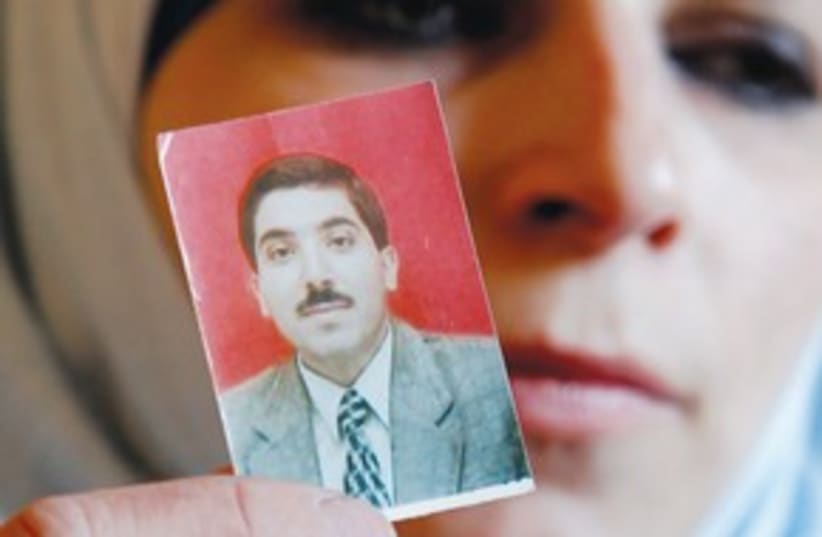
By RON FRIEDMANwife of abu sisi_311(photo credit: Gleb Garanich/Reuters)
Petah Tikva Magistrate’s Court, on Sunday, partially removed a publication ban and confirmed that Dirar Abu Sisi, a Palestinian engineer believed to have been abducted from the Ukraine by Mossad agents in late February, is currently in Israel. The ban was removed as a result a petition filed to the court by the Association of Civil Rights (ACRI).The affair, which received wide coverage in the foreign press, was placed under a publication ban in Israel. Much of the details, including reports of a train-mounted abduction and transfer to Israel as well as the details of the investigation against Abu Sisi, will remain under a cloak of secrecy, at least for the next 30 days.RELATED:It’s a bird, it’s a shark, it’s a Mossad spyTrial of Egyptian accused of spying for Mossad delayedAbu Sisi is the manager of the only power plant in the Gaza Strip. He is not known to have any direct ties with Hamas or other terrorist organizations, although it is likely that his senior position was the result of political affiliation.In interviews to foreign reporters, Abu Sisi’s wife Veronica, blamed the kidnapping on the Mossad, claiming they did it to sabotage the Gazan power plant and that he was being held at the Shikma Prison in Ashkelon. She denied that he had any ties to Hamas.Little is known about the circumstances surrounding Abu Sisi’s disappearance during a visit to Kiev with his family, but his sister Suzanne Abu Sisi, 45, told Reuters her brother had been abducted from a train in Ukraine last month, then taken to an Israeli prison.“Friends there told us Dirar had been seized by six people who had abducted him from the train en route between Kharkhov and Kiev,” she told Reuters. “We know now that he is in prison in Israel, so they were the ones who abducted him. We do not know why they did it.”Suzanne Abu Sisi, who lives in Gaza, said her brother had gone to Ukraine with his Ukrainian wife and six children to apply for citizenship there.In its petition, argued before the court last Thursday, ACRI argued that the public had a right to know about the actions of the security forces and said that “it is inconceivable that the authorities in a democratic country be able to secretly arrest people and ‘vanish’ them from the public eye.”“The blanket secrecy in cases like this may negatively effect the rights and mental well being of the arrested person,” continued the petition. “Leaving the publication ban in place could raise concerns that the ban’s purpose is to prevent public debate on the accused’s arrest and enable the authorities to investigate him away from the critical eye of the media and the general public.”In her decision to partially remove the publication ban, Judge Lia Lev On wrote that, taking into account the needs and the progress of the investigation and the material she was shown, the ban could partially be lifted, with the arrest and investigation details remaining under ban for the next month.ACRI said that they would wait to see the state's response to the petition before deciding on whether to appeal to have all the details made public.
if(catID != 151){
var cont = `Take Israel home with the new Jerusalem Post Store