Canberra's highest court blocks extradition on technicality that "war crimes" weren't codified at time of alleged murders.
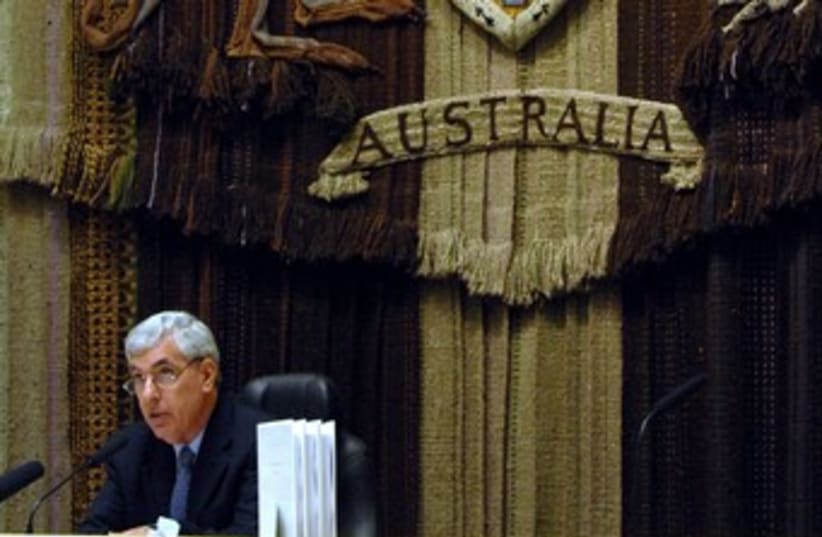
By REUTERS, JPOST.COM STAFFA Federal Court Judge in Canberra, Australia 370 (R)(photo credit: reuters)
CANBERRA - An alleged Nazi war criminal living in Australia won on Wednesday a long battle against the government's attempts to extradite him to Hungary to stand trial for the murder of a Jewish teenager.Charles Zentai, now 90, was accused by Hungarian authorities of beating to death a Jewish teenager, Peter Balazs, in Budapest in 1944.Australia's highest court ruled that Zentai could not be extradited to the country of his birth because the offense "war crime" did not exist in Hungarian law at the time the murder was alleged to have been committed.Zentai, who migrated to Australia in 1950 and became an Australian citizen, has maintained his innocence throughout his legal challenge.Zentai, a 23-year-old warrant officer in the pro-Nazi Hungarian military at the time of Balazs' death, said he was not in Budapest when the attack took place.A spokesperson for Jason Clare, Australian Minister for Home Affairs, confirmed that Zentai would not be surrendered to Hungary.A retired mental health nurse, Zentai was arrested by Australian police in 2005 after Hungary requested his extradition. Australia ordered in 2009 that Zentai be sent to Hungary, but the Federal Court overturned that ruling in 2011.The government contested that decision, but Wednesday's court ruling threw out its appeal and leaves the government with no further challenges.Zentai's family welcomed the ruling, but told Australian radio that they wanted the Australian government to apologize."As a soldier I just had to carry out orders ... but none of those orders I was given had anything to do with rounding up Jews or torturing them or anything like that," Zentai told Australian television in 2008.The Simon Wiesenthal Center "harshly criticized" the Australian High Court's decision and questioned the basis for the rejection of the Hungarian extradition request.The Simon Wiesenthal Center director and Nazi hunter Dr. Efraim Zuroff noted that "numerous Nazi war criminals had been extradited from countries of refuge to stand trial in Germany for crimes which had not yet been categorized as such when they were committed."“Today’s unfortunate decision to refuse the Hungarian extradition request appears to ignore numerous legal precedents which in the past facilitated the prosecution of the leaders of the Third Reich and additional Nazi war criminals. In practical terms, it signals a dismal conclusion to Australia’s totally unsuccessful efforts to bring to justice any of the numerous Nazi war criminals who found refuge in the country. Today is a sad day for Australia, and for justice, but most of all for the Nazis’ victims, their families and those who empathize with their suffering," Zuroff stated.On behalf of the The Simon Wiesenthal Center, Zuroff extended his sympathies to the family, "who tried to see justice achieved in this case, but were thwarted by the Australian authorities.”
if(catID != 151){
var cont = `Take Israel home with the new Jerusalem Post Store