Officials: We expected waves to be 50% bigger in Hawaii.
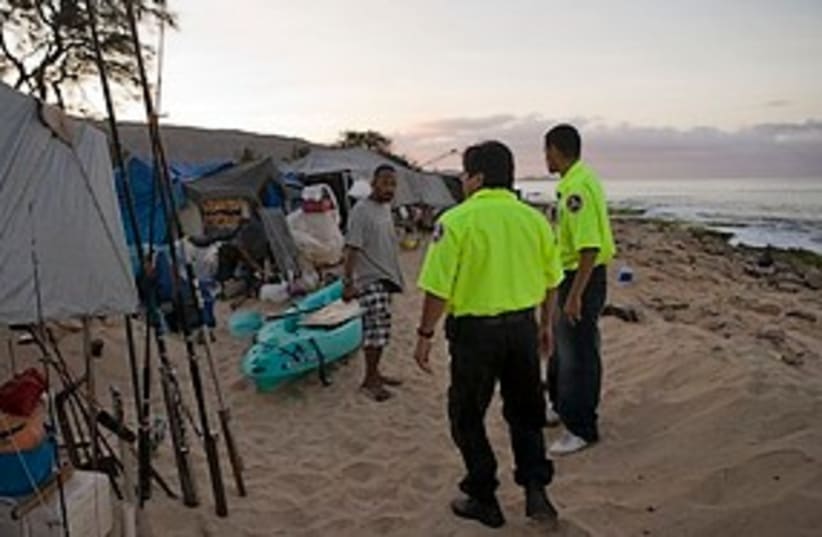
By ASSOCIATED PRESStsunami hawaii cops in yellow cool 311 ap(photo credit: ASSOCIATED PRESS)
TOKYO — A tsunami that raced across the Pacific swiped island nationsand Asian coasts lightly Sunday, proving to be more spectacle thandestructive force for communities that had hours to prepare afterChile's devastating earthquake.Hundreds of thousands of peoplefled shorelines for higher ground after the Pacific Tsunami WarningCenter in Hawaii warned 53 nations and territories that a tsunami hadbeen generated by Saturday's magnitude-8.8 earthquake. After the centerlifted its warning, some countries kept their own watches in place as aprecaution.In Japan, the biggest wave hit the northern islandof Hokkaido. There were no immediate reports of damage from the1.2-meter wave, though some piers were briefly flooded.As it crossed the Pacific, the tsunami dealt populated areas — including the US state of Hawaii — only a glancing blow.Thetsunami raised fears Pacific nations could suffer from disastrous waveslike those that killed 230,000 people around the Indian Ocean inDecember 2004, which happened with little-to-no warning and muchconfusion about the impending waves.Officials said the oppositeoccurred after the Chile quake: They overstated their predictions ofthe size of the waves and the threat."We expected the waves tobe bigger in Hawaii, maybe about 50 percent bigger than they actuallywere," said Gerard Fryer, a geophysicist for the warning center. "We'llbe looking at that."Japan, fearing the tsunami could gain forceas it moved closer, put all of its eastern coastline on tsunami alertand ordered hundreds of thousands of residents in low-lying areas toseek higher ground as waves raced across the Pacific at hundreds ofkilometers per hour.Japan is particularly sensitive to the tsunami threat.InJuly 1993 a tsunami triggered by a major earthquake off Japan'snorthern coast killed more than 200 people on the small island ofOkushiri. A stronger quake near Chile in 1960 created a tsunami thatkilled about 140 people in Japan.Towns along northern coastsissued evacuation orders to 400,000 residents, Japanese publicbroadcaster NHK said. NHK switched to emergency mode, broadcasting amap with the areas in most danger and repeatedly urging caution.Asthe wave crossed the ocean, Japan's Meteorological Agency said waves ofup to three meters could hit the northern prefectures of Aomori, Iwateand Miyagi, but the first waves were much smaller.People packedtheir families into cars, but there were no reports of panic or trafficjams. Fishermen secured their boats, and police patrolled beaches,using sirens and loudspeakers to warn people to leave the area.InKesennuma, northern Japan, seawater flooded streets near the coast forabout four hours before receding but caused little impact to people.But the tsunami passed gently by most locations.Bythe time the tsunami hit Hawaii — a full 16 hours after the quake —officials had already spent the morning blasting emergency sirens,blaring warnings from airplanes and ordering residents to higherground. The Navy moved a half dozen vessels out of Pearl Harbor and acruiser out of Naval Base San Diego to avoid the surge.Picturesquebeaches were desolate, million-dollar homes were evacuated, shops inWaikiki were closed and residents filled supermarkets and gas stationsto stock up on supplies. But after the morning scare, the islands wereback to paradise by the afternoon.Waves hit California, but barely registered amid stormy weather. A surfing contest outside San Diego went on as planned.InTonga, where up to 50,000 people fled inland hours ahead of thetsunami, the National Disaster Office had reports of a wave up to 6.5two meters high hitting a small northern island, deputy director Mali'uTakai said. There were no initial indications of damage.Ninepeople died in Tonga last September when the Samoa tsunami slammed thesmall northern island of Niuatoputapu, wiping out half of the mainsettlement.In Samoa, where 183 people died in the tsunami fivemonths ago, thousands remained Sunday morning in the hills above thecoasts on the main island of Upolu, but police said there were noreports of waves or sea surges hitting the South Pacific nation.Atleast 20,000 people abandoned their homes in southeastern Philippinevillages and took shelter in government buildings or fled to nearbymountains overnight. Provincial officials scrambled to alert villagersand prepare contingency plans, according to the National DisasterCoordinating Council.Philippine navy and coast guard vessels,along with police, were ordered to stand by for possible evacuation butthe alert was lifted late Sunday afternoon.Indonesia, whichsuffered the brunt of the 2004 disaster, had been included in thetsunami warning Saturday, but the country's Meteorology and GeophysicsAgency said Sunday there was no tsunami risk for the archipelago as itwas too far from the quake's epicenter.On New Zealand's Chatham Islands earlier Sunday, officials reported a wave measured at two meters.Severalhundred people in the North Island coastal cities of Gisborne andNapier were evacuated from their homes and from camp grounds, whileresidents in low-lying areas on South Island's Banks Peninsula werealerted to be ready to evacuate.Waters at Tutukaka, a coastaldive spot near the top of the North Island, looked like a pot boilingwith the muddy bottom churning up as sea surges built in size throughthe morning, sucking sea levels below low water marks before surgingback.Australia's Bureau of Meteorology canceled its tsunami warning Sunday evening."The main tsunami waves have now passed all Australian locations," the bureau said.Nodamage was reported in Australia from small waves that were recorded inNew South Wales, Queensland, Tasmania and Norfolk Island, about 1,600kilometers northeast of Sydney.New Zealand's Ministry of CivilDefense and Emergency Management downgraded its tsunami warning to anadvisory status, which it planned to keep in place overnight.
if(catID != 151){
var cont = `Take Israel home with the new Jerusalem Post Store