Hungarian FM: EU will adopt stricter Iran sanctions
Martonyi tells the 'Post' EU position is always to follow a "double-track approach" to the Iranian nuclear issue.
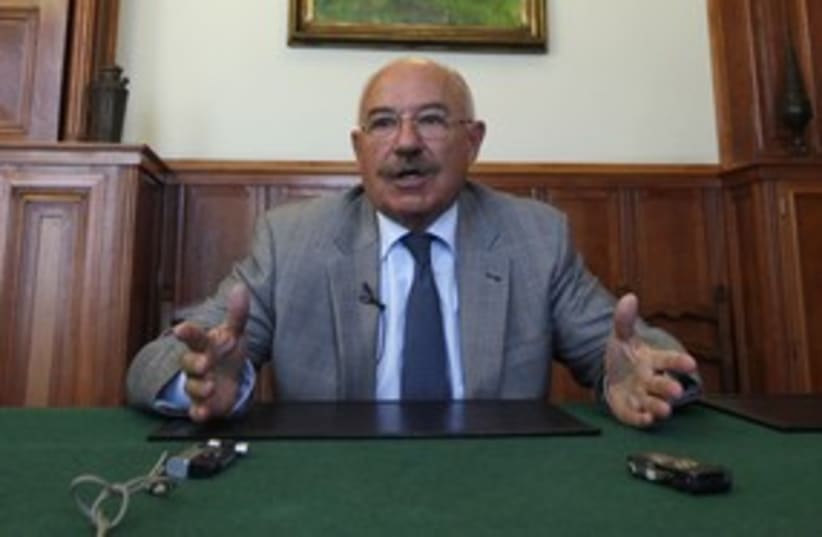
By HERB KEINONHungarian Foreign Minister Janos Martonyi 311 (R)(photo credit: REUTERS/Laszlo Balogh)
BUDAPEST – European Union foreign ministers meeting in Brussels on Monday will likely introduce “new and much more stringent” sanctions against Iran, Hungarian Foreign Minister Janos Martonyi told The Jerusalem Post this week.“I do feel that sanctions work, and the EU’s position is always that we have to follow a double-track approach,” he said, referring to sanctions and attempts at finding a diplomatic solution to prevent Tehran from developing nuclear capabilities.RELATED:Netanyahu pressuring Europe to embargo Iranian oil France's Juppe: EU to agree on Iran sanctions Asked whether Hungary will support the imposition of an embargo on Iranian oil, an issue scheduled to be decided at Monday’s meeting, Martonyi said he believed there would be a EU consensus that tougher sanctions needed to be introduced.
In addition to an oil embargo, the 27 EU foreign ministers are expected to agree on a freeze of Iranian central bank assets.Consensus on Middle East issues inside the EU is often elusive, the most recent example being an EU split on whether to grant full membership to “Palestine” in UNESCO, a motion that passed in October.While five EU countries voted against the measure, 11 voted for and another 11 abstained, including several Central European countries such as Hungary.Martonyi said one factor behind his country’s decision to abstain on the vote, rather than to vote against as did the Czech Republic, Germany, Lithuania, the Netherlands and Sweden, was that a Hungarian diplomat was the president of UNESCO’s General Conference this year, something that meant Hungary had to show “neutrality” on the issue.Martonyi danced around the question whether he thought Israel was being treated fairly inside the EU.Hungary for its own part is facing heavy criticism inside the EU because of concerns that its Prime Minister Viktor Orban is leading the country down an authoritative path.Many leading Hungarian officials believe that Hungary itself is now not being treated fairly by the EU.Click here for full Jpost coverage of the Iranian threatAccording to diplomatic officials in Jerusalem, Budapest is friendly toward Israel in the EU institutions, but not at the level of former Iron Curtain countries such as the Czech Republic, Poland and, to a lesser extent, Bulgaria, Romania, Latvia and Lithuania.On the on the other end of the spectrum, Slovenia is seen as the “coldest” toward Israel of the former Soviet bloc countries that joined the EU in 2004.Asked why it was important for his country to have a strong relationship with Israel, Martonyi said “because we have an extremely important Jewish community, on the one hand, and on the other hand we have 200,000 Hungarian citizens living in Israel.”At a speech on Tuesday at a ceremony in Budapest launching events marking the 100th birthday of Raoul Wallenberg, the Swedish diplomat who saved more than 20,000 Hungarian Jews in the waning days of World War II, Martonyi said Hungary placed a “special emphasis on Israel’s security.”Asked about this during his interview with the Post, Martonyi said the two countries had a “special relationship” that could be seen in “trade, investment, and foreign policy.” The volume of Hungarian-Israeli trade is some $350 million a year.This “special relationship” was also evident in the “revival of Jewish culture, Jewish music, Jewish festivals, Jewish food and Jewish religious life” in Hungary, he asserted. Martonyi said it was further evident in the 200,000 Hungarian-born Jews in Israel, a community he maintained continued to form a “bridge between the two countries.”
if(catID != 151){
var cont = `Take Israel home with the new Jerusalem Post Store