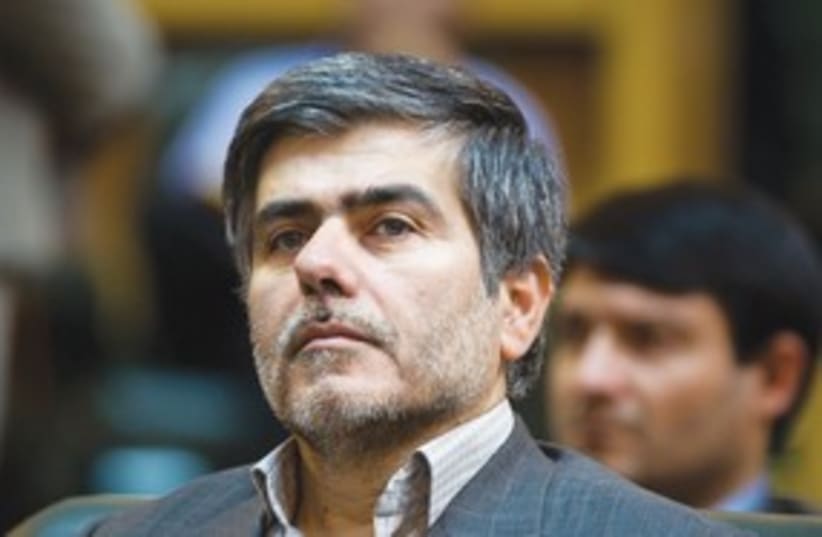
Abbasi-Davani dismisses as "false" AP report that Iran is "working on a nuclear bomb more powerful than Hiroshima."
By JOANNA PARASZCZUKhead of Iran's Atomic Energy Org. Abbasi Davani_311(photo credit: Reuters)
The head of Iran’s Atomic Energy Organization (AEOI) rejected on Wednesday claims made by an American news agency that a leaked diagram suggested Tehran was “working on a nuclear bomb more powerful than [the bomb that hit] Hiroshima.”Dr. Fereydoon Abbasi-Davani dismissed the AP article as “false,” Iran’s ISNA news agency reported.The diagram, leaked to the Associated Press’s correspondent in Vienna and widely distributed around the world, comprises a single line chart plotting power and energy in kilotons against time. The diagram also has a caption in Persian, which reads “Figure (5): Changes in power and energy released versus time during power pulse.” The axes of the graph are labeled in English.AP said the diagram was leaked by “officials from a country critical of Iran’s atomic program to bolster their arguments that Iran’s nuclear program must be halted before it produces a weapon.”The news agency said the graph, which peaks at 50 kilotons, showed that Iranian scientists had run computer simulations for a weapon that “would produce more than triple the explosive force of the World War II bomb that destroyed Hiroshima.”The explosive yield of modern nuclear weapons is far greater than the World War II bomb dropped on Hiroshima.The United States’ most powerful nuclear free-fall weapon, the B83, has a maximum yield of 1.2 megatons, although the US had a 9 megaton nuclear weapon, the B53, that it dismantled last year. The AP news story was widely reported in the Iranian media on Wednesday, with news sites quick to condemn the claims as deliberate fear-mongering by the US media against Iran.Iran’s Mehr News Agency, which is owned by the Islamic Ideology Dissemination Organization, slammed the article as a “ridiculous American media allegation.”The Tabnak website, which is close to Mohsen Rezaee, former IRGC commander and current secretary of Iran’s Expediency Discernment Council, said the diagram could “just be a chart from some thesis or scientific research paper” and that it was being used as a means to create an anti-Iran atmosphere in the press.The leak of the diagram comes amid reports that world powers are seeking renewed nuclear talks with Tehran in the wake of a new IAEA report this month that said Iran was set to expand uranium enrichment in its underground Fordow plant.In talks earlier this year, world powers urged Iran to end its production of higher-grade enriched uranium, close the Fordow plant and export its enriched uranium stockpile.Amid increasingly crippling pressure from sanctions, and following US President Barack Obama’s reelection, some analysts say there are signals that Iran may consider direct talks with the US over its nuclear program.Writing in the US Institute of Peace’s Iran Primer on Tuesday, Shaul Bakhash, a professor of history at George Mason University, noted that this month a number of officials close to Iran’s Supreme Leader Ali Khamenei have spoken of the possibility of direct talks “without condemning or dismissing the idea.”Bakhash referred to remarks made by Mohammad-Javad Larijani, the head of the Iranian judiciary’s human rights council, a hard-line advocate of Iran’s right to nuclear energy, who said that negotiations with Washington are not taboo and that Iran would “negotiate with America even in the depths of hell” if it were in Iran’s interests to do so.Some senior conservative figures, such as the head of Iran’s judiciary, Ayatollah Sadegh Larijani, have recently expressed cautious optimism about talks with the US.Earlier this month, Sadegh Larijani said he did not rule out direct talks with the US over the nuclear issue, but warned that Iran’s relations with Washington were “not simple.”Bakhash also mentioned a recent Persian-language report made public by Iran’s Intelligence Ministry, which discusses military and diplomacy options for resolving the nuclear issue and which, he noted, says that diplomacy is an “essential and low-cost” option.The report, titled “Reasons and barriers to the Zionist regime’s [a term Iranian officials use instead of Israel] military strike on Iran,” says that the US has a “completely different perspective” to Israel regarding Iran’s nuclear program.However, the report does not indicate that Iran expects any diplomatic solution to the nuclear crisis to involve any compromise on enrichment.In the past week, some Iranian lawmakers have emphasized that Tehran is not prepared to budge over enrichment and would insist on preconditions in any direct talks with Washington.Hossein Sobhaninia, a member of the parliament’s Presiding Board, said that uranium enrichment is one of Iran’s “red lines.”“Iran’s position has been said to be clear and transparent.Discussions about enrichment has been one of our red lines. Negotiations do not mean that we would back down from enrichment,” he said according to the Iranian Students News Agency’s Persian service.Sobhaninia added that Iran “welcomed dialog” because it can “resolve ambiguities,” ISNA said.Last month, Sobhaninia called reports that Obama sought direct talks with Iran an election campaign ploy and said that there was no room for direct negotiations with the US “as long as Washington refuses to end its hostile policies towards Iran.”Lawmaker Hossein Nejabat said on Friday that Iran will set preconditions for negotiations with the US, according to Iran’s parliamentary news agency, ICANA.“For negotiations, both sides should be in an equal position,” ICANA quoted Nejabat as saying.Nejabat added that before direct talks could happen, the US would have to “take a practical step to preparing the ground” by loosening sanctions.
if(catID != 151){
var cont = `Take Israel home with the new Jerusalem Post Store