Analyst says Israeli strike on Iran would be difficult as long as international community negotiating with Tehran; location for P5+1 talks in April under consideration, Erdogan offers to host them again.
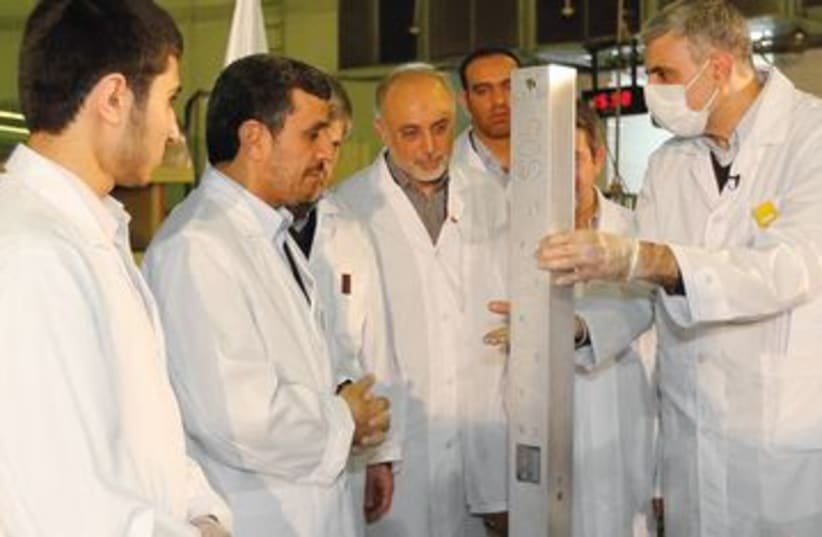
By HERB KEINONAhmadinejad at nuclear ceremony in Tehran 390 (R)(photo credit: REUTERS)
Negotiations between the world powers and Iran will succeed only if they lead to an immediate change in Iran’s behavior and a halt to its enrichment of uranium, an Israeli government official said Wednesday, commenting on prospects the talks will begin on April 13.Iranian media quoted Iran’s Foreign Minister Ali Akbar Salehi as saying discussions were taking place now about where the talks between Iran and representatives of the US, Russia, China, France, Britain and Germany will take place. This group of nations is known as the P5+1 because it comprises all five veto-wielding members of the UN Security Council, plus Germany.Salehi said Turkey, which hosted the talks that ended in failure last year, had offered to host the talks again. Turkish Prime Minister Recep Tayyip Erdogan arrived in Tehran Wednesday for two days of talks on the nuclear program and the situation in Syria.According to media reports from Iran, Erdogan spoke out against any attack on a country “pursuing a peaceful nuclear program.”While Israel had no formal reaction to the upcoming P5+1 talks, one official said that the world needed to make it clear to the Iranians that it was unacceptable for them to “talk and enrich” uranium at the same time.Earlier this month in Ottawa, Prime Minister Binyamin Netanyahu warned the world against “falling into the trap” of allowing the Iranians to buy time through negotiations to move their nuclear program forward.“Right now, Iran is feeling the pressure of economic sanctions, and it could try to evade that pressure by entering talks,” he said.To avoid that, Netanyahu laid down what he said needed to be the three goals of the talks: Iran must stop all uranium enrichment, remove from the country all uranium already enriched beyond 3.5 percent and close down its underground nuclear facility at Qom.On Saturday, Intelligence Agencies Minister Dan Meridor replaced the demand to close Qom with a call for a much tighter inspection regime.So far only Israel has listed these principles as the goals of the talks, with none of the countries involved in them adopting that language as their own.The official would not say whether Israel viewed this as the last diplomatic opportunity to solve the Iranian nuclear crisis, but said “we are close to crunch time.”Foreign Minister Avigdor Liberman has said in recent days that Israel was giving the talks a chance to see “where they will go.” The last meeting between Iran and the P5+1 in Istanbul in January 2011 ended without even an agreement on an agenda.Since then, Washington and the European Union have imposed tough new sanctions on Iran, including an EU oil embargo that is due to go into effect in July and a move by the Society for Worldwide Interbank Financial Telecommunication (SWIFT) to cut off a number of key Iranian banks, making international financial transactions with those banks all but impossible.While Western diplomats have said it is hard to be optimistic about the upcoming talks given Iran’s previous track record, analysts say the negotiations could provide breathing space from the possibility of an immediate Israeli attack.“It will be difficult for the Israelis to attack Iran while there are nuclear talks ongoing,” said Gala Riani, an analyst at London-based risk consultancy Control Risks.
Click here for full Jpost coverage of the Iranian threat“It will also temporarily boost the position of Western camps... as they will seek to illustrate that tighter sanctions on Iran are having a desired effect by bringing the Iranians back to the negotiation table.”EU foreign policy chief Catherine Ashton is expected once again to lead the talks on behalf of P5+1.Earlier this month, the group called on Iran “to enter, without pre-conditions, into a sustained process of serious dialogue, which will produce concrete results.” Reuters and Jerusalem Post staff contributed to this report.
if(catID != 151){
var cont = `Take Israel home with the new Jerusalem Post Store