2 other officers wounded in terror shooting in Hebron Hills area.
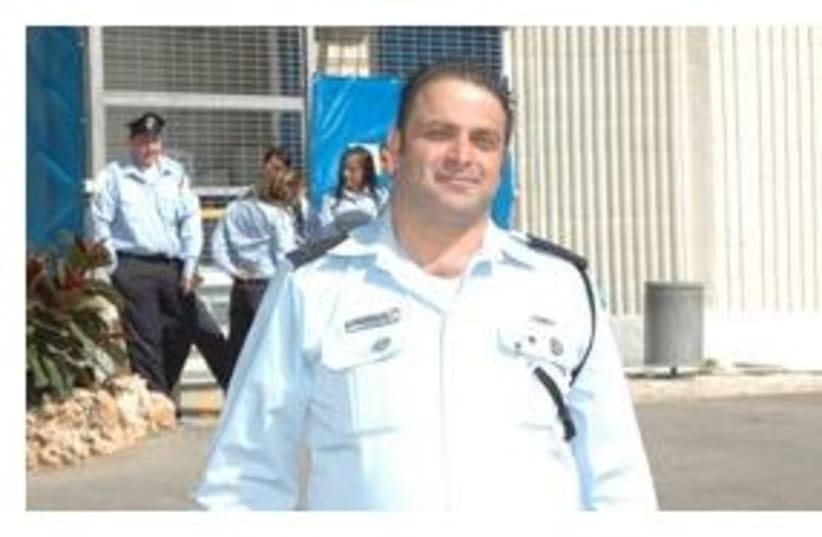
By YAAKOV LAPPIN, JPOST.COM STAFFMurdered policeman 'Shuki' Sofer 311(photo credit: Israel Police)
One of the Israeli police officers, Yehushua "Shuki" Sofer, who was shot in a terror attack on a patrol car Monday morning in the Hebron Hills area has succumbed to his wounds.Sofer was rushed to Hadassah Ein Kerem Hospital in Jerusalem from the scene of the attack by Magen David Adom where he died from gunshot wounds to the chest approximately two hours after the attack.RELATED:Hebron Hamas leader killed in shootout with commandosIDF troops foil West Bank terror attackSofer, 39, was a police veteran having served 19 years on the Hebron police force and resident of Beersheba.His funeral will be held in the military section of Beersheva's old cemetary at 6 p.m. this evening.Two other police officers were injured in the attack, as they were driving northwards on Route 60 in the West Bank, south of the of settlement of Bet Hagai, in the Hebron Hills region.Public Security Minister Yitzhak Aharonovitch, who is currently in Romania, released a statement following the attack, saying, "Today we have seen that the relative quiet is deceitful and we cannot know when it will be broken. I send my condolences to the family of F.-Sgt. Shuki Sofer, and I hope the injured will recover swiftly." Ahronovitch added that the police, IDF and Shin Bet would "do everything to quickly capture those responsible for this terrorist attack."The shooter was likely a lone terrorist or a local cell operation on its own, without direction or backing from a larger group, IDF sources assessed.According to IDF officers, the trend in terrorism in recent years has been attacks carried out by individuals, without working with a larger organization."It's very difficult to collect intelligence on an individual, and then to prevent what that individual plans to carry out all by himself," an IDF officer said.The officer referred to an incident in the West Bank earlier this year, in which a bulldozer driven by a Palestinian man struck an Israeli vehicle and caused a second motorist to swerve into a road ditch.IDF troops were still searching for the perpetrator of Monday's attack, though it remained unclear whether the shots were fired from a passing car, or a sniper lying on the side of the road.One policemen shot in chest has improved from serious to moderate condition, while the third officer was shot in the arm and is in light condition, Magen David Adom paramedics said.In March 2009, two Judea and Samaria police officers, Yehezkel Ramazreger and David Rabinovitch, were shot dead in the Jordan Valley in a terrorist ambush.The policemen had stopped to provide assistance to a Palestinian terrorist who pretended that his car had broken down.
if(catID != 151){
var cont = `Take Israel home with the new Jerusalem Post Store