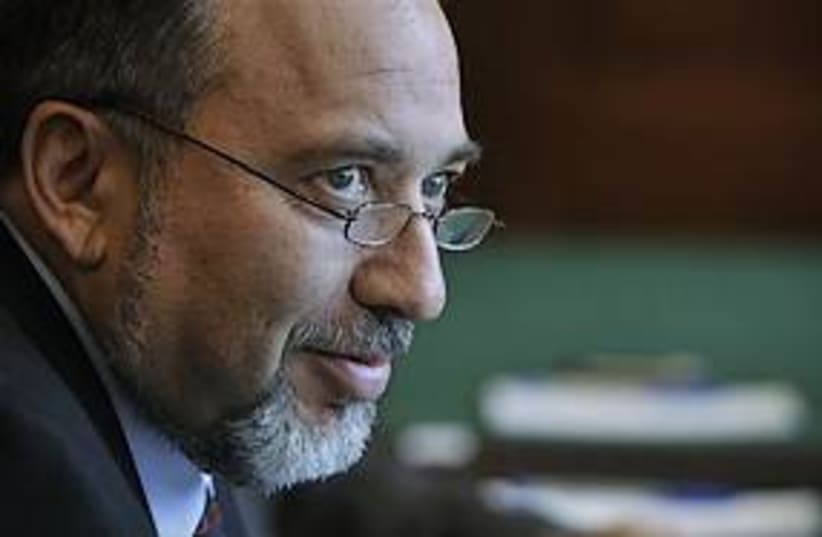
Comparisonsbetween contemporary Iran and Nazi Germany are not only appropriate,but pertinent and true, Foreign Minister Avigdor Lieberman said while ona visit to Hungary on the morning of International HolocaustRemembrance Day.
Speaking toIsrael Radio on Wednesday, the foreign minister stated that while the victims ofthe Holocaust must be remembered and commemorated, the Jewish peopleand the international community must also take heed of the lessons ofthe tragedy and prevent such an event from ever recurring. “It isenough to take a look at the report which appeared in this week's DerSpiegel,” Lieberman said, referring to intelligence acquired bythe German BND which gives credence to suspicions that Iran may bedeveloping two separate nuclear programs – a civilian energyendeavor and a clandestine military one which is directly answerableto the country's defense ministry.
Liebermanclarified that no comparison between Iran and Nazi Germany could beconsidered an exploitation of the genocide. “Anyone who remembersthe rise of the Nazis even before 1938, after the Weimar Republic,anyone who understands history and remembers the reaction of theinternational community – how they tried to placate [the Nazis], tonegotiate, to yield to them – must only think of the annexation ofwhat was then Czechoslovakia.”
While the foreignminister acceded to the fact that the mullah-led Iranian regime wasnot targeting Jews, he stated that Jews were nonetheless beingarrested and tried in the Islamic republic. “I certainly don't envythe Jewish community in Iran. The president of Iran himself keepscalling for a world without Zionism. He is replacing Judaism withZionism. 'There is no place for Jews in the Middle East,' he says. Hetells them to go back to Europe. It is fortunate that he(Ahmadinejad) has yet to acquire the kind of power he aspires to.”
During theinterview, Lieberman also touched on the controversial treatment ofTurkish Ambassador Oguz Celikkol by the foreign minister's deputy,Danny Ayalon. “It's not just the television show [portraying Mossadagents as baby-snatchers],” he said. “The day after it aired, Turkish Prime Minister [Recep Tayyip Erdogan] held a joint pressconference with [Lebanese Prime Minister] Sa'ad Hariri in which theyboth defined Israel as 'the greatest threat to the security of theinternational community,' and I won't even repeat all the otherexpressions [Erdogan] used.”
Asked if hebelieved the current tension between Israel and Turkey stemmed fromthe policies of a government led by Erdogan, Lieberman replied thatnot much could be expected from a prime minister who calledAhmadinejad a “close friend” and stated he would prefer to meetwith the “criminal president of Sudan,” Omar Al-Bashir, ratherthan with President Shimon Peres. He cited a recent EU report whichbrought to light discrepancies in Turkey's legal system, its use oftorture and its refusal to address tensions between Turkish and GreekCyprus. “We must look outside our little swamp. Change in Turkey isnot a change in its stance toward Israel,” Lieberman said. “Wehave no interest in a deterioration in relations with Turkey. Weapproach Turkey with respect and appreciation and expect the same.”
On the impasse inpeace talks between Israel and the Palestinians, Lieberman wasadamant that Prime Minister Binyamin Netanyahu's government would“clearly” not make any more gestures in order to renewnegotiations. “We brought [former Palestinian Authority chairmanYasser] Arafat in from Tunis, we gave him land and weapons, wetransferred 10,000 Jews from Gush Katif,” the foreign ministersaid.
“[Former primeminister Ehud] Olmert, [Palestinian Authority President Mahmoud]Abbas and [former US president George W.] Bush sat in Annapolis andwe watched Olmert explain that he is ready to return to the '67borders, to divide Jerusalem, to address the issue of refugees. The[Palestinians] said – 'no, nyet.' If they did not accept thesegroundbreaking concessions, how will any gestures help?”
Liebermanassessed that since the Oslo Accords were signed in 1993, barely anyprogress had been made in peace negotiations. “I don't think theadministration of [US President Barack] Obama is naïve, onlythat the international community has a false perception that peacecan be forced,” he told his interviewer.“Peace is achieved through many years of hard work. Security and a[stable] economy must first be ensured. It isn't a question of goodwill.”
Praising effortsin the international arena by European leaders such as FrenchPresident Nicolas Sarkozy and his own host country, Hungary,Lieberman concluded that Israel “must not underestimate itsfriends.”