Israel denies assurances on J’lem building; Kassam hits near Ashkelon.
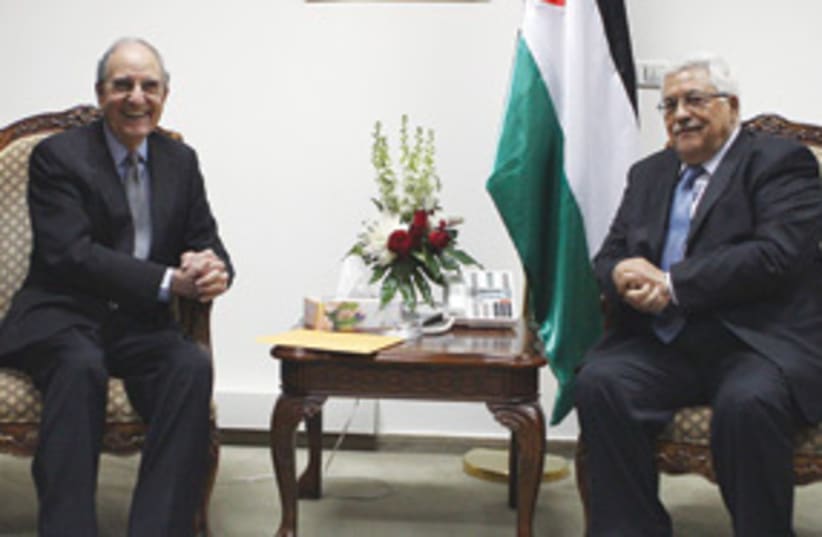
By HERB KEINONAbbas and Mitchell 311(photo credit: AP)Prime Minister Binyamin Netanyahu on Saturday evening welcomed the Palestinian Authority’s long-delayed decision to enter indirect talks, but added that these needed to be without preconditions and should lead “as soon as possible” to direct negotiations.Hours earlier, the PLO’s Executive Committee and the Fatah Central Committee gave their backing for the indirect talks.In Gaza, meanwhile, Hamas denounced the PLO decision as a “stab in the back of our people” and said the PLO does not represent the Palestinians, underscoring that the negotiations will be with representatives of only little more than half the Palestinians.While the focus of US diplomacy for months has been on how to restart talks with Israel and the PA, there has been little discussion on how to pry Gaza loose from Hamas.Hamas has said in the past it would accept any peace deal negotiated by Abbas, provided it is approved in a referendum. However, it is not clear whether that promise still stands.Meanwhile, a Kassam rocket was fired at Ashkelon from Gaza on Saturday night.It was the first rocket launched from the Strip in more than a month. The Kassam exploded south of the city, causing no casualties or damage. Warning sirens were sounded.< Police and IDF troops were scouring the area for the rocket.In the past, Israel has responded with air strikes to rocket attacksfrom Gaza. Netanyahu has vowed to respond to every such attack.RELATED:Kassam fired into western Negev'US commitment to Israel unshakable''PA boycott harms proximity talks'US envoy George Mitchell, who met with Netanyahu on Wednesday andThursday, met with PA President Mahmoud Abbas on Saturday, and wasscheduled to do so again on Sunday, before leaving in the afternoon.After meeting with Mitchell, Top Palestinian negotiater Saeb Erekat said that Abbas handed Mitchell a letter containing the Palestinian leadership's view on the proximity talks, Israel Radio reported.Erekat says Israel and the Palestinians will discuss borders and security. The discussions will include Jerusalem and the settlements, because they are connected to the issue of returning to 1967 borders, Erekat explained.According to Israel Radio, Erekat also said that the Americans will decide when the proximity talks begin, not the Palestinians.Mitchell is expected to leave a team behind to continuediscussions with each side and map out their respective positions. He isalso expected to personally brief US President Barack Obama and Secretary ofState Hillary Clinton on his week of talks here, and to return to theregion in two weeks.The framework of the “proximity” talks was not immediately clear, norwhether Mitchell would be shuttling between Netanyahu and Abbas, orwhether he – or one of his representatives – would be bouncing betweenNetanyahu’s envoy Yitzhak Molcho and PA negotiator Saeb Erekat.An official in the Prime Minister’s Office denied Palestinian claimsthat Israel had given the US assurances regarding a halt in newconstruction beyond the Green Line, including in Jerusalem.“The Israeli government refuses to accept the Palestinian demands thata building freeze in Jerusalem is a precondition to these talks,” theofficial said.Nevertheless, PLO general-secretary Yasser Abed Rabbo told reportersthe Palestinians decided to engage Israel, even if indirectly, becauseof a number of US assurances, including one on settlement construction.“The decision is based on guarantees and assurances we have receivedregarding the settlement activities and the necessity to halt them...and that the US will take a decisive position toward any provocationsthat influence the path of negotiations,” he said.Abed Rabbo said the US also assured the Palestinians that all so-calledcore issues would be raised in indirect talks, such as the borders of afuture Palestinian state and Jerusalem.'Israel will bewilling to take tangible steps'Israel, however, wants to see the indirect talks as little more than a“corridor” into direct negotiations, fearing that the Palestinians wantthe US involved in discussions on the core issues in the hope that theywill then step in and side with the Palestinian positions.One Israeli official did not rule out the possibility that once theindirect talks pick up steam, Israel would institute moreconfidence-building measures. Among the measures that have beendiscussed are a release of Palestinian security prisoners, turning overadditional territory to full PA control, and an IDF pullback from partsof the West Bank.“In the framework of the talks, once they start, I think Israel will bewilling to take tangible steps to complement those talks. Theassumption is that both sides will take steps in parallel,” theofficial said.Among the steps Israel expected the Palestinians to take, the officialsaid, were to clamp down on incitement, step up security measures, andcease their diplomatic offensive against Israel in a variety ofinternational forums, including a reported last-minute effort to blockIsrael’s acceptance into the OECD.The diplomatic offensive against Israel does not create a “conducive atmosphere” for negotiations, the official said.Defense Minister Ehud Barak also welcomed the Fatah and PLO endorsementof the indirect talks, saying that if both sides act in a responsiblemanner and are willing to make brave decisions, “it will be possible toget to direct negotiations and a breakthrough toward an agreement.”Mitchell also met with President Shimon Peres, Foreign Minister Avigdor Lieberman and opposition head Tzipi Livni.AP contributed to this report.
if(catID != 151){
var cont = `Take Israel home with the new Jerusalem Post Store