PM on talks: All issues should be discussed together
Netanyahu has spoken vigorously against what he has called “cherry picking” certain contentious topics.
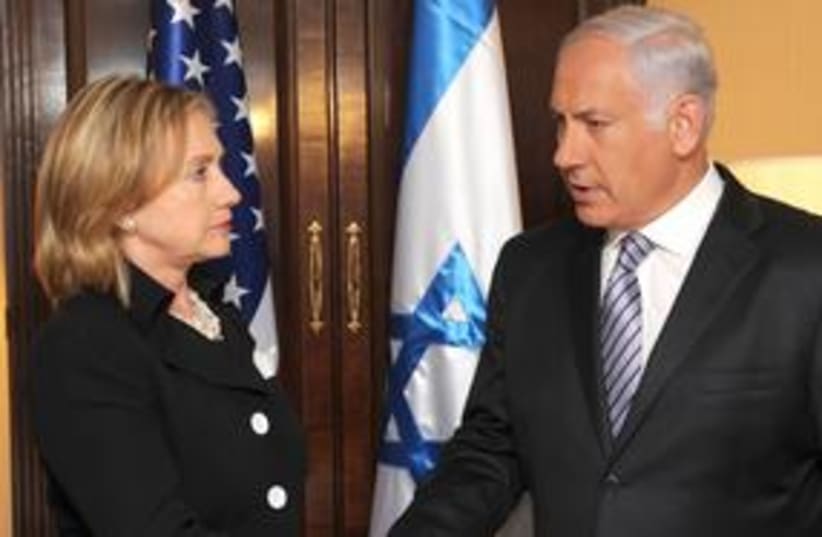
By HERB KEINON, HILARY LEILA KRIEGERNetanyahu Clinton(photo credit: Moshe Milner GPO )
WASHINGTON – Prime Minister Binyamin Netanyahu flew to Washington on Tuesday firm in his position that the way to reach an agreement with the Palestinians is to deal with all the issues together as one package, and then to phase implementation of an agreement over time.In recent days Netanyahu has spoken vigorously against what he has called “cherry picking” certain issues, such as the settlement moratorium, and making those issues central to the whole process, and ones over which the process would rise or fall.RELATED:PM wants regular talks with Abbas'Direct talks are in our interests'His statements have been made within the context of a Palestinian threat to pull out of the talks if the settlement construction moratorium was not extended at the end of the month.Netanyahu is expected to argue in Washington that just as Israel isn’t saying that it will not negotiate with the Palestinian Authority until PA President Mahmoud Abbas exerts full control over Gaza, so too the Palestinians must not place the settlement moratorium issue as a roadblock right at the outset of the talks.Likewise, Netanyahu has said that while everyone knows that for an agreement to be concluded the Palestinian refugee issue must be solved outside the borders of Israel, Jerusalem is not demanding that the PA dismantle a single refugee camp, or even a single street in a refugee camp, by a certain date before carrying on with the negotiations.Netanyahu’s position is that the core issues need to discussed as a package. In this way, concessions on settlements, for instance, could be counterbalanced by Palestinian concessions on other issues, such as refugees or Jerusalem.In this way, too, Netanyahu has argued, it will be easier to sell an agreement to the public.Netanyahu has spoken recently – in the context of the continuing debate about the settlement construction moratorium – of not wanting to expend all his political capital on one issue.Regarding implementation, Netanyahu is expected to present the position that this must be done in stages, spread out over a period of years, and that any Israeli withdrawal would be gradual and based on Palestinian security performance and security arrangements implemented on the ground.Netanyahu believes that both spreading the implementation of an agreement over time and making it performance-based are critical from a security point of view, to see whether the security guarantees promised are implemented and effective.He has said that since the last time he negotiated with the Palestinians, at Wye Plantation in the late 1990s, the security situation in the region has worsened considerably, and this must be taken into account and dealt with.Specifically, Netanyahu has referred to Iranian control of “half of Lebanon,” through Hizbullah, and half of the Palestinian Authority, through Hamas.In Netanyahu’s view, what are needed are not only security promises, but effective security arrangements on the ground that actually work. The model Netanyahu frequently holds up as an example are the Camp David Accords with Egypt, where security arrangements were implemented on the ground and – in his mind – have been instrumental in the perseverance of that agreement for some three decades.In Netanyahu’s view, concern in the Arab world about Iran and Islamic radicalism has created a positive regional constellation that could help bring about an agreement.In recent days Netanyahu has said repeatedly that he is going to the talks looking for a solution, not a pretext or excuse to torpedo the talks, and that the Palestinians should approach the negotiations in the same spirit.He has said that if the two sides want to move down the road, they will have to get around the speed bumps of the first 100 meters.With the settlement construction moratorium looming large on the horizon, government officials said it was not coincidental that the prime minister, at an appearance before Likud activists Monday night, did not make any declarations about the moratorium – or vow that building would take place at full speed once it ended – so as not to appear provocative.The US has appealed to both sides not to do anything, nor make any statements, that could harm the atmosphere for the talks. On Monday, Netanyahu pointedly said only that the moratorium would end, but nothing more, one official noted.Prior to Thursday’s launch of direct talks, Israeli officials downplayed concern that the announced year time frame for an agreement was unrealistic, saying that Netanyahu – during his visit to Washington in July – was the one who first said that an accord could be reached within a year.If an agreement is out there, the sides can get to it within a year, Netanyahu has said. But, in a reference to the moratorium issue, he has also said that if hurdles are placed in the path, an agreement will never be reached.Abbas said Tuesday the success of the talks, aimed at forging a peace deal with Israel within a year, will depend on how hard US mediators push to break any deadlocks.Abbas told reporters accompanying him to Washington that if the two sides reach a deadlock, the Obama administration should “present bridging proposals to bridge the gap between the two positions.”The Palestinian Authority president said the one-year deadline is reasonable because many of the issues have already been discussed in previous rounds of talks.“If there is goodwill, then it [one year] is more than enough,” he said. “Everything is clear.”Meanwhile, the United States backed Israel’s proposal for the format of peace talks, as it continued with its preparatory meetings even as the murder of four Israelis near Hebron threatened the nascent process.“We are very aware that as we go forward in this process, not everyone sees this in the same way, and there are those who will do whatever they can to disrupt or derail the process,” said US State Department spokesman P.J. Crowley, in response to the Palestinian shooting attack.He said that the US expects the sides to press on, and reiterated the American belief that an agreement can be reached within a year.“We will be relying, first and foremost, on the commitment that we think the leaders themselves have made to pursue peace at this time, understanding that there’s a window here where we think peace can be accomplished, and our goal is to do so – to reach an agreement within one year,” he said.US Middle East envoy George Mitchell also stressed the US belief in the possibility of the sides reaching an agreement before the end of the year, in a briefing for reporters held before the West Bank attack.He also began to sketch out the American perspective of how talks would proceed, embracing Prime Minister Binyamin Netanyahu’s suggestion that he meet personally with Palestinian Authority President Mahmoud Abbas every two weeks.“We think that’s a sensible approach which we hope is undertaken,” Mitchell said, also pointing to an American desire to see “meetings at other levels on a consistent basis.” He indicated that the US would not be “physically represented in every single meeting” because US officials “recognize the value of direct, bilateral discussion between the parties.”He also stressed that an agreement must be made by the two sides alone, saying, “We recognize that this is a bilateral negotiation and in the end the parties must make this decision by and for themselves.”But he also pointed to a robust American involvement on an “intensive basis,” as he noted that “the United States will play an active and sustained role in the process.”Tuesday was a case in point, as US Secretary of State Hillary Clinton had meetings scheduled with Netanyahu and Abbas and her counterparts from Jordan and Egypt.Crowley said that these talks would address the logistics for the coming days, as the various parties met frantically to iron out last-minute details, and that the US wanted to coordinate expectations for each side, as well as the “core issues” of the talks.One of those was to be the issue of settlements, as Netanyahu’s temporary settlement moratorium is set to expire at the end of September and Abbas has threatened to pull out of the talks if it isn’t extended.US officials, however, declined to discuss the moratorium or single out the issue of settlements despite its impending prominence in the future of the talks.On Wednesday, Netanyahu and Abbas, as well as Jordan’s King Abdullah and Egypt’s President Hosni Mubarak, are set to have bilateral meetings with US President Barack Obama.Obama plans to make a statement following the meetings, and then each of the leaders will make remarks ahead of an intimate dinner expected to be held in the White House.The following day, Clinton will hold a three-way meeting with Netanyahu and Abbas that is likely to last several hours. Afterwards, the three are expected to make public addresses formally launching direct talks.Late Tuesday, Clinton was also scheduled to met with Quartet envoy Tony Blair and former president Jimmy Carter.Carter, who helped broker the peace accords between Israel and Egypt, was at the State Department to talk about North Korea following his role arranging the release of a US citizen being held by the authorities there.Crowley said Carter’s meeting being on the same days as the Middle East talks were getting under way was pure coincidence.“It’s entirely possible that president Carter, given his history on this issue, may offer advice, but the meeting’s on North Korea,” he said.US officials did, however, acknowledge the important work done in the many previous iterations of the peace process, which haven’t been as successful when it comes to the Israelis and Palestinians.Mitchell said he had studied those previous attempts and the frameworks they engendered, and that while the Obama administration has tried to “avoid a slavish adherence to the past,” it has gleaned essential principles.He pointed to the need for frequent direct contact between the leaders involved; active and sustained US participation; maintaining broad international support; and the importance of creating an atmosphere conducive to success and conveying a “sincerity and seriousness of purpose” on the part of both sides.“We’re conscious that a lot of work has been done over the years and that on both sides there’s an understanding of what needs to be done, but the broad parameters of an agreement are actually fairly well known,” Crowley said.“What we need is the critical will and creativity to work through the complexity and challenge of these issues to actually reach an agreement,” he said, adding, “We believe that the leaders understand that the moment is now.”Defense Minister Ehud Barak, at a ceremony Tuesday at Beit Hanassi, expressed hope for success in the negotiations.“I am aware of the security challenges we are facing and yet I believe with a full heart that we can and must reach a breakthrough that can lead to the peace we have been hoping for,” Barak said.It was revealed on Tuesday that when Barak visited Jordan on Sunday, he met with Abbas and two other Palestinian officials and discussed how to help the talks succeed. The two met following Barak’s meeting with King Abdullah, and Barak then briefed Netanyahu.“Barak maintains a close connection with Palestinian leaders,” a source close to the defense minister said. “He speaks regularly to Palestinian Authority Prime Minister Salam Fayyad and met with him recently at the King David Hotel and now he also met with Abbas.”Gil Hoffman and AP contributed to this report.
if(catID != 151){
var cont = `Take Israel home with the new Jerusalem Post Store