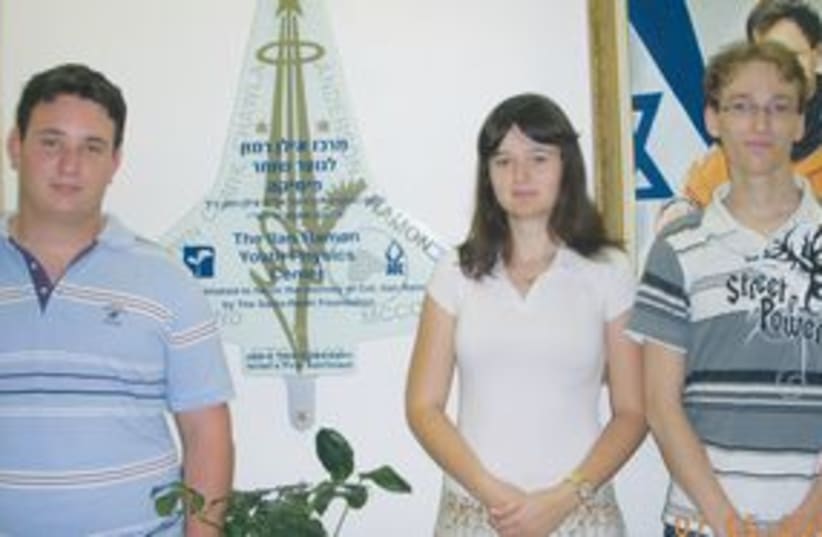
For 3rd year in a row, high school students at BGU’s Ilan Ramon Center and Amit Beer Sheba take first place in international First Step to Nobel Prize competition.
By JERUSALEM POST STAFFFirst Step to Nobel Prize 311(photo credit: BGU)
“Once you’re lucky, twice you’re good, but when it happen three years running, there’s got to be a pretty good reason,” said Prof. Victor Melamed, the director of Physics at the Ilan Ramon Youth Physics Center at Ben- Gurion University of the Negev, explaining the success of Amit Beersheba high school students at the annual First Step to Nobel Prize competition held in Warsaw last month.This year Eli Godinsky, Evelyn Genis and Danny Niemark, members of the physics program at the Ramon Center, took first, second and fourth place, respectively, in the prestigious competition.The event brings together teams from the US, China and Europe. High school students submit projects that are then judged by professors of physics for originality and academic excellence.Eli Godinsky, who won first place for his project on the theoretical study of the generation of large-scale turbulence with homogeneous wind shear, will begin the IDF Academic Reserve Program at BGU next fall, studying physics and computer science.“This win came as a total surprise and I feel very honored,” said Godinsky. “It was a lot of work but it was worth it. My studies at the center helped me decide to study physics at a university level – it opened a whole new world for me, showing me things I never would have been exposed to.”Evelyn Genis won second place for her project on phase transitions and incommensurate phase in the layered ferroelectric- semiconductor TlInS2 by means of nuclear magnetic resonance.Daniel Niemark, whose research study of magnetic properties for nanocrystalline materials won fourth place, says that the center gives him a chance to see how research is conducted in the field.“The lecturers treat us like regular university students,” Niemark said. “They’re always willing to explain, and make us really want to broaden our horizons.”Dr. Amnon Eldar, Amit CEO, announced that the students will be awarded for their achievements by Amit. "These students are a symbol of excellence and an example to young people."Established in 2007 by the Moshav Ben Shemen-based Rashi Foundation of Israel, the Ilan Ramon Youth Physics Center – in collaboration with the university’s Department of Physics – advances hands-on learning activities for high school students from Kiryat Gat to Eilat. The center, named in honor of Israel’s first astronaut, who grew up in Beersheba, is located in the Sacta- Rashi Building for Physics and includes sophisticated laboratories, a planetarium and a rooftop observatory.Winning once is impressive.Winning twice is great, but three times in a row? “The fact that students from the Negev, Israel’s most s o c i a l - e c o n o m i c a l l y depressed region, would achieve such fantastic success three years running,” continues Prof. Melamed, “is more than just a fluke – it’s phenomenal!” “In 2008 and 2009, the Tzabag sisters – first Mor and then Hadas – of Netivot, pupils at the center, won first place in the competition, causing much discussion about their ‘fabulous physics genes,’ but succeeding three years running shows that we are onto a system that works.”Malamud attributes much of the success to the Rashi Foundation, with support from the Ministry of Education and the Beersheba Municipality.“Rashi sets a target and then will do anything to reach it. I am in awe of them, because they are actively realizing the Zionist vision. They really believe in the younger generation and are willing to invest whatever it takes to help our kids reach their full potential. In the present economic reality, this is not something that should be taken for granted,” he exclaims.Malamud, who made aliya in 1990 after he was fired from his job in the Soviet Union for being Jewish, describes himself as “determined – like a tank!” and says that in Rashi, “I found a true partner. Eli Elalouf, the CEO of the foundation, is an exceptional person. He is determined to succeed and tells me to ‘keep bringing more pupils and doing what you doing, because no price is too high to pay for the results you’re getting. Just do it!’” The Ramon Center’s unique teaching methods also play a part: “Our dedicated team of instructors are crazy about teaching, and know how important it is to develop creative thinking. Israeli pupils are creative by definition, and you’ve got to cultivate that and get them to believe in themselves,” says Malamud, who previously taught at the Moscow Institute of Physics and Technology.The center implements PBL – Project Based Learning, a system created by Intel Israel.“We don’t just teach formulas and say, ‘Go learn this by heart.’ “It’s important to give the students a full picture of how the world is built and only then to delve into the mathematical descriptions. Students need to get passionate about physics, to be interested in how this field can be applied to any area of science and especially to hi-tech industries, which is our chance to make a place for ourselves in the future,” Malamud says.“I try to get pupils interested by appealing to their Israeli-born competitiveness; they think, if my friends can do this, then maybe I can too.”And the center’s connection to BGU makes the formula complete: “The university president Prof. Rivka Carmi gives us fantastic support. She never says no, and provides us with all the services we need to run the program. She realizes that these pupils are the future of BGU, and will eventually become the top students in engineering and in all sciences,” Malamud says.So what does it take to be fabulous in physics? Malamud believes every child has potential, “but someone who will go far in physics needs to be ambitious, willing to work hard, interested in science, and have to have good English.”Although you don’t necessarily need a scientific background, you do need a supportive family that will cheer you on, “because studying at the center, in addition to your high school studies, demands high motivation: You have to be willing to cut down on computer games and soccer.“Last years winner, Hadas Tzabag, would travel from her home town of Netivot to the center at six in the evening, after going to school all day, and do her research at the center till 10 almost every night.”In physics, as in life, Malamud says, “You’ve got to want it.”
if(catID != 151){
var cont = `Take Israel home with the new Jerusalem Post Store