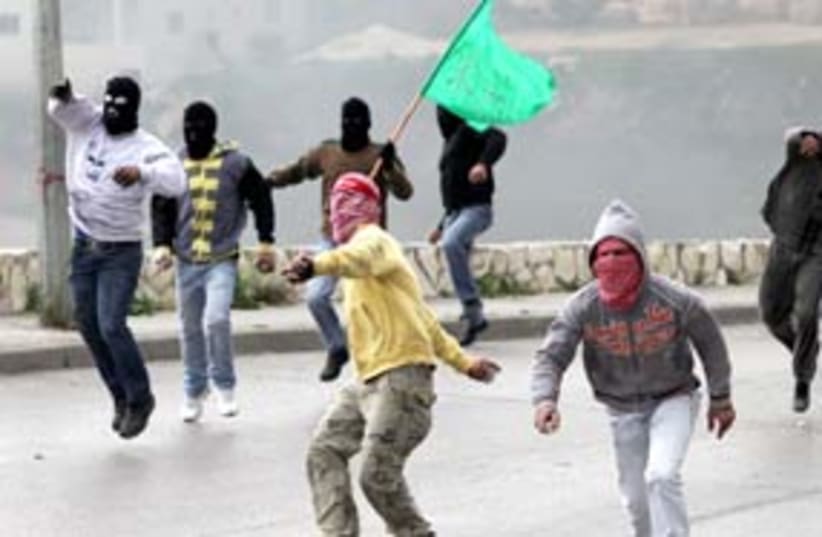
By AP, JPOST.COM STAFF, ABE SELIG, BEN HARTMANissawiya hamas flag arab riot 311(photo credit: Ariel Jerozolimski)
Just as east Jerusalem violence appeared to have subsided, an Israelipoliceman was lightly wounded on Tuesday evening when he was shot in the hand in Ras el-Amud.The policeman, a member of the elite Yasam unit, was evacuated to the capital’s Hadassa Mount Scopus Hospital.Security forces were searching for the assailant.The attack came at the end of a day of unrestin which 60 Arab rioters were arrested and fourteen policemen were wounded.After a morning of violent clashes, during which dozens of masked Palestinians hurled rocks at Israeli police and burnt tires invarious east Jerusalem neighborhoods, order was restored to the capitalfor a brief interlude on Tuesday afternoon, with the exception ofShuafat, where sporadic clashes were still being reported.Sixty Palestinians were arrested on suspicion of stone-throwing and disruptions. Inaddition, a Jewish activist who attempted to enter the Temple Mountthrough the Mughrabi Gate was arrested after he attacked policemenbarring his way.Intotal, fourteen border policeman and security personnel were lightlywounded during Tuesday'sclashes. Four were evacuated for medicalattention, and the rest were treated at the scene.Related:Opinion: Jerusalem deserves betterEditorial: The Hurva's symbolismHurva is again a house of prayerAt one point, police used stun grenades to disperse dozens of Arabs whowere blocking the Majlis Gate, one of the Old City entrances to theTemple Mount. The protesters, some of them chanting slogans, werepushed back into the nearby Via Dolorosa.Israel Police Insp.-Gen. David Cohen completed a tour of the WesternWall plaza, from where he proceeded to a tour of the recentlyrededicated Hurva synagogue.Speaking to reporters, Cohen said he wasn't concerned that the unrestwould spread to become a "third intifada," and that by Sunday theaugmented police presence in the capital would drop back to normal.Cohen also blamed the recent violence on the Arab leadership, who,according to the inspector general, were inciting their public.Earlier Tuesday, two buses carrying Arabs from the North to Jerusalemwere turned back by police, who suspected that the passengers wereheeding the call to take part inunrestin the capital. One passengerwas arrested after he attacked a policeman who boarded the bus.In addition, dozens of buses carrying hundreds of Israeli Beduin fromthe Negev will make their way to Jerusalem every day this week, toprotest what they say are Israeli threats against the Aksa Mosque onthe Temple Mount.The protests, organized largely by the Islamic Movement in Israel, will include busloads of protesters from the Galilee as well.Jews “have no right to the Temple Mount,” Rahat Mayor Faiz Abu Sehaba,whose Negev city of some 45,000 inhabitants is the country’s largestBeduin community, told The Jerusalem Post on Monday, citing Jewishteachings that says that Jews cannot go onto the Temple Mount beforethe arrival of the messiah.Abu Sehaba, a member of the Islamic Movement in Israel’s “moremoderate” southern branch, said that while busloads leave Rahat for theAksa compound every day, this week far more would make the journey, tobring the masses to protest what they see as threats to the foundationof the mosque from Israeli archeological digs nearby.“We feel that there is a threat to the foundations of the Aksa Mosque,”Abu Sehaba said. “It would threaten the peace of the entire Middle Eastif, God forbid, something were to happen to the building.”“We don’t want this, we want peace, not a new war in the Middle East,” he said.“Religious Jews know about the ban on going to the Temple Mount,” the Rahat mayor said.He blamed “settlers and right-wing Jews” for heading to the site for the sake of “provocation and politics.”In the West Bank on Monday, former Palestinian Authority prime ministerAhmed Qurei warned that if construction were to continuein Jewishneighborhoods in east Jerusalem, together with the continued demolitionof Arab homes there, “another intifada will break out.”Speaking to reporters in Abu Dis, Qurei added, “If the situationremains at this level, regardless of whether we take the decision ornot, [a third intifada] is coming. If Israel continues these practices,it is coming.”Yaakov Katz contributed to this report.
if(catID != 151){
var cont = `Take Israel home with the new Jerusalem Post Store