Campus group seeks increased engagement with Jewish students – to be welcoming, not political. But has openness left Hillel insufficiently supportive of Israel when it is attacked on campus?
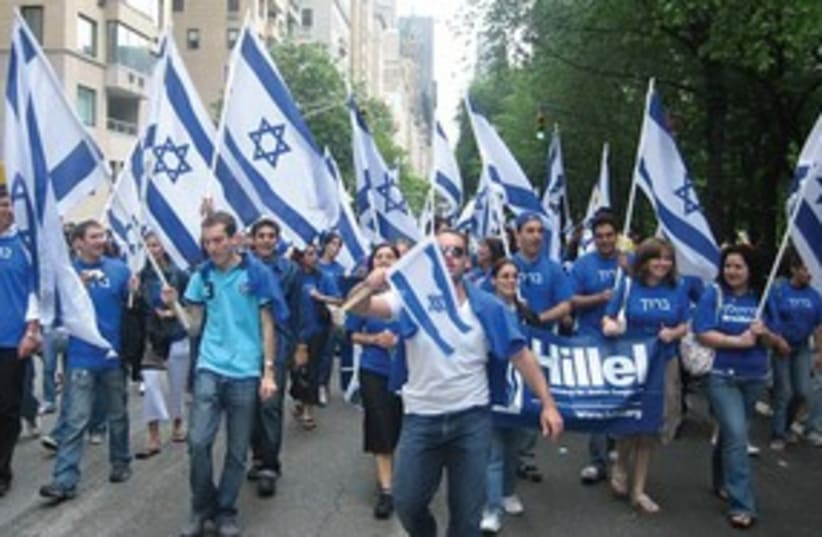
By E.B. SOLOMONT, HILARY LEILA KRIEGERhillel baruch college(photo credit: Courtesy: Hillel)
On a frigid night in February, Rabbi Howard Alpert wended his way through the cafeteria inside the Hillel building at the University of Pennsylvania as a storm brewed around him. Upstairs, J Street organizers were putting the finishing touches to a kickoff event for more than 20 local chapters around the country. Downstairs, dissenters had organized a counter-event, and some students were handing out fliers opposing what they described as J Street’s anti-Israel policies.For weeks, Alpert – a 34-year Hillel veteran who is executive director of Hillel of Greater Philadelphia – took heat for allowing the event to proceed, despite critics who argued that Hillel’s pro-Israel stance would be undermined by the J Street event. The self-described Washington-based “pro-Israel, pro-peace” lobby has been criticized by several groups on the Right that view it as not truly supportive of Israel.Throughout the fall, Alpert and the Hillel board had grappled with other tough decisions regarding controversial speakers who were invited to speak on campuses in Philadelphia. The outcome in each case was varied, with Hillel refusing to host Jeff Halper, the director of the Israeli Committee Against House Demolitions, and Geert Wilders, the far-Right Dutch politician, at Temple University. But the board approved a November 3 event featuring former Israeli cabinet minister Effi Eitam, who in 2004 remarked about the Palestinians, “We will have to kill them all.”By the time the J Street event rolled around, the debate had reached a fever pitch, prompting the board to adopt a set of guidelines governing on-campus speakers a month later.“Staff and student leaders were reluctant to make decisions in the gray areas,” Alpert said in February, when the board was still working on draft guidelines. “We need to be able to say clearly, beyond this line you’re out, but before that you’re in, no matter how unpopular or controversial your point of view may be.”FOR HILLEL of Greater Philadelphia, the guidelines were the latest effort to clarify what posture Hillel should take on Israel as it faces the challenge of being open and inclusive, even while defining itself as a pro-Israel space. Straddling that line has left the organization as a whole open to criticism, but others see it as a model for the Jewish community in bringing people together and charting a course forward.Part of the issue is that several outside groups have rapped Hillel for not being supportive enough of Israel, while at the same time it sees its mandate as being welcoming and not political – and focused on campus realities rather than the desires of outside activists. Hillel says it is devoted to Israel in a way that mirrors those objectives of inclusivity and providing a venue for students where they are.Dani Klein, the former campus director for the grassroots pro-Israel organization Stand With Us, says he has seen a variety of approaches that Hillels have taken on Israel, as is to be expected for a group that deals with such a large number of different campus communities.“There are some Hillels I worked with that are phenomenal,” he says about Israel activities, while “for some it’s very minimal and superficial.”But his real gripe is with those that he says have actively kept his organization, which often takes a hard line in support of Israel, from doing programming that students themselves want.“Sometimes students want to do something [but] the Hillels will say no, that might upset other people. They’re more worried about how others will see them,” he charges. “Very often they’re restricted to what they can do about Israel, lest a Muslim student group gets upset.”Klein says events on radical Islam are the most likely to get the ax, and points to a planned appearance by Noni Darwish – a prominent, controversial Arab critic of radical Islam – at Brown University in 2007 that was canceled after a local imam complained to Hillel.And a pro-Israel activist long involved in the Israel on Campus Coalition, an Israel advocacy umbrella group under the aegis of Hillel whose 33 member organizations range from Americans for Peace Now to the Zionist Organization of America, criticizes the group for taking such a broad stance on Israel that it’s meaningless, citing in particular its slogan, “Wherever I stand, I stand with Israel.”“They put out a statement that manages to sound like they’re supportive of Israel without saying how they’re supportive of Israel,” claims the activist. “You don’t really have to do all that much Israel education, because whatever you do, it’s okay.”Wayne Firestone, president of Hillel, readily acknowledges that there is a tension between having a broad coalition and having ideological rigidity, and the ICC is no exception.“Jews are entitled to have different opinions and perspectives on Israel,” he says, adding that despite the diversity of views the ICC provides an important umbrella for the Jewish community at a time when Israel’s legitimacy is increasingly being attacked. “There’s no question in my mind that the community needs a place where it comes together and overcomes its differences.”But he says there are exceptions when not all those views are voiced, citing the Darwish case as an exception to the rule.“Not any view that anyone wants to express at every moment is always accommodated 100 percent,” he says.Regardless, he defends Hillel's policy as unquestionably backing Israel.“We say we’re steadfastly committed to support of Israel as a Jewish and democratic state with secure and recognized borders and a member of the family of free nations,” he says of Hillel’s official policy, adding the organization’s vision conceives of Israel as “a core value of Jewish life” and part of “our identity as an organization.”FOR ALL Firestone’s clarity, defining what constitutes “pro-Israel” became a flash-point in the debate at Penn this winter. At the time, critics of Hillel’s decision to rent space to J Street charged that its foreign policies undermined Hillel’s own definition of what it means to be a pro-Israel organization.“I vehemently disagreed with the decision to rent to J Street in the Hillel building,” says Lori Lowenthal Marcus, a board member of Hillel of Greater Philadelphia whose right-leaning group, Z Street, held a counter-event that night in protest. “Although it is only rented space, and not a Hillel-sponsored event, I believe it will be known and remembered as the J Street event at Hillel and that it is handing the keys to J Street into the mainstream Jewish organization club, and I don’t think it’s a mainstream Jewish organization.”Rachel Lerner, vice president of the J Street Education Fund, says Hillel is a communal space and emphasized that J Street rented the space. “This was not a campus event,” she says. “Of course we’re a pro-Israel organization. Our whole reason for existing is to ensure a Jewish, democratic homeland with safe and secure borders. That is our mission, that is our goal.”Months after Hillel of Greater Philadelphia adopted its guidelines for campus programs in March, Marcus – who praised the overall effort – acknowledges certain shortcomings and said she fought for tougher governance. She points out that for the guidelines to be enacted, someone first needs to raise an alarm, which may or may not happen.“In terms of decision-making, it’s a little attenuated for it to be as effective as it should be, or as it’s intended to be,” she says. “I think if there’s something about Hillel that makes me uncomfortable sometimes, it’s the affirmative desire to have things be student driven. I think sometimes people in leadership positions, they have to lead.”MANY HILLEL directors and participants don’t necessarily appreciate the outside criticism. They see many of these external individuals and groups as beholden to agendas that are far different from their own mission and that of the college environment.“Who is driving our agenda?” asks University of Maryland Hillel director Ari Israel, who gathered with fellow directors at a winter conference at his school. “I see a lot of outside organizations that are not campus-based and they end up raising a lot of ruckus.”Speaking generally, rather than about specific groups, he says that their approach can actually alienate students more than instruct or attract them. He describes scenes where people at either end of the spectrum “are screaming at each other,” which means people in the middle “are turned off.”Instead, he says, “We need to come up with an agenda that is positive and articulate about what Israel is. We are that middle, and we understand our students better than anyone else.”Just the same, Israel thinks there should be some universal standard of support for the Jewish state.“We cannot and should not ever be afraid to advocate a position on Israel that is part of our value system,” he maintains. “There are colleagues of ours who are afraid to have an Israeli flag because it will offend some people.”Aaron Weil, a Hillel director in Pittsburgh and the facilitator of the conference session, agrees.“What’s the litmus test? When someone says no Israeli flag?” he says. “The litmus test [is] if you support the right of Israel to exist as a Jewish, democratic state in safe and secure borders – welcome.”Alpert says the new guidelines his board adopted governing speakers draw clear lines, based on the concept that building an inclusive community requires parameters. “For Hillel in Philadelphia, the red line is drawn first at supporting Israel as the nation-state of the Jewish people and not advancing punitive measures against Israel,” he says.In his view, alienating Jewish students is “far more dangerous” than ideas put forth by J Street. Offering a parenting analogy, he says: “When you’re raising kids, you need to avoid the control battle.”Rachel Baker, a junior at Penn, says she supports Hillel’s open tent approach, but like many other students there believes that administrators mishandled the J Street event. (Protesters were not allowed upstairs near the J Street event, which infuriated some students.) The chaos that ensued “confused and angered student leaders, such as myself,” she says.Baker, who is head of Penn Hillel’s Israel Sector, has a unique relationship to J Street. Last fall, she signed up to be a J Street campus representative, only to quit after news reports that J Street’s student chapters could reserve the right to drop “pro-Israel” from its motto. “If we’re embarrassed to work for Israel, I’m embarrassed to work for you,” Baker recalls.But she neither dismisses J Street in its entirety – “I think it’s really important, especially on a college campus, to have the widest umbrella when it comes to Israel,” she says – nor agrees with those who said Hillel should ban the group from its facility.“Hillel’s role on campus is to appeal to as many Jewish students as possible while staying in the range of what is sketchily defined as ‘appropriate,’” she says. “The main question at hand when making the decision should be ‘What do the Jewish students at Penn want?’ not ‘What do the grown-up donors and board members want the students to hear?’”Whether Hillel board members like it or not, students are interested in various points of view, she says. “It is Hillel’s job to engage those pro-Israel students just as much as it is its job to engage AIPAC-style pro-Israel students,” she said.SEVERAL OUTSIDE groups do give Hillel high marks for working with a wide range of organizations and push back against some of the recent criticism – including the American Israel Public Affairs Committee.“Hillel has taken upon itself a very, very difficult task. It is looking to be a portal for the entire Jewish community and a point of engagement for every Jewish student, regardless of Israel affinity or ideological orientation,” notes Jonathan Kessler, AIPAC’s leadership development director.“I see Hillel as a strategic partner when it comes to Israel. The campus has long been a difficult environment. Hillel was one of the very first to step into the breach.”He adds that in his experience, “I cannot think of one occasion in the past decade where there have been obstacles or a lack of cooperation between our two organizations.”J Street also praises Hillel for providing an inclusive umbrella for groups – not least its own – that it feels by necessity has to be a broad rather than ideological one.“Hillel in general has done a very, very good job of engaging students where they are, and I think that’s part of why it’s been successful and why we want to work with it,” says J Street’s Lerner. “It wants to provide positive Israel experiences. It wants to provide varied Israel experiences.“We have very good relations with Hillel on every campus that we have a strong presence on. We’ve been welcomed as a part of the Jewish community on campus by it, so the impression that I’ve gotten from it is that there’s room for this voice on campus.”TRYING TO describe Hillel’s challenges and also its approach to reaching out to a diverse group of Jewish students in a time of flux and intermarriage, two major Hillel lay leaders turned to the biblical story of Abraham.“Our tradition amplifies Abraham’s righteousness by teaching that his tent was open on all sides so that he would not miss a single passerby,” wrote Edgar Bronfman and Randall Kaplan in a December JTA opinion piece titled “Hillel’s open tent helping to open minds.”“Today’s Jewish college students are more diverse than ever. They come from a variety of ethnic, educational, political and ideological backgrounds. The children of two Jewish parents will study with the children of the intermarried. They have to be equally accepted and at ease in their Hillel activities. Embracing Jews of divergent and sometimes conflicting ideologies challenges us to create environments in which differences are respected and civil discourse is promoted. Hillel’s open tent shouldn’t just be a metaphor but a living, breathing forum in which big ideas are discussed.”Indeed, Hillel prides itself on providing a gathering space for a broad range of students and needs, and argues that the open stance – with a decentralized approach adaptable to individual campuses – is essential for creating a space that is attractive and relevant to a broad cross-section of the Jewish student body. But that approach has left it open to criticism that with no standardization, there are no lines. Israel is just the most outstanding example of questions over where those lines are – if they are there at all.But Firestone says such criticism misses the point of what Hillel is trying to do – and the role that it uniquely among organizations can play. Though he doesn’t prefer the “big tent” metaphor himself, he says the American Jewish community has to recognize that its children are not growing up in a shtetl but an inclusive society giving them many choices – and many are opting out of Judaism.“We’re not trying to get everyone under the same tent,” he explains. “We’re trying to do community building. You build communities in tens and hundreds and aggregate those communities.”The important point, he underscores, is that “instead of building it top down, we’re trying to build it bottom up.”And Hillel directors across the country say that if you are going to build bottom-up communities, you can’t take a centralized, cookie-cutter approach.“Hillel’s not a monolithic organization,” notes Andrew Getraer, executive director at the Hillel at Rutgers University in New Jersey. “Each university has a personality.”And Michigan Hillel director Cindy Hughey insists, “That’s what makes it succeed.”Debbie Pines, a rabbi and Hillel director at Johns Hopkins in Baltimore, says that it’s important that students are given space to chart a course rather than submit to a centralized process: “It’s because of the students coming to terms with what’s meaningful for them, because it’s not about the staff or the rabbis, it’s powerful.”Penn student Baker appreciates the approach. She praises Hillel administrators and student leaders for keeping communication and discussion open.This past year, she points out, students heard from Ambassador Daniel Kurtzer and Effi Eitam. Israel Seminars ran a program that encouraged students to debate the Gilad Schalit case from the different perspectives of a soldier, mother, victim of terror and Palestinian citizen.“Penn Hillel, as an institution, has done a great job, in my opinion, about allowing for a wide range of opinions and discussions on the Israel front,” she says.FOR EVERY Jewish student like Baker, however, Hillel estimates there are nearly two others who haven’t joined the discussion at all. More than just the “big tent,” Hillel is increasingly orienting itself toward including those who don’t even know there’s a tent.Firestone is forthright about the fact that the majority of Jewish students don’t go to Hillel, something that was made very clear in a strategic review and subsequent planning committee six years ago – which called for a doubling of students involved in meaningful Jewish experiences in college.The new vision was one that places “the emphasis on every Jewish student,” explains Firestone. “We’re really going to try to be welcoming and opening to everyone.”But it isn’t enough to say that; the overhaul affected content and delivery.“What Hillel is doing now is actually a new paradigm of engaging people who are uninvolved, people who are referred to as unaffiliated,” Firestone stresses.That “new paradigm” means expanding from the old-school model where a campus Hillel is synonymous with a passive building holding services, discussions and other programming that students would make their way to only if they knew about it and cared to. “We stop trying to advertise everything by fliers,” Firestone notes.While paper has been replaced with cyberspace and social networking tools, it’s not just the medium that’s changed.In a new national program in various stages of implementation at 48 colleges, Hillel now pays a small group of students a stipend (about $2,000 for around 10 hours of dedicated time each week) with the mandate that they each identify 60 uninvolved Jews and build meaningful relationships with them, often by bringing them to content- rich events designed by the students themselves, over the course of the year. (The focus on meaningful programming means a Purim party is out, unless your campus has a heavy contingent of Persian Jews who use the festivities to connect to and explore their heritage, as was the case at one California institution.)The program is called the Campus Entrepreneurs Initiative, its student employees dubbed “interns” in the belief that these terms are attractive to the current generation of students looking to build resumés and spread the word about their work.Graham Hoffman, a former management consultant who is now the director of strategy for Hillel’s Schusterman International Center, describes the student hires as “super-connectors” who are in touch with and able to motivate large numbers of students.The idea is that this approach is better suited to the sensibilities and lifestyles of today’s students, who know better than their elders how to draw in unaffiliated Jews.“Students are engaging their peers and saying, this is a valuable thing,” says Firestone.There’s no doubt the approach is revolutionary, and is bound to increase participation at least somewhat for those who haven’t been involved before as it’s geared so heavily toward that group.A recent study by the Jim Joseph Foundation, which gave Hillel a $10.7 million grant to pursue the innovative programming, found that “in the past year, 8,000 students across 10 campuses have been impacted by this work,” according to a Hillel posting on its Web site.But there are some who wonder where this new path will lead – and what could get sacrificed along the way.Ari Israel, the University of Maryland Hillel director, notes that there is not enough time or money to focus on everyone.“How much energy are we going to spend – because we have limited resources – on what population?” he asks, worrying aloud that fishing for unaffiliated children of intermarriage could mean those who are more committed would be overlooked and ill-served.“CEI is the mantra,” Israel told his fellow Hillel directors at their winter meeting. “All we care about is trying to reach the fringe and there’s a whole middle.”But Firestone sees Hillel’s outreach to those less engaged as one that can enrich Jewishly engaged students as well and ultimately offer a guide for programs nationwide.“We think it’s going to be a model for all of Jewish life,” he proclaims, arguing that it’s not a “zero sum game” between involved and uninvolved Jewish students.He asks whether, if current Hillels touch 40 percent of students on campus, “should we be saying, ‘Dayenu?’” And if there are some students and programs for those already well-connected to their Jewishness that lose out as a result, he can live with that.“If there’s a cost, it’s a cost worth paying,” Firestone says.He is aware that there are critics, not least of them among many of the parents who underwrite students’ finances and other donors to his organization. But those groups aren’t his clients, he maintains.“If we do a bang-up job of impressing the parents with Hillel, it guarantees you zero that we’ll be relevant to students.”Despite the many uncertainties in the Jewish community and its future, one thing Firestone is willing to bank on: Parents will continue sending their children to college.“They will be there,” he says. “The only question is whether we will retool ourselves to be relevant to their lives.”
if(catID != 151){
var cont = `Take Israel home with the new Jerusalem Post Store