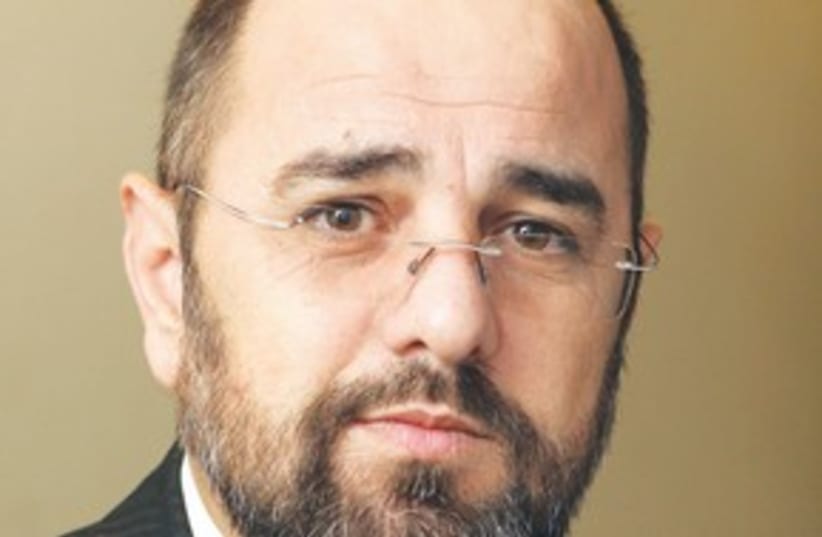
Margi calls for law against non-Orthodox movements
Move “to determine by law that there are no streams in Judaism," meant to strengthen status of Chief Rabbinate.
By JONAH MANDELMargi 311(photo credit: Ariel Jerozolimski)
As part of a bid to strengthen the Chief Rabbinate, Religious Services Minister Ya’acov Margi is hoping to see legislation determining that non-Orthodox movements have no place on Israel’s religious map, and move the rabbinate back to his ministry’s auspices.Speaking at a Knesset event Tuesday marking 90 years since the rabbinate’s inception, Margi noted the factors weakening the status of the Chief Rabbinate. One is the rabbinate’s being under the ministerial authority of the Prime Minister’s Office, where it moved in 2003 after the government dismantled the Religious Affairs Ministry.When in 2008 it was reestablished under its current title, some of the responsibilities returned to the ministry, while others remained where they had been assigned. The rabbinic courts, for example, remain part of the Justice Ministry.But a more dominant factor in threatening the rabbinate’s status are “the extra-parliamentary bodies,” Margi said, such as “the women’s groups who made their struggle with the rabbinate and rabbinic courts their agenda, in order to weaken them as much as possible. These were joined by the Reform and Conservative movements, and recently rabbinic organizations that criticize the rabbinate, and act from outside it.”The modern Orthodox Tzohar rabbinical group, for example, offers the public a variety of services, including marriage registration and conducting wedding ceremonies in some locales.Margi also slammed the conduct of “some of the rabbinates in the country that cut themselves off from the public discourse in Israel, and challenged decisions of the Chief Rabbinic Council.”The minister might have been referring to the four marriage registrars who refused to recognize conversions approved by the Chief Rabbinate – Rabbi Haim Blau of Ashkelon, Rabbi Simcha Hacohen Kook of Rehovot, Rabbi Yehuda Dov Wolpe of Rishon Lezion and Rabbi Yosef Sheinin of Ashdod.The rabbinate has decided to allow them to remain in their positions, but refer converts to other marriage registrars instead.To strengthen its status, Margi called for legislation making the Chief Rabbinate the supreme rabbinical institution in Israel and the world, and wants to move the rabbinate under the ministerial authority of the Religious Services Ministry instead of the Prime Minister’s Office.He wants to give more weight to adjudications of the chief rabbis regarding legislation pertaining to religious affairs, and empower the rabbinate to reform its internal management, to include online national marriage registration, unifying and strengthening its kashrut supervision, and increasing outreach and the availability of information on Jewish identity.In addition, Margi called, “to determine by law that there are no streams in Judaism, only one that has been passed down to us from generation to generation.”A spokesman for Margi would not elaborate on Wednesday what exactly such legislation could entail, but merely stressed the need to have “one rabbinic body that will concentrate all religious services, and that the struggles to weaken the rabbinate will be put to an end.”
if(catID != 151){
var cont = `Take Israel home with the new Jerusalem Post Store