Jobbik can hold rally wherever it wants, Hungarian gov’t says
EJC: Jobbik rally in former synagogue ‘trampling on the graves of Holocaust victims.’
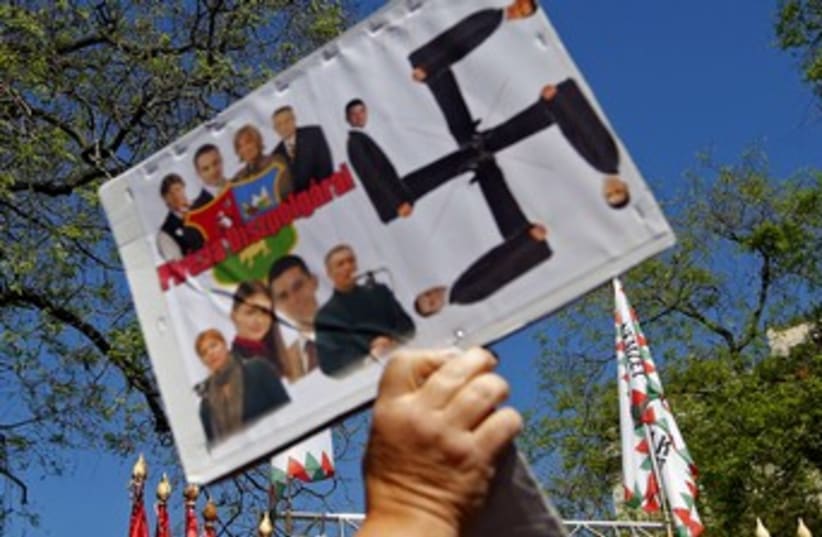
By SAM SOKOLFar-right Jobbik party rally370(photo credit: REUTERS)
The Hungarian government defended the right of an alleged neo-Nazi party to hold a political rally in a former synagogue in the city of Esztergom despite an outcry from Jewish groups.Plans for the rally by the Jobbik faction resulted in condemnation by European Jews on Sunday, with both the European Jewish Congress and the Hungarian Jewish community calling on the government to ban the event.In response to an inquiry from The Jerusalem Post, Hungary’s International Communications Office stated on Friday that the government “does not comment on party rallies” and that Jobbik has a legitimate right to hold its rally wherever it wants.“Official parties have the right to hold events at venues where the owners of the venue allow them to. In this case, the community center [which was a synagogue until 1945] in Esztergom is owned by the municipality,” the government spokesman said.Esztergom Mayor Éva Tétényi did not reply to an email requesting comment.The Federation of Hungarian Jewish Communities (Mazsihisz) told the Post last week that it intends to block Jobbik from holding the rally by physical force, if necessary.“In case this [gathering] will not be prohibited, the Mazsihisz and Jewish civil organizations will protest and physically hinder the Jobbik rally on the spot,” Mazsihisz president Andras Heisler wrote in an email.The rally by Jobbik “will be literally and figuratively trampling on the graves of Holocaust victims,” EJC President Dr. Moshe Kantor told the Post through a spokesman on Sunday. Jobbik, which the World Jewish Congress considers a neo-Nazi organization, is Hungary’s third-largest party with 43 out of 386 seats in the legislature. Friday’s rally is part of Jobbik’s campaign to improve its standing in the elections scheduled for April.“The community of Esztergom was wiped out in the Holocaust and this synagogue is not in use today because the Jews there were exterminated,” Kantor told the Post.“While the Nazis physically destroyed this community, its ideological descendants in Jobbik are destroying it once more with their intended rally.”Kantor called on the Esztergom municipality, which owns the synagogue building, to cancel the event “on the grounds that by its very nature it will be celebrating the massacre of Jews and destruction of their communities during the Holocaust.”He also demanded action from the central government to “uphold the memory of the Holocaust.”
if(catID != 151){
var cont = `Take Israel home with the new Jerusalem Post Store