To whom does the Torah belong?
05/25/2012 13:32
Every Jew is entitled to this source and secret of our longevity,
which defines and distinguishes all who take hold of it.
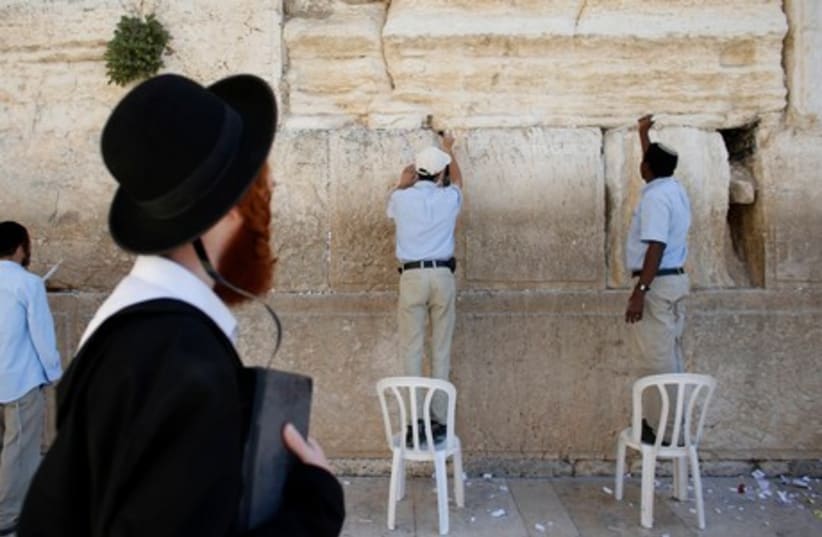
Torah Photo: Baz Ratner/REUTERS
The question, at first, seems superfluous, almost silly. After all, anyone – if
he or she has the money – can buy a Torah scroll. Or study it – from a book,
online, via audio or even video. As history’s greatest best-seller, it is
eminently accessible. Yet, like politics, sovereign territory and sports teams,
Torah has its own “turf wars.” Any number of groups and individuals lay claim to
it, declaring that they care more about it, understand it better and are more
qualified to decipher, defend and disseminate it. They will tell you that they
have invested more in it than others, and so are its rightful “owners.” The
Torah begs to differ. By its very nature and constrict, it breathes unity and
eschews exclusivity. At one and the same time, it is the province of no one in
particular, and everyone.
The Torah, one notices almost immediately upon
opening, is written without vowels. No punctuation; no periods, question marks
or exclamation points. No telling where one sentence begins or ends; no
paragraph breaks or page numbers. While there are indeed Masoretic traditions as
to how words should be written and pronounced, the text itself is clearly
ambiguous and open to interpretation.
The reason for this is not only to
increase scholarship – the Torah demands serious study to unlock its vast wisdom
– but also to allow for a vast range of opinion, speculation and commentary. As
the rabbis put: “Like a hammer upon a rock, there are 70 facets to the
Torah.”
The form of the Torah itself – a scroll, rather than a book –
accentuates this idea. You can open it anytime, anywhere, and you will
immediately be confronted by a combination of law, story, ritual and history.
The cycle of Torah reading, which begins anew the moment it ends, on Simhat
Torah, establishes it as the classic, kabbalistic ein sof; an endless, ongoing,
eternal fount of spirituality that cannot be confined to one community, one
approach or one generation. Created, says the Midrash, 2,000 years before the
world itself – serving as a blueprint for creation – it was, and always will be
there, rolling on and on for eternity.
The location where the Torah was
given also lends itself to a sense of universality. Matan Torah was in the
middle of a desert, somewhere between Egypt and Israel, on Mount Sinai. The
Sages note the important message this sends. Had the Torah been given in Israel,
some would argue that this signifies it is meant for the Holy Land exclusively;
and had it been given in the Diaspora, the reverse message might be assumed.
Furthermore, had it been given in a city, some would argue that the Torah is
meant for “sophisticated” citydwellers, but not for the simple country folk, who
would not be able to grasp its complexities.
Conversely, had it been
given in a rural location, some would conclude that the Torah is essentially
meant to “civilize” the outlying communities, but not altogether essential for
the educated class in the city.
So its origin in the wilderness signals
that it is for everyone: city, country, Israeli and foreign Jews, of all levels
and backgrounds.
How many letters are there in the Torah? The Zohar, the
foundational work of Jewish mysticism, says there are 600,000, corresponding to
the 600,000 people tallied in the census conducted in the desert. This is
symbolized by an acronym using the first letters of the word “Yisrael:” Yesh
Shishim Ribo Otiot L’Torah – there are 600,000 letters in the Torah. Yet a true
count of the letters yields just 304,805 letters! How do we account for this
major discrepancy? One approach is found in the statement by Nahmanides that the
Torah was created as “black fire upon white fire.” The letters are, of course,
the black fire. The white fire consists of the blank spaces between the words or
the chapters. Like a “pregnant pause,” these spaces, too, have meaning. When you
add them all together, the sum equals 600,000.
Another approach is to see
certain letters of the Torah as composites of several letters: An alef, for
example, is made up of a vav and two yuds; a heh is a resh and a yud, and so on.
Put them all together and you reach 600,000.
These two ideas convey a
deep message.
First, not all people are alike. Some are outspoken,
defined, visible and prominent, like the black fire. Others are quiet, reserved
and modest, like the white fire. We need all of them to make a whole people – or
to make a kosher Torah. Furthermore, not every letter stands alone; some need
“help” from a fellow letter to be complete; the heh, for instance, needs the
tall vav and the small yud. Likewise, we Jews need each other to make a people,
as we do to make a Torah.
Think of it this way: Each letter of the Torah
represents a person; each chapter a community; each portion a city; each book a
different segment of the Jewish population – male and female, young and old,
Sephardi and Ashkenazi, rich and poor. Just as a Torah scroll is ruled invalid
if even one letter is missing, so our Jewish peoplehood is incomplete if anyone
is missing, if anyone is disconnected from the totality of the people of Israel.
And just as a defective Torah must be fixed, so must our nation be fixed if
there are those who are alienated, ostracized or marginalized.
Moses, the
transcriber of Torah and its greatest hero, understood this message well. With
typical humility, he downplayed his own greatness and extolled the nation,
referring to Israel as “this nation of which I am but a part.”
Shavuot’s
place in the calendar comes at a unique juncture, amplifying its message of
unity. It immediately follows the Torah reading of Bamidbar, the chapter which
includes the census taken of the various tribes, as well as the description of
their diverse flags and common march towards Israel. E Pluribus Unum – “from
many, come one” – could certainly be our own national motto, as well as that of
the US dollar. Shavuot also is the culmination of Sefirat Ha’omer, the daily
counting which began on Passover and concludes with Matan Torah, the giving of
the Torah.
Clearly, this is a direct and dramatic indication to us that
everyone counts, that everyone has an equal share in the honor and heritage of
the Torah. The quintessential Jewish dance, the hora – performed most memorably
on Simhat Torah, when we joyfully encircle the Torah seven times – is a visual
reminder that there is no first in line and no last in line; we are all part of
the same circle, equidistant from the Torah, which forms the center, or core, of
our commonality.
The word “Shavuot” technically means “weeks,” referring
to the seven weeks since Passover. But, in a play on words, Shavuot can also
means “vows” or “pledges.” As we celebrate God’s amazing, eternal gift of the
Torah to humanity, we might also make a pledge to connect to each and every Jew,
and assure them of their legitimate entitlement to this source and secret of our
longevity, this “great equalizer” which defines and distinguishes all who take
hold of it. Hag sameah.
The writer is a rabbi and the director of the
Jewish Outreach Center of Ra’anana and a Ra’anana city councilman.