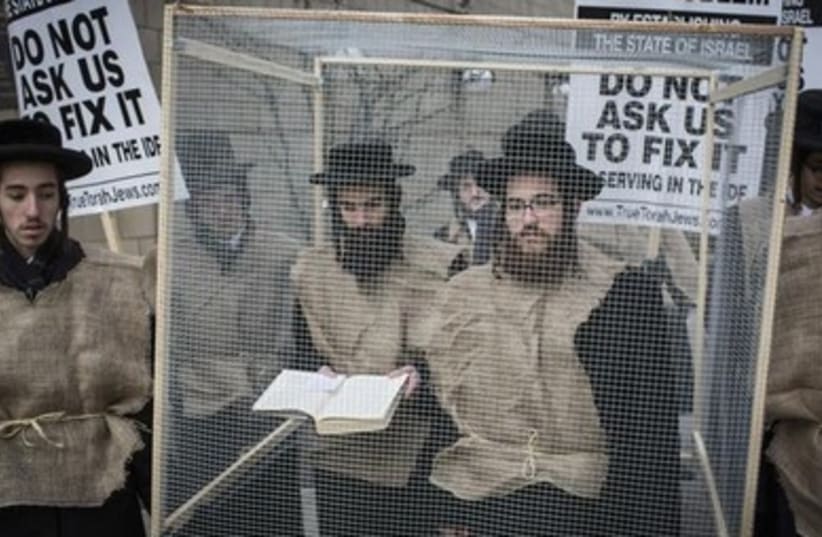
Joining the IDF should be a source of pride and unification for the Jewish nation, not of angst, resentment and violence.
By IZZY GREENBERGUltra-Orthodox Jews in New York protest IDF enlistment law 3(photo credit: Reuters)
In the debate regarding IDF enlistment and "sharing the national burden," a historic and momentous opportunity is being missed. Politics, power-plays, and ignorance are overshadowing the enormity of an unprecedented opportunity to unify our people through this issue and make it a rallying cry to have what can be truly called a Jewish state for the first time. Those who have a vested interest -- like hyper-secular politicians pandering to the salivating appetites of their anti-haredi masses or the godfathers of the rabbinical mafia looking to protect their turf -- have hijacked these issues to serve their needs. Instead of searching within to find the cause of their weakness and failure, they need an external scapegoat upon which to pin the blame. Like all tyrants, they must divide and conquer in order to preserve their rule. We Jews know this tactic well, having experienced it at the hands of our hosts throughout 2,000 years of exile. How sad that we now use it on each other. But the rest of us bystanders are also to blame. Because tyranny only has power in a void created when hatred and ignorance are left to fester.There is nothing about serving in the IDF that contravenes anything in the Torah. That's why thousands of orthodox men and hundreds of haredi men have no problem enlisting each year. Not only are they enlisting, but they are thriving and succeeding, filling an overwhelmingly disproportionate percentage of the leadership positions. In fact, not only is serving in the IDF not against the spirit of Torah, but, according to Judaism, serving in the IDF is probably the highest spiritual service one could hope to aspire to – mesirat nefesh, or self-sacrifice. This is something that the greatest sages in history, from Abraham to Rabbi Akiva, aspired to. Look at any source – Tanach, Talmud, Kabbalah, Shulchan Aruch, Jewish philosophy, mussar, Chassidic thought – and you'll find the concept of self-sacrifice discussed in the loftiest terms. Every pious Jew and every spiritual person hopes to aspire to it in some way, at least in theory. Every IDF soldier achieves it instantly, in reality, every time she or he dons the uniform.So why are all these supposedly top rabbis so against it? I don't know. Ask them. Maybe it has something to do with fear of the real world, fear of outside influences tainting the purity of their way of life. But if what I have is truly strong and real, I would expect my students to share the light of Torah with their less-observant brothers and not fear being influenced by their secular ways. Or maybe it has something to do with losing their power and authority over their flock should they become educated, empowered individuals. Maybe keeping them in the dark and in poverty has an advantage.Regardless of the motivation behind the rabbinical edicts, a growing minority are defying them and enlisting anyway – those who appreciated the spiritual and material benefits of joining the IDF. A soldier needs to believe in his cause, he needs to be motivated to serve effectively. Threat of jail or fines is not going to cut it. It may stop him from speeding, but it's not going to get him to overcome social barriers so that he can lay his life on the line for a cause. You have to convince people. You have to win them over by explaining how much the IDF needs them and their Torah, how much the Jewish people need them, how IDF service is in the spirit of Judaism not against it, and how serving in the IDF can be a springboard to material prosperity and a better future.Changing the rhetoric won't suddenly result in every yeshiva student enlisting right away. But neither will the threats. The IDF itself admits it cannot enforce the penalties suggested in the current legislation, nor can it logistically integrate a sudden influx of observant soldiers. And even if it could, what kind of soldiers would they be? What is needed is a sustained, methodical effort to achieve a paradigm shift, a grassroots movement that empowers people through a campaign of education and positive motivation.Calling IDF service a burden is idiotic as a recruitment strategy. But, on a deeper, existential level, imagine how demoralizing it is to every soldier and therefore to Israel as a whole to hear IDF service referred to as a burden. I remember my mother, may her memory be blessed, speaking of her IDF service with such pride- an entire album full of photos, newspaper clippings, and mementos proudly on display in our home. She spoke of the feeling that her life could always be in danger, and the moments of fear when it actually was as she came under enemy fire, but mostly she told me of the strength and exhilaration she felt in knowing she was fulfilling the greatest purpose on earth. IDF service is not a burden – it is a privilege. A privilege that comes with many benefits. A privilege to be shared equally by all. We don't want to force yeshiva students to trade in their Talmuds for army boots so they can share the burden. We want them to come happily with their Talmuds in hand to help strengthen, complete and unify our people, and to share in the privilege.Izzy Greenberg is a writer, scholar and teacher of Jewish thought and mysticism, as well as the Creative Director of Tekiyah Creative (tekiyah.com). To learn more and read his writings, visit izzygreenberg.com.
if(catID != 151){
var cont = `Take Israel home with the new Jerusalem Post Store