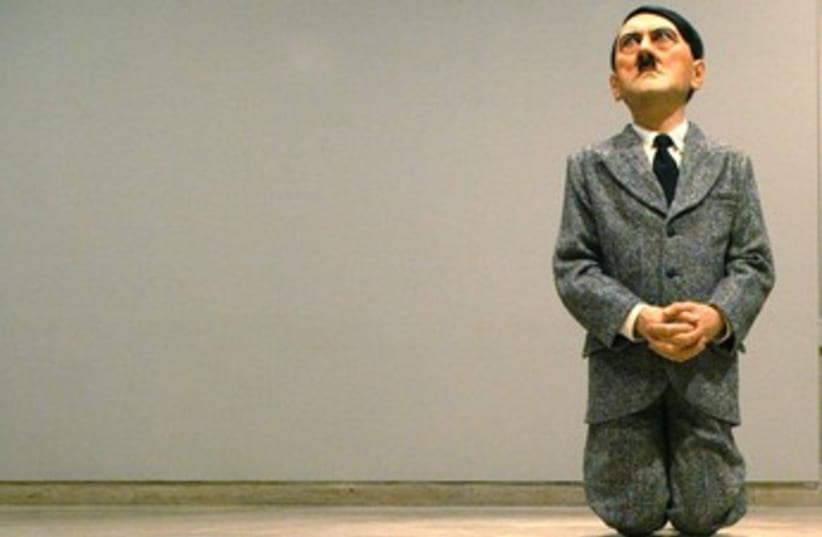
‘Kneeling Hitler’ placed in Warsaw’s Jewish ghetto
A new exhibition by an Italian artist, which includes a praying Adolf Hitler, has sparked outrage from Jewish groups worldwide.
By NISSAN TZUR, JERUSALEM POST CORRESPONDENTKneeling Hitler statue 370(photo credit: REUTERS/Michael Dalder)
WARSAW – If you look through the bars of the locked gate at 14 Prozna Street in Poland’s capital, a place that was the center of the Jewish ghetto 70 years ago, you may spot a small statue of a figure kneeling in prayer. That figure is Adolf Hitler.“Amen,” a new exhibition by Italian artist Maurizio Cattelan, which includes the praying Hitler, has caused outrage among the Jewish community in Poland as well as among Jewish and Catholic organizations worldwide that regard the exhibit as extremely offensive.Cattelan, 52, an Italian-born sculptor living in New York, is known for his controversial work. One of the most famous is “La Nona Ora” (“The Ninth Hour”) depicting Pope John Paul II being struck down by a meteorite.Last month, Cattelan opened a show at the Center for Contemporary Art in Warsaw.Most of the exhibits are displayed inside the museum, which is elsewhere in Warsaw. Only the praying Hitler has been placed in the middle of the former Jewish ghetto.The Center for Contemporary Art has a description of Cattelan’s exhibition on its website: “In a Warsaw ravaged by the cataclysmic 20th century, Maurizio Cattelan’s works take on a particular dimension; they become an artistic commentary on the Catholic credo. What, in fact, does love thy enemy mean? What does forgive those who trespass against us mean? Evoking the traumas of history, they deal with memory and forgetfulness, good and evil.”Cattelan’s decision to put the Hitler figure in the former Jewish ghetto has angered many in Poland, Jews and Christians alike. The organizers of the international film festival Human Docs being held in Poland and dedicated to human rights, have decided to hold a debate on the question “What’s Hitler up to in Poland? The moral impact of provocation in art.”Historians and artists have tried to explain Cattelan’s decision to place the figure in one of the most sensitive places for Jews in Poland and to resolve the question of whether it is a legitimate art exhibit or an offensive provocation. Some said the kneeling figure appears to be vulnerable and ambiguous. On one hand, the hero is an icon of evil; on the other, the view of Hitler kneeling may evoke sympathy in the viewer. Viewing this object, they say, provokes mixed feelings.A few days after the Hitler figure was placed in the yard of 14 Prozna Street, someone covered its face and hands in an attempt to obscure its identity, perhaps fearing the reaction it would produce.Another sign of the strong emotions the figure has raised is that, despite there being no public access to the exhibit, the museum’s management has mounted 24-hour security around it.Maria Poprzecka, an art historian, said: “Cattelan is a provocateur, to some extent, but it is definitely not a blasphemer. He is one of a few artists who have won fame not because of their artistic activity, but because of scandal caused by politicians."In the exhibition 'Amen' he is trying to deal with such subjects as suffering, martyrdom and death. That’s the reason his other works present a crucified woman and a wounded horse.”The controversial exhibit has aroused great interest, and hundreds arrive every day to look though the gate at the praying figure. Two women, both aged 81, read about the exhibit in the Polish newspaper Gazeta Wyborcza and came to see it with their own eyes. “We want to believe that the statue is intended to show Hitler repenting or apologizing for his evil actions,” they said.Another passerby wondered: “Why did the artists decide to put a praying child here? Is he praying for those who lived here? It must be a Christian, because Jews do not pray on their knees.”When she heard that the “child” was in fact Hitler, she said angrily: “Hitler did not have the right to ask for forgiveness.”
if(catID != 151){
var cont = `Take Israel home with the new Jerusalem Post Store