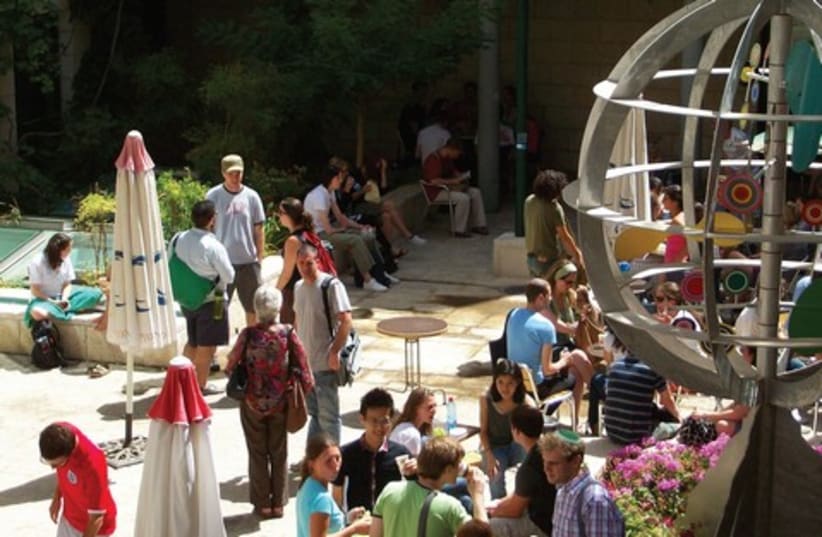
In summer, Jewish studies flowers in Eastern Europe
Programs reflect remarkable resurgence of Jewish informal learning, academic studies that has occurred in Europe since fall of communism.
By RUTH ELLEN GRUBER / JTAstudents 521(photo credit: Courtesy)
KRAKOW, Poland -- In Austria and Poland recently, I couldn't seem to get away from students, scholars and just plain interested folks who were taking or teaching summer programs in Jewish studies.I myself spoke at a three-day "summer academy" in Vienna where more than 100 members of the general public turned up for lectures by international experts on Eastern European Jewish history.RELATED:MKs mull bill to recognize, fund pluralistic Jewish studiesRussia’s Jewish educational spring (premium)Are Jewish studies in decline?In both Vienna and Krakow, I met informally with some of the 71 teachers from Jewish and public schools in North America and Israel attending a nine-day summer academy of lectures, travel and workshops organized by the Vienna-based Central Europe Center for Research and Documentation.The programs reflected the remarkable resurgence of both Jewish informal learning and academic studies that has taken place in Europe since the fall of communism. This process has opened up opportunities and fields of scholarship to new generations of students and researchers. It also has gone some way toward repairing the damage wrought by the Holocaust.About 750 institutions of European Jewish learning were "lost forever" in the war, according to the European Association of Jewish Studies, with many cities experiencing a "near total devastation of their Jewish studies resources." In postwar communist Europe, teaching and research in Jewish and Holocaust studies was virtually taboo.The pace of reconstruction has varied from country to country. But today the European Association of Jewish Studies lists nearly 450 academic institutions and universities in two dozen European countries where Jewish studies courses or classes are taught. Many other programs are associated with non-academic bodies.Summer programs have a special place in this scheme, as they often are geared specifically to visiting foreign participants. Some of them, such as the 5-year-old Leo Baeck Summer University at Humboldt University in Berlin, are organized in partnership with North American or Israeli institutions.The benefits of study abroad programs are well known: exposure to other cultures and languages, contact with new ideas, the opportunity to forge international connections.Looking back, my own days on a university study abroad program in Europe set the course of my life. I spent the first semester of my senior year studying art and art history on an American university program in Rome. I returned to the States to complete my degree and graduate, but within a few months I had moved back to Europe. I have lived here ever since.So it was revealing to meet people who had chosen to spend part of their vacations this summer delving into Jewish history or Holocaust studies -- and to hear about the often-unexpected impact of such on-site experience. That was the case especially in Poland, the prewar Jewish heartland that turned into the main Nazi killing ground."These are seriously motivated people," Annamaria Orla-Bukowska, a professor at Krakow's Jagiellonian University, told me about the more than 20 students from the United States, Latin America, Israel and elsewhere who had enrolled in the first international Summer Academy organized by the memorial museum at the former Auschwitz death camp.Held in July, it focused on Auschwitz and the Holocaust as well as on postwar history, Polish-German relations during the war and the educational challenges facing the Auschwitz Museum."You can imagine that it is physically and geographically and psychologically not easy to decide to take courses that will not only take up weekends and holiday time, but will actually be held at Auschwitz," said Orla-Bukowska, who has taught Jewish and Holocaust courses in several summer programs in Poland.Hailey Dilman, a Jewish studies graduate student at Hebrew University in Jerusalem, was one of 10 US and Canadian students who took part in the annual fellows program for graduate students offered by the Auschwitz Jewish Center. The center is an independent institution affiliated with the Museum of Jewish Heritage in New York and is located in Oswiecim, the town where the Auschwitz camp is sited.The three-week fellowship combined travel to Holocaust and Jewish heritage sites with courses and archival work on Polish Jewish history and contemporary Jewish life.Though much of the focus of her graduate and undergraduate work had been on the Holocaust, Dilman had never visited Poland or the Nazi death camps. She said that studying the impact of the Holocaust where it actually took place had been a revelation."It was amazing for me to learn that even though the Jews basically disappeared from Poland, they left such a strong imprint on Polish society that is still felt today," said Dilman, who is from Toronto. "Before the trip, I theoretically knew this was so, but I had to experience it to actually learn of it."
Elizabeth Bryant, a doctoral candidate at Florida State University, also was an Auschwitz Jewish Center fellow. Her master's degree had focused on Auschwitz -- but like Dilman, she had never visited the camp."Trips like this serve as a reminder that life is not always in black and white -- something that is sometimes difficult to remember when studying the Holocaust," she said. "The complexities of Polish culture serve to eradicate the notion that Poland can only be defined by its past, whether through communism or World War II."Bryant called her fellowship experience "life changing.""I do not say this lightly," she told me. "This program impacted me more deeply than I ever could have imagined."And that, indeed, may have been the point.
if(catID != 151){
var cont = `Take Israel home with the new Jerusalem Post Store