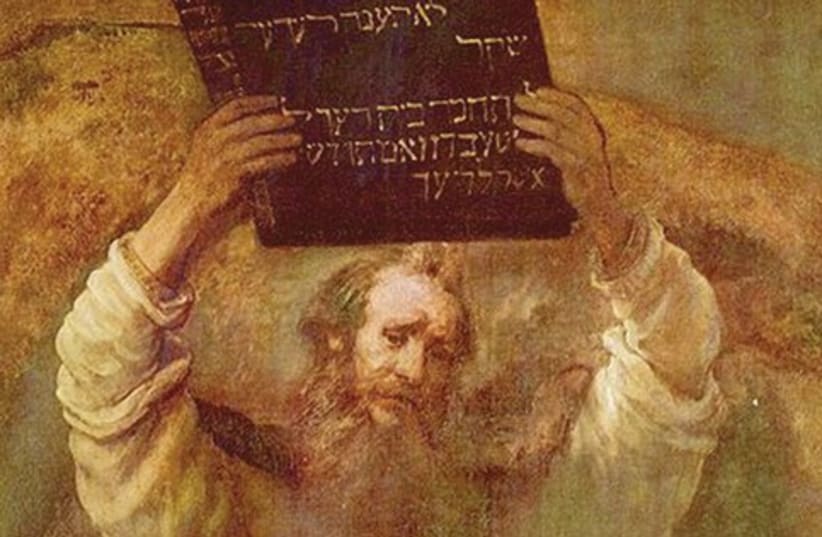
The Middle Eastern practice of dual proceedings in reaching important deals, agreements or covenants may provide and explanation.
By ALEXANDER ZVIELLIMoses_521(photo credit: Courtesy)
There have been many attempts to clarify why Moses went up Mount Sinai twice. Recent archeological research likely provides a correct answer to this question and testifies to both the originality and the antiquity of the biblical text.The giving of the Torah to Israel on Mount Sinai, whether oral or written, was the most momentous event in the Jewish people’s history. The once-wandering Israelite tribe that had just escaped from Egypt created, under the leadership of Moses, a new kind of society. Josephus, in the first century CE, defined this as a “theocracy,” or “placing all sovereignty in the hands of God.” Centuries later, our sages understood this as “taking on the yoke of the Kingdom of Heaven” (Berachot 2, 2). The text of the principles and laws of the newly created nation was deposited in the specially prepared and decorated Holy Ark.Josephus explains that Moses went up Mount Sinai for the first time to bring back “a happy method of living for the people, and an order of political government, a short history of the Patriarchs and Egyptian slavery, and a Decalogue.”But, he continues, “on the following day the multitude came to his tent and desired to bring them, besides, other laws from God.”So Moses went up for the second time, and after 40 days, “he showed them the two tablets, with the ten commandments engraved upon them, five upon each tablet, and the writing was by the hand of God.”Josephus mentions that during these 40 days Moses spent on the mountain, “fear seized upon the Hebrews,” but he fails to mention the Golden Calf.Philo Alexandroni wrote that Moses went up for the first time to bring to the Jewish people the “jurisdiction concerning things which are most necessary for human welfare, namely food,” and he ascended the mountain for the second time “for all other urgent needs of his people.” He mentions that those who made the Golden Calf during his absence in imitation of Egyptian worship were subsequently heavily punished.There is no doubt that Moses’s ascension was to bring the people a covenant, a signed agreement between the God of Israel and His people. It is also likely that the attending sacred ceremony was conducted in the spirit and the manner of his time. It is therefore most likely that he followed the traditional ancient Middle Eastern practice of reaching and verifying an important agreement.The fact that Moses, according to all sources, went up the mountain twice and made the tablets twice suggests that he was acting in accord with the prevailing Mesopotamian legal practice.THE MAINTENANCE of law and order was duly respected, obeyed and strictly enforced in the ancient Middle East. The national discipline was extremely strict, and the oral or written agreements achieved by oral oaths and written testimonies, frequently accompanied by oaths to various gods, were considered holy and binding. From the dawn of human civilization, a king was the supreme lawful authority, but there were also his appointed judges and people’s courts. Oaths, contracts and signed agreements or undertakings had to be carried out to the letter, even if the texts were sometimes challenged in the courts of law.Agreements may have been oral, written on papyrus or parchment, written with special ink or engraved on tablets of clay, stone or ivory, all according to their order of importance. International agreements were engraved on bronze, copper or silver plates. The special “small stone tablets” and the “large stone tablets” were highly respected, due to their strength, longevity, and admissibility as evidence in the courts of law.In his book Reading and Writing in Babylon, Dominique Charpin, professor of Mesopotamian History at the Sorbonne, Paris, explains that according to an ancient legal procedure, a written agreement between the contracting parties was first written or engraved on a small tablet. It was only after the text of the small tablet was agreed upon by both parties that it was transferred to the large tablet, which was henceforth binding and duly recognized by the court of law.This custom of reaching an agreement in two parts continues today, even if in a different manner. When negotiating any formal valid deal, we first sign a letter of intention, then seek a complete agreement on every point, and only then allow ourselves or our lawyers to formulate a final, binding written agreement, on which we put our signature and a copy of which is stored in the government administration’s archive.In Babylonia, the legally binding large tablets were preserved in a special family ark and kept by the private families or the king’s archives for generations.No court would recognize the validity of a small tablet, which might have been broken upon the completion of a deal. A difficult procedure was introduced in case the large tablet was lost. Therefore, particular care was taken by respective families, clans or tribes to own such arks containing the large tablets. A large tablet specified the size and character of a property, as well as birth, marriage or divorce details and all other documents of legal importance. Such ceremonial arks were kept by the respective families for generations.It was said in Babylon that judges “listened” (semum) to the large tablet, before taking any action or giving a verdict. In a similar manner, the expression used by the people referred to “the mouth of the tablet” (pi tuppim).A written agreement was therefore considered to be “a frozen word” – since a tablet had a mouth and was listened to. The stones were very much alive – the people were born, were wed and died with such tablets, just as we do with our administrative papers and computers.Some tablets were even stored in specially prepared envelopes before being stored in an ark.There were agreements reached by the big states, like the famous treaty between the Hittite king Hattusili III and the Egyptian pharaoh Ramses II. But one of the most interesting examples of a small and a large tablet was the case of the negotiations between the Babylonian king Hammurabi and Silli-Sin, the king of Eshnunna. The two kings, as quoted by Charpin, had first to exchange a “small tablet,” which included only the clauses to which each proposed that the other subscribe.Once they reached an accord, the kings exchanged a “large tablet,” which they would store in their respective arks.THIS MIDDLE Eastern practice of the dual proceedings in reaching important deals, agreements or covenants may explain why Moses went up to Mount Sinai twice before finally depositing the Decalogue and the two large tablets of the law in the ark, which was prepared with great care for this occasion.By the time of Josephus Flavius and Philo, this ancient custom of a small and a large tablet may already have been forgotten. But the Patriarchs who descended from Ur and Haran, and their descendants who preserved their own customs and national identity in Egypt, remembered the old Babylonian traditions of reaching an important agreement. It is therefore quite likely that Moses went up the mountain twice in accordance with the Middle Eastern legal practice. The first time, he came down with small tablets, and only after obtaining the people’s approval did he go up the mountain for the second time, in order to return with a large tablet. This act would make the covenant both complete and legal.Eventually, as in Babylon, the Holy Ark became a repository of the earliest Israeli history and a collection of documents which were regarded as sacred.The ark was actually a small library, and Middle Eastern archeologists unearthed many similar libraries, dating from a remote past, in the Near Eastern excavations.If Moses indeed followed such procedure, this would add another argument in the current dispute raging among scholars, questioning the veracity of some biblical texts and the Jewish people’s antiquity. We should consider the fact that before the Masoretic edition of the Bible was completed, the texts went through the hands of numerous priests, editors and copyists who were eager to add and improve and who could misinterpret certain ancient actions, or adapt them according to their own ideas, to make them better understood by successive generations.
if(catID != 151){
var cont = `Take Israel home with the new Jerusalem Post Store