Both Judaism and Christianity have geula as a central theme. But for Christians, geula means “salvation from sin.” For Jews it means “redemption.”
By REUVEN HAMMERMessianic Jews 311(photo credit: Ariel Jerozolimski)
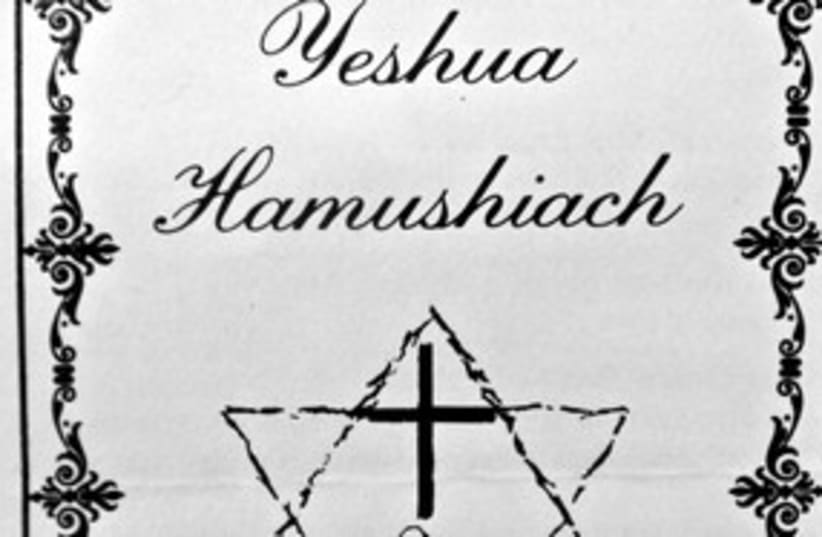
For the second time in recent weeks, I have found leaflets in my mailbox from a “Messianic Jewish” sect urging me to allow “Yeshua” to cleanse me of my sins and impurities so I will be accepted into the Kingdom of Heaven that is imminent.Both of these beautifully produced and illustrated Hebrew ads play on the fears of impending war, with pictures of gas masks and army boots. The texts contend that because of the sins of Adam and the innate sinfulness with which we are born, there is no way we can overcome our sinfulness without identifying with the Messiah that God sent to cleanse us. Only this will save Jacob – i.e., Israel – from impending doom.The success, albeit limited, of these campaigns and those that preceded them over the past decades can be seen in the fact that there are many so-called “Messianic Jewish” congregations in Israel made up of native Israelis who have been seduced by this propaganda into thinking they can be Jews and still accept these beliefs.Financing these efforts are evangelical Christian groups in America who sincerely believe that they are doing Jews a favor by showing them the way to salvation. These organizations have found that by urging them to become “Jews For Jesus,” as one group is known, they will have better success than if they simply try to convert them to Christianity.This idea was originally promulgated by Martin Rosen in 1973.Rosen was born a Jew, but converted to Christianity and became a Baptist minister. He led a mission to convert other Jews, but when he discovered that they were not responsive, he came up with the idea that the impediment to their accepting Jesus was their reluctance to give up their identities as Jews and become Christians. Therefore, he founded Jews for Jesus, a misnomer if ever there was one.Of course, such a compromise is not possible. Accepting Christian belief makes one a Christian, no matter what one calls oneself, even if technically one remains a Jew in limited ways. “Messianic Jewish” sects, by believing in Jesus as Messiah, as one of a trinity, as “the son of God” and as the one who leads to salvation, have crossed the red line and become Christian sects in everything but name. As such, members of any such group are apostates as surely as are Jews who have converted to Christianity or to any other religion but who do not pretend they are still normative Jews. As the great Provence scholar the Meiri (Menahem ben Solomon, 1249-1316) put it, “Whoever leaves the Jewish religion and adopts another religion is considered a member of that religion in every respect except in matters of divorce, marriage or any matter of familial affairs.”I RESPECT Christians and their beliefs, but as a Jew, I cannot accept their belief that the central problem we face is that we are all born sinful and cannot rid ourselves of sin through any actions of our own. In Judaism, the story of the sin of Adam and Eve does not play the central role that it does in Christianity. Yes, we are born with an inclination that can lead to evil, but, as God says to Cain, “sin crouches at the door; its urge is toward you, but you can overcome it” (Genesis 4:7). Furthermore, if we do sin, repentance is available to us. We pray daily for forgiveness, not only on Yom Kippur, and believe that God is forgiving.Both Judaism and Christianity have geula as a central theme. But for Christians, geula means “salvation from sin.” For Jews it means “redemption” – i.e., freedom from enslavement, as in Egypt, and a return from exile and restoration of our independence.It is time for us to learn to respect our differences and for Christian groups to desist from attempts at conversion, especially when they are disguised and deceptive as these messianic groups’ attempts are. It is also time for those who have joined these groups to stop deceiving themselves and to realize exactly what they have done in adopting another religion. They should also know that it is never too late to return home.The writer, former president of the International Rabbinical Assembly, is a two-time winner of the National Book Award. His latest book is The Torah Revolution (Jewish Lights).
Related TagsSolomon
if(catID != 151){
var cont = `Take Israel home with the new Jerusalem Post Store