‘And he confronted the place and lodged there because the sun had set …’ (Genesis 28:11)
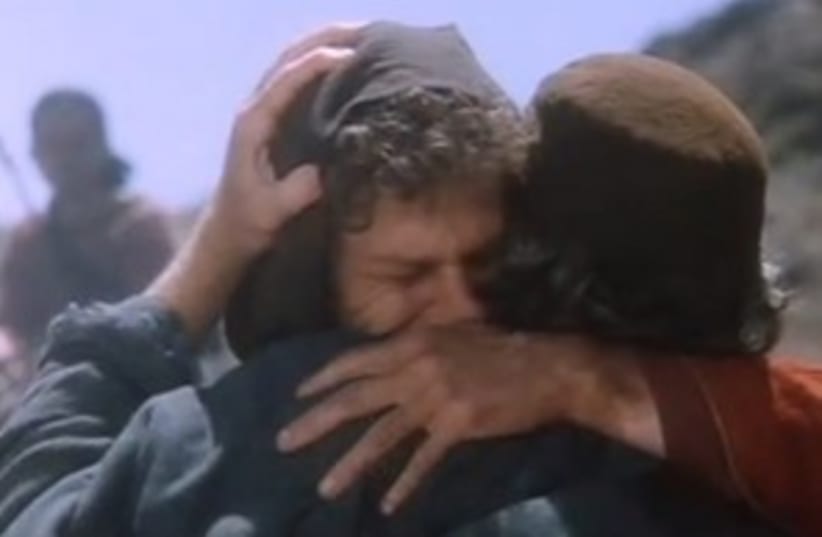
By SHLOMO RISKINesau and jacob_311(photo credit: Courtesy)
Jacob, the last of the patriarchs, is forced by his brother, Esau, to leave his ancestral home for exile.The Talmud (B.T. Brachot 26b) interprets our opening verse as follows: “Jacob enacted the evening prayer, as it is written, ‘And he confronted the place and lodged there;’ the term ‘confrontation’ [Hebrew: pegiya] refers to prayer, as it is written ‘And you are not to pray on behalf of this nation and you are not to raise songs and prayers on their behalf and you are not to confront Me’ (Jeremiah 7).”This talmudic passage ascribes one of our three daily statutory prayers to each one of our patriarchs.“Abraham enacted the morning prayer, as it is written, ‘and Abraham arose early in the morning toward the place where he had stood.’ (Genesis 19); the term ‘standing’ (Hebrew: amida) refers to prayer, as it is written ‘And Phinehas stood and he prayed’ (Psalms 106).“Isaac enacted the afternoon prayer, as it is written ‘Isaac went out to converse with the Divine in the field before sunset;’ the term ‘conversation’ refers to prayer, as it is written, ‘The poor person prays when he wraps himself in his prayer shawl and pours out his conversation before the Lord’ (Psalms 102).”I believe that our Sages are purposefully identifying each of these three prayers with the unique personality of one of the patriarchs. Abraham is identified with the early morning prayer; our first communication with God at the beginning of the day, with the rising of the sun. Abraham emerged at the dawn of Jewish history.He was the great path-breaker who discovered ethical monotheism and began to teach it to the world. He raised multitudes of adherents to his newfound faith and his teaching of compassionate righteousness and moral justice. He was immensely successful in all that he did; a wealthy shepherd and an internationally famed military commander. It makes sense that his prayer comes at the dawn of a new day, when each of us is most optimistic regarding the possibilities that lie ahead.Isaac is the most passive of the patriarchs. He is taken by his father to the akeda (binding), his wife is chosen for him and the blessings are wrested from him through subterfuge. He is the great continuator, the consummate follower who certainly represents the masses of descendants who faithfully follow Abraham’s path. It is understandable that Isaac’s prayer comes as the sun is beginning to set, at a time of day when much has already occurred, and it is up to the individual to react more than to initiate action.Jacob’s life is more tragic than the lives of his two forebears.He spends many years in exile because his brother, Esau, has threatened to kill him. After working for 14 years to win the hand of his beloved Rachel, he mourns her premature death in childbirth. He then spends more than two decades mourning the loss of Joseph, whose brothers sold him into slavery and told Jacob that he had been killed by a wild beast. His life is identified with the darkness and the fear symbolic of night.My revered teacher, Rabbi Joseph B. Soloveitchik, suggested another way of looking at these three prayers.The morning prayer, Shaharit, is a young man’s prayer.After all, it is only after the morning prayer that one may eat, that one may partake and declare ownership of the world around us. Youth believe that the entire world is at their fingertips.The afternoon prayer, Minha, comes in the midst of the day, in the midst of what is often frenzied activity, and so Minha is the prayer of the individual at midlife.The evening prayer, Ma’ariv, is the prayer of the person at the end of his life, the prayer that asks for survival more than for success. This prayer is made at a time of anxiety and uncertainty, when one feels one’s powers waning. Ma’ariv is the prayer of the brave, because “Old age is not at all for cowards” (told to me by Mira Koschitzky in the name of her mother).Our Sages expressed the varying moods of our prayers by citing the verse: “One must declare God’s lovingkindness in the morning and His faithfulness in the evening” (Psalms 92: 2). It is comparatively easy to praise God in the midst of one’s success and optimism – although many tend to think that they themselves are responsible for their good fortune. During times of darkness, uncertainty and anxiety, it is necessary to grasp onto God, but sometimes most difficult.What does the psalmist mean when he speaks of faithfulness? The Hebrew word “emuna” is usually translated as “faith”; but what it really means is “steadiness” (Exodus 17:12). Faith does not mean that we must believe everything will work out well in the end as long as we pray strongly enough and live good enough lives.Faith means faithfulness: we must be faithful in carrying out what God asks of us – with as much sincerity and good cheer as we can muster – no matter what difficulties and trials He may send our way. It was this ability that made Jacob the most chosen of our Patriarchs.The writer is the founder and chancellor of Ohr Torah Stone Colleges and Graduate Programs and chief rabbi of Efrat.
if(catID != 151){
var cont = `Take Israel home with the new Jerusalem Post Store