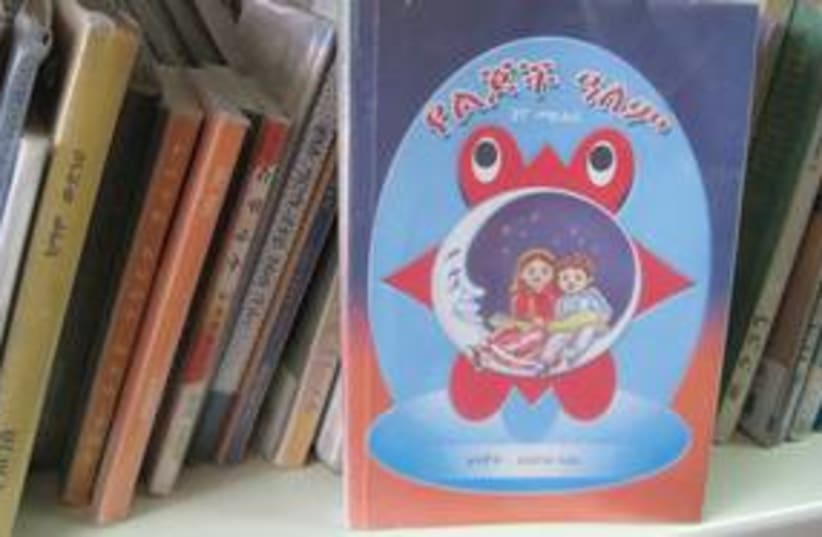
The Benjamin Children’s Library is struggling valiantly with dwindling funds to accommodate its ever-growing community of readers.
By STEVE LINDEBenjamin Book311(photo credit: Steve Linde)
The inspirational story of The Benjamin Children’s Library in Beit Shemesh is worthy of a book itself. And books, the wonder of books, is what it’s all about. But just as children outgrow their clothes, the busy library located in the Meyerhoff Community Center near the town’s second entrance is inundated with books, and its dedicated management is struggling to find funding to not only keep it afloat, but fulfill its dream of expansion.The library serves thousands of children from all sectors of the local population. Many of them are from English-speaking families, while others are veteran Israelis and immigrants from Ethiopia, Russia and elsewhere. The children range from haredi to modern Orthodox, Conservative, Reform and secular.A large percentage of its regular visitors from disadvantaged homes use the library as a study and play center, making it a home away from home.“It is the one place in Beit Shemesh that has a lot of harmony,” says director Bibsi Zuckerbrot, originally from New York. “This is the only place in town that brings every sector of the population together. We really run the gamut. It’s a kibbutz galuyot.”“This is an amazing library,” adds librarian Karen Feldman, who made aliya from New Jersey. “It is the only place in town where you can see secular and religious kids, Americans, Ethiopians, Russians, kids with payot and kids with spiky gelled hair all sitting next to each other reading. The library is truly a special place, a healing but not quiet place that attracts kids – babies to teens – and grown-ups alike. Don’t let the name fool you – we have adult books, too. The library is a ray of light and hope to the people of Beit Shemesh.”The library has a children’s section downstairs and an adult section upstairs with a special Holocaust collection donated by the family of Holocaust educator Harry Reiss. It is run by a nonprofit organization, receiving no money from the town council or the government, and relying entirely on private donations and subsidies from Keren Keshet and the New York Jewish Federation.“We’re not supported by the municipality or the matnas [community center] that we’re in,” says Zuckerbrot. “We started as a private library, and it is our goal to become part of the public library system or part of the matnas. While we serve the entire public, we are not supported by the government. We do receive funds from Keren Keshet and the New York Federation, but these might end next year, so we’re looking for donations and contributions. We are an amuta [a registered non-profit organization], and if we don’t get significant donations in the next year, we could be in trouble.”The library was established by Eliyahu and Tami Kruger, who was born in Jerusalem to English-speaking parents and has since moved from Beit Shemesh to Zichron Ya’acov after the tragic death of her fouryear- old son, Benjamin, 20 years ago.“I married Eliyahu, who was a widower, and he had a son who was ill, and were were living on a moshav near Beit Shemesh,” says Kruger. “Because he was a sickly child, Benjamin loved books. That was his favorite thing. So when he passed away in February 1990, we thought a children's library would be a very nice way to remember Benjamin. We started the library in September of that year. In 1993, we moved to Beit Shemesh. I think the combination of the dati community of readers and volunteers with disadvantaged kids who come to the library really clicked. My vision for the library was that it would serve everybody,” says Kruger.It soon became a central gathering point for residents of Beit Shemesh and moved several times to provide more space for its rapidly growing collection of books and avid readers.“The story of how we came to be in existence is an interesting one,” recounts Feldman. “We started in a small building. The library began with a shelf of donated books. But we outgrew that space in the building, so we moved to a house. Then we were getting too big again, so this building was built. The boss then, the founder of the library, Tami Kruger, talked to the people who built the matnas and said, ‘I have a library with no space and you have a space with no library, so let’s get together.’ And that’s what we did. In the beginning, it was 100 percent donations, and Tami did the fund-raising.”Kruger takes up the story.“In 1997, we started an amuta and began fundraising, and we moved into the new building in March 1998,” she says. “For me, the library was like dropping a seed into fertile soil. There’s something very miraculous about the whole project. Right now, it’s absolutely bursting at the seams. We’ve run out of room for people and for books. Libraries aren’t meant to look like this, with shelves overflowing with books,” she says.“In terms of fund-raising, none of us is a professional fund-raiser. We’re all do-gooders. We need to fund the running costs of the library, which are about $160,000 a year, as well as raise money for a new building. Libraries are not well funded here, and it’s not easy. People like to fund particular programs, but we still need to find the person who would like to put up a new building.”TODAY THE Benjamin Children’s Library offers a wide range of resources and programs, which has included story hours, puppet theater, summer reading, workshops in paper and book making and a storybook carnival.“It is a stimulating, safe activity center run by and for the community by a small professional staff and an army of dedicated volunteers,” declares its Web site (http://library.shemesh.co.il). “Children can do homework, use computers, draw and play with puppets, toys and dress-up clothes. And, of course, read.”“We are mostly run by volunteers, a dedicated core of about 50 people who come in to catalog, wrap, shelve, do bookkeeping and dozens of other jobs,” says Feldman. “Our English collection is about 98% from donations, and we use what little money we have to buy in Hebrew. At this point in time, we are stuffed to the gills with books – a nice problem to have! – and we are looking to expand the building.”“We have an average of 8,000 books taken out a month,” says Zuckerbrot. “That’s a lot. The city library has twice as much space as us, but we have twice as many books taken out.”Zuckerbrot says the library is packed with people all year round, especially in the summer when it offers afternoon programs to children on school vacation.“We’re not a quiet library. We’re a noisy library, proudly so, and we need to expand,” she says. “We can’t run programs while the library is open. We have high hopes to build and double the size of the library because we want to run programs at the same time as people are using the library. We want the kids to be comfortable with the atmosphere of the books and the library, but we have a problem: We have tons of kids coming, and the library is very full with all the shelves and all the space filled.”MANY OF the children who use the library are from English-speaking or Amharic-speaking homes. “I’d say about half are English-speaking.But we also have one of the largest Amharic collections in Israel,” Zuckerbrot says. The books were flown in from Ethiopia by a cousin of Kruger’s who works there.“Ethiopian kids are here all the time, from the minute we open to the minute we close. Four afternoons a week we have professional staff to do homework with the kids. It’s free homework hour and it’s filled with Ethiopian olim, usually girls, very few boys. There’s one afternoon a week that we’re not open to the public so we can do programs,” says the director.“We have a leadership training program where we teach the older kids to help the younger kids,” she continues. “We have a weekly story hour for three- and four-year-olds in Hebrew but mostly attended by Anglos. We have an eightweek reading program over the summer, where 150 kids have their names written up and the hours they read. Their goal is to reach 16 hours of reading. They have a workshop, and this year the theme is science. Each week, a professional teacher teaches them a concept, let’s say ‘balance,’ and then they do an experiment so that they all understand it at their own level. My own son goes to it, and he loves it,” she says.Do children read as much nowadays as they used to before the computer age? According to Zuckerbrot, kids read a lot. “One of the big things was Harry Potter,” she elaborates. “That spurred a lot of kids to read, and once they started it was hard to stop them. Anglo parents want their children to do everything – to read in Hebrew and English.”“The children love the teachers who look after them in the afternoons. They draw the kids to them just by their personalities,” says Feldman. “They are so kind and so lovely. Kids just want to sit next to them and want to learn from them.”Two of the counselors, Sima Yitzhak and Tova Aharon, explain how they instill the love of books in the children by reading to them and discussing the content with them. “We have taught some very special children over the years,” says Yitzhak. “Sometimes, when they are older, they come back and volunteer themselves.”In 1999, the library won an award for Outstanding Volunteer Organization of the Year. The Jewish Agency reported that it had “grown from a few books to more than 12,000 volumes [there are now 38,000], half in Hebrew and half in English, and serves the children of the entire city of Beit Shemesh.”The library has three rooms downstairs with doors labeled “Articulate,” “Sane” and “Coherent.” Feldman jokes: “When people ask where I am, they are told, ‘She might be in Articulate [inarticulate] or in Sane [insane] or in Coherent [incoherent]. I don’t know; I have to go see.’ You see, librarians have a sense of humor!” She says she is opening a new humor section in memory of her mother, who passed away recently.SEVEN YEARS ago, as the library overflowed with books, Feldman came up with the idea of the Benjamin Wandering Library, which involves leaving free books for the public at choice spots, such as hospitals. The English books are neatly wrapped in plastic and left in piles for potential readers to pick up.“The idea for the Wandering Library came to me after a discussion about promoting literacy with my thenboss Tami Kruger,” she says. “I thought it would be a fun idea to send books out into the world. I started doing this around 2003, but it wasn’t until 2005 that I began to keep records. Since I started keeping records, I have sent out about 275 books, and I am guessing that at least 75 or more before that. I am very careful with the books I send out. I pretty much send out only books that I have read and know that they are really good. I send out stuff for all ages – from board books to adult books, lots of classics rather than junk. I’m picky about what I choose to distribute,” she says.“Here’s how it works. Since our library is such a small one, we depend solely on book donations for our English collection. When a book comes in that we already have in our collection that I think would be good for the Wandering Library, I use it. The book gets a bookplate and is wrapped by me or one of our volunteers. After I collect between 10 and 20 books for different ages, I give them to somebody to distribute or I take them out myself,” says Feldman.“I get a real kick from giving out books personally, so usually when I travel I give out books at the airport or on the plane, although I prefer having the books stay in Israel. I’ve gone into malls and handed out books. I’ll pick a woman with children, for example, and say, ‘Would you like to choose and have a book for free?’ and I explain the concept of the Wandering Library. One woman thought I was a Jehovah’s Witness and wouldn’t take books from me. I had to explain to her that I was a dati Jewish woman who just likes giving books out. I’ve left sacks of books at restaurants like Burgers Bar, but mostly where I concentrate is hospitals because I have a friend who goes to hospitals on a regular basis and she leaves books in the MRI room and the CT room, etc., “ says the librarian.“I sort of picture as I’m sending each book off that the characters wave good-bye and then head bravely off to a new life somewhere else to have new adventures.”Zuckerbrot relates that in July, the Schalit family stopped in Beit Shemesh on their march from Mitzpe Hila to Jerusalem to rally support for Gilad on the fourth anniversary of his abduction at Kerem Shalom and incarceration in Gaza.“We collected a box of about 10 books for Gilad, including Treasure Island and books on survival and humor,” she says. “They were mostly adult books and they were all in Hebrew. Noam and Aviva Schalit came to the Beit Shemesh merkaz [town center], and we had a whole big production, with the mayor speaking and music playing. I had the privilege to speak to Aviva Schalit. I gave her the books from the library with an accompanying letter. She said she would keep them for Gilad until he came home.”A short story written by Gilad in Hebrew when he was 11 and in fifth grade was published in English and other languages for children two years ago under the title “When the Shark and the Fish First Met.”It tells the story of how a little fish and a big shark become friends despite parental opposition, ultimately creating peace between their two species.Today, Benjamin Kruger’s contemporaries are almost the same age as Gilad Schalit, who turned 24 this month.“I never made the connection before, but yes, Benjamin was born in 1985 and he would be turning 25 this year, about the same age as Gilad,” says Kruger. “I can’t imagine what it is like for Gilad to be without books for so long. Books keep you going. I don’t know if you know that wonderful story of the four Israeli pilots who were held as prisoners of war in Egypt in the 1970s, and they used the time to translate The Hobbit into Hebrew from a book sent to them by family members via the Red Cross. I think the idea is beautiful, and it’s absolutely absurd that the Red Cross can’t take books to Gilad.”
Related TagsSteve Lindelibrary
if(catID != 151){
var cont = `Take Israel home with the new Jerusalem Post Store