Analysis: Bashar Assad: What you see is what you get
Syria’s president is not a ‘pragmatist’ but fiercely anti-Israel, which is why efforts to lure him out of Iran’s orbit aren’t working.
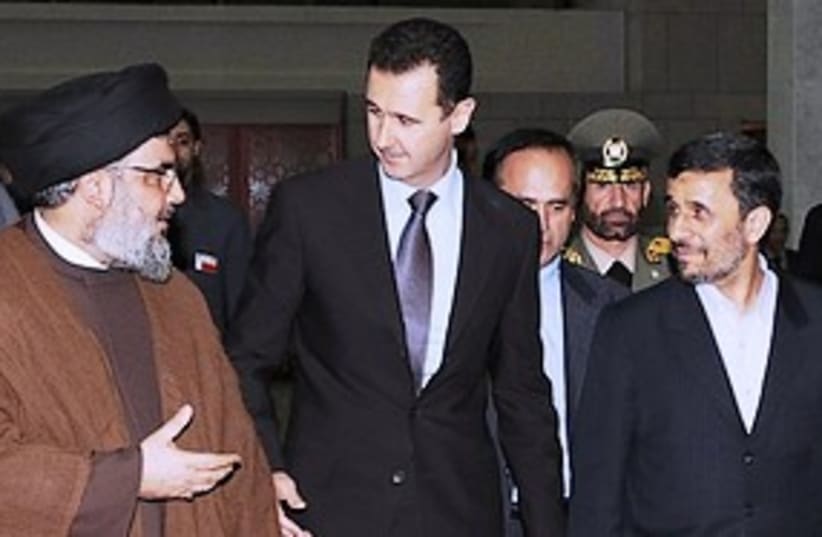
By JONATHAN SPYERNasrallah Assad Ahmadinejad 311(photo credit: courtesy)
In Damascus last week, the full array of leaders of the so-called “resistance bloc” sat down to a sumptuous meal together.Presidents Ahmedinejad of Iran and Assad of Syria were there, alongside a beaming Khaled Mashaal of Hamas and Hizbullah General-Secretary Hassan Nasrallah. There were some lesser lights, too, to make up the numbers – including Ahmed Jibril of the Popular Front for the Liberation of Palestine-General Command (PFLP-GC), a fossil from the old alphabet soup of secular Palestinian groups.The mood – replicated a few days later in Teheran – was one of jubilant defiance.The reasons underlying Syria’s membership in the “resistance bloc” remain fiercely debated in western policy discussion. It has long been the view of a powerful element in Washington – strongly echoed by many in the Israeli defense establishment – that Syria constitutes the “weakest link” in the Iranian-led bloc.Adherents to this view see the Syrian regime as concerned solely with power and its retention. Given, they say, that Syria’s ties to the Iran-led bloc are pragmatic rather than ideological, the policy trick to be performed is finding the right incentive to make Damascus recalculate the costs and benefits of its position.Once the appropriate incentive tips the balance, it is assumed, the regime in Damascus will coolly absent itself from the company of frothing ideologues on display in Damascus and Teheran last week, and will take up its position on the rival table – or at least at a point equidistant between them.The specific incentive required to perform this trick varies depending on who you ask. In Israel, it is generally assumed that the recovery of the Golan Heights is the great prize. In this view, Syrian backing for Hizbullah and for Palestinian terror groups is intended to keep up the pressure on Israel, in order to force it to concede the Golan.In Washington, one may hear a number of other incentives discussed – the removal of the Syria Accountability Act, US aid and investment, and so on.The logic of all these positions depends on the basic characterization of the Assad regime as ultimately motivated purely by Machiavellian power interests. This characterization remains received wisdom in Israeli and US policy circles to a far greater extent than the evidence for it warrants.Western wooing of Syria has undeniably produced remarkably little in terms of changing the regime’s behavior. In recent weeks, the Obama administration increased the volume of its formerly cautious overtures to Damascus. Undersecretary of State William Burns visited Damascus, and attempted to raise the issue of Syrian support for insurgents in Iraq, and for Hizbullah and Palestinian terror groups. Assad, according to reports, denied all knowledge of such support.The recently announced US decision to return an ambassador to Damascus was followed by the resistance jamboree in Damascus – in which Assad openly mocked US hopes for a Syrian “distancing” from Iran.It has now been announced that Secretary of State Hillary Clinton is considering a visit to Damascus. In the meantime, Syria is gaily crashing through the red lines on its military support for Hizbullah. Sophisticated anti-aircraft equipment, such as the Russian-made Igla system, is rumored to be following the advanced surface-to-surface missiles and antitank systems supplied to the Lebanese terror group.Which brings us back to the core question of Syrian motivation. Clearly, the Syrians have a habit of swallowing incentives and giving nothing in return. But if the alignment with Iran is purely pragmatic, then why does it prove so difficult to offer Syria the right carrot to lure it away from Teheran?There are two possible answers. The first and most obvious one is that Syria calculates, probably correctly, that since there will be no real price imposed on it for not changing its behavior, it can afford to maintain its current level of relations with Iran, while happily accepting any gestures from the west or Israel designed to induce it to change them.But this explanation fails to account for the brazenness and fervor of Syria’s current stance of defiance. The statements of individuals close to the Syrian regime in recent months suggest that there is more to the current Syrian stance than simply playing all sides off against the middle.Rather, the Syrians believe that a profound restructuring of the balance of power is under way in the Middle East – to the benefit of the Iran-led bloc. This restructuring is being made possible because of the supposed long-term weakening of the US in the region.This enables the aggressive, Islamist regime in Teheran to fill the vacuum. It also renders feasible policy options – such as direct confrontation with Israel – which in the 1990s seemed to have vanished forever.The characterization of the young Syrian president and his regime as ultimately cool-headed and pragmatist is incorrect. The Damascus regime always held to a fiercely anti-Israeli and anti-American view of the region.In the 1990s, realities appeared to require a practical sidelining of this view. But the 1990s were over a while ago.Regimes like that of the Assads (and even semi-farcical figures likeold Jibril and his PFLP-GC) are not anomalies in the alliance based onIranian ambition and regional Islamist fervor. Rather, they are naturalpartners, sharing a base-level understanding of the region, commonenemies, and a common, brutal approach to asserting their interests.It is for this core reason that attempts to prise Bashar Assad away from his natural habitat will continue to prove fruitless.The writer is senior researcher at the Global Research in International Affairs Center.
if(catID != 151){
var cont = `Take Israel home with the new Jerusalem Post Store