With elections overdue, questions over the legitimacy of both Fatah and Hamas are only likely to increase.
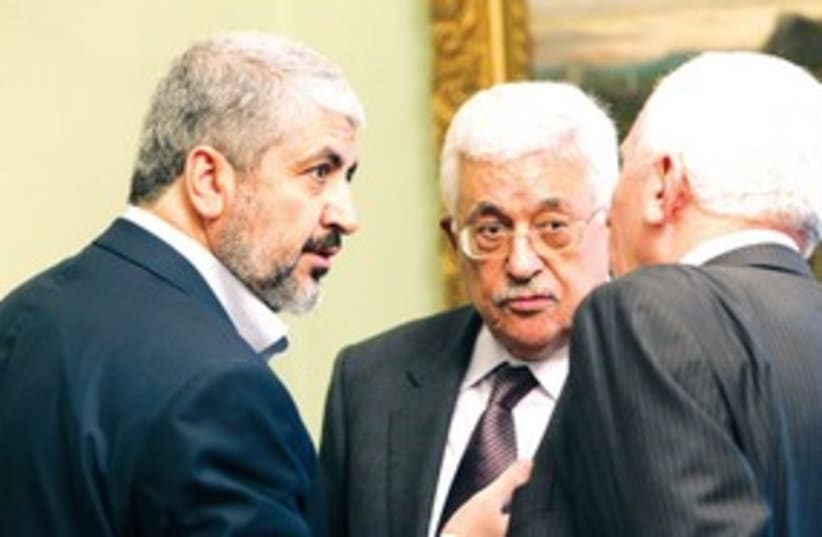
By REUTERSMashaal with Abbas 311 R(photo credit: Reuters)
Hamas and Fatah are Palestinian rivals facing the same dilemma: how to justify their role as leaders of the Palestinian people while making little headway in achieving their national goals.With elections overdue, questions over their legitimacy are only likely to increase unless they find a way to galvanize the Palestinians' struggle with Israel.RELATED:Hamas supporters still targeted by FatahZahar: Abbas is not serious about reconciliationThe rivals, who fought a civil war in 2007 at the height of their hostility, have turned to each other in an effort to preserve their relevance, reviving talks aimed at ending the feud which has splintered the Palestinian national movement.They are promising elections in May for the parliament and presidency. But analysts doubt voting will go ahead.Barring a surprise, they do not expect major steps towards the reunification of Gaza, ruled by Hamas, and Ramallah, seat of the Palestinian Authority led by Fatah chief Mahmoud Abbas.
His presidential term having expired in 2009, Abbas today rules on the basis of a decree from the Palestine Liberation Organization, which he also leads. Legislative elections, last held in 2006 and won by Hamas, are now some two years overdue.Privately, both sides question whether the other is serious about steps that would allow new elections. To analysts, the new unity talks appear an attempt by both to buy time while they await the outcome of the upheaval in the Middle East."It will be a period of wait and see," said George Giacaman, a political scientist at Birzeit University in the West Bank.Both Fatah and Hamas believe democracy in the Arab world will be to the Palestinians' advantage, bringing to power governments that reflect popular sympathy with their cause. Hamas is heartened further still by the gains made across North Africa by groups that share its Islamist program.But in a region of fast change driven by people power, some believe Fatah and Hamas, untested at the ballot box in six years, could be left behind if they do not come up with new ideas for directing the struggle against Israel."They have already become partially irrelevant. Neither has a plan of action," said Sam Bahour, a business consultant and political commentator based in Ramallah. "They look more like an old-style Arab regime than a national liberation movement."The groups struck a new tone at a Nov. 24 meeting in Cairo, where both talked about "popular resistance", a term including protests, boycotts and other non-military means of struggle.But there has been no quick translation on the ground."The legitimacy of these national forces will be defined by their role and participation," said Jamal Juma, an independent organizer of a grassroots campaign against Israel's West Bank security fence and settlement expansion."What is required is popular action, resisting on the ground," he said. "They must take steps in this direction, or they will be left behind by the Palestinian people."Legitimacy of both factions in doubtHamas and Fatah appear to be struggling to plot a path that doesn't depend on the tools they have long employed in the struggle with Israel.While Hamas rockets still fly into Israel from Gaza, the group these days appears more interested in calm than conflict. It remains committed to armed "resistance", but has clamped down on other groups seeking to attack Israel to avoid reprisals.Abbas, meanwhile, has called a halt to the peace talks around which he built his career. He will not go back to the table until Israel halts construction of Jewish settlements on the land where he seeks to found the Palestinian state.Israel has refused to accept pre-conditions to any talks."The absence of the peace process and the absence of resistance means they (Hamas and Fatah) do not have political legitimacy," said Hany al-Masri, a political commentator involved in efforts to foster reconciliation between the two.Loyalists defend their leaders from such criticism, arguing they are doing the best they can in the face of Israeli power and US policy which they believe is slanted against them.Both administrations have won a degree of respect for their efforts in government. Law and order is one area they have worked to improve, though human rights activists say the result is Palestinian police statelets in both the Gaza Strip and the West Bank, territories separated from each other by Israel.And both know good governance will not be enough to satisfy a people seeking independence.That explains why Abbas asked the United Nations to recognize Palestine as a state and Hamas concluded a prisoner swap that set free hundreds of Palestinians in exchange for an Israeli soldier captured and held in Gaza since 2006.These actions generated support for both. But the momentum is fading and having played those cards, the sides have turned to reconciliation, a phrase now heard more often from Palestinian leaders than "resistance" and "peace process".Abbas and Hamas chief Khaled Mashaal exchanged upbeat remarks on prospects for unity at their Nov. 24 meeting. They are due to meet again later this month.Ismail Haniyeh, head of the Hamas administration in Gaza, provided a reality check in Dec. 13 remarks. He blamed slow progress on the detentions of Hamas activists in the West Bank."The most they can agree on is a new cabinet, composed of independents. But this is still difficult and I don't see much beyond that," said Birzeit's Giacaman.The reasons are many and include the financial repercussions of unity on the Palestinian Authority. The United States and Israel, which both view Hamas as a terrorist group, would respond to a unity pact with sanctions at the very least.If the sides do reach a deal, Israel would also be able to torpedo it by blocking Palestinian elections in east Jerusalem.The Palestinians last went to the polls in 2006, an election that gave rise to the division. Hamas was propelled into government but would not bow to Western demands that it renounce violence and recognize Israel.Acrimony grew as Hamas accused Abbas of undermining its efforts to govern in the face of a boycott by states whose financial support remains vital to the Palestinian Authority.Tayseer Khaled, a member of the Democratic Front for the Liberation Of Palestine, spoke of "great efforts" to clear the way for unity. "We only have only one option: going back to the ballot box, going back to the Palestinian voter," he said.Such talk, Giacaman said, was "pie in the sky".
if(catID != 151){
var cont = `Take Israel home with the new Jerusalem Post Store