UN rights chief Navi Pillay slams Assad regime over violence; Clinton meets Turkish FM over Arab League plan.
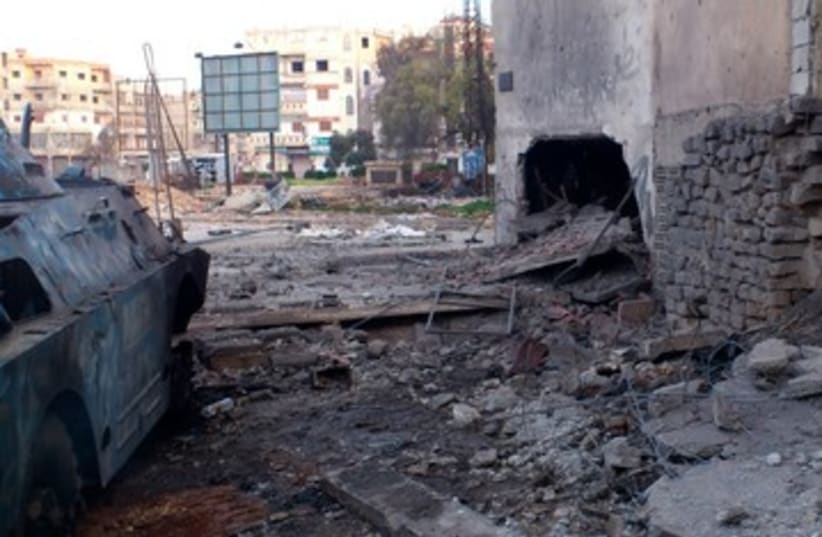
By ELIEZER SHERMAN, REUTERSHoms after bombardment 390(photo credit: REUTERS)
Syrian President Bashar Assad’s regime has used chemical warfare in order to ease its entrance into Homs, said Awad Al-Razak, an officer who defected from the Syrian armed forces.Al-Razak, who served in the chemical warfare department of the Syrian military, told the Al-Arabiya network that the government used nerve gas under the supervision of Russian and Iranian scientists, and intends to do so again in other parts of the country.On Monday, UN High Commissioner for Human Rights Navi Pillay said that the failure of the United Nations Security Council to reach an agreement on a resolution against the ongoing violence in Syria has emboldened the Syrian government in its deadly crackdown on opposition activists.Russia and China on Feb. 4 vetoed a European-Arab drafted resolution condemning the Syrian government's suppression of anti-government demonstrations and endorsing an Arab League plan for Assad to step aside.Pillay's speech to the 193-nation assembly came after Syrian UN Ambassador Bashar Ja'afari, backed by delegates from Iran and North Korea, tried unsuccessfully to block her from addressing UN delegations by citing procedural arguments.Pillay spoke extensively about what she called an assault on the restive city of Homs, where she said the Syria army had targeted civilians using "tanks, mortars, rockets and artillery."The humanitarian situation in Homs is "deplorable," she said, adding that "food remains scarce," and electricity is often cut off to the city's over 800,000 residents.Pillay said that the Syrian military was carrying out indiscriminate attacks on civilian neighborhoods, and that residents have been "effectively trapped in areas under attack."The "civilian army has shelled densely populated neighborhoods in Homs,"' she said. More than 300 people have been killed in the western Syrian city since the beginning of the 10-day assault, according to Pillay."The majority of them were victims of the shelling," she said.
Click for full JPost coveragePillay said that at least 400 children have been killed since last March, when mass protests in the southern Syrian city of Daraa - akin to those that sprung so-called Arab Spring revolutions in countries like Egypt and Tunisia - caused a similar eruption in Syria.She said Assad's forces have used schools as "detention facilities, sniper posts and military bases."Detained children have been subjected to solitary confinement, and are often put in cells with adults, she said.Cities across Syria have been blockaded, blocking access to water, food and medical supplies, according to the UN human rights rapporteur."The failure of the Security Council to agree on firm collective action appears to have emboldened the Syrian government to launch an all-out assault in an effort to crush dissent with overwhelming force," Pillay told the General Assembly. Clinton meets Turkish FM on SyriaAlso Monday, US Secretary of State Hillary Clinton met with visiting Turkish Foreign Minister Ahmet Davutoglu to discuss the Syrian unrest. During their meeting, Clinton stated that the United States backs the Arab League's latest plan on Assad, but sees challenges in winning UN approval for peacekeepers to halt the Syrian government's violent crackdown on protests.Clinton added the US would work to tighten international sanctions on the government of Syrian President Bashar Assad and seek ways to deliver humanitarian aid amid what she said was a "deplorable" escalation of violence by government forces."We have heard the call of the Syrian people for help and we are committed to working to allow the entry of medical supplies, of emergency help to reach those who are wounded and dying," Clinton said.But she suggested that the Arab peacekeeper proposal would be tough to get through given Russian and Chinese support for Damascus."There are a lot of challenges to be discussed as to how to put into effect all of their recommendations and certainly the peacekeeping request is one that will take agreement and consensus," Clinton said."We don't know that it is going to be possible to persuade Syria. They have already, as of today, rejected that."Davutoglu, whose country has been at the forefront of those calling for action against the Assad government, said the international community needed to look at all options as the crisis unfolds."We cannot be silent when these humanitarian tragedies continue," Davutoglu said.
if(catID != 151){
var cont = `Take Israel home with the new Jerusalem Post Store