As environmentalist campaigns intensify against El-Dabaa plant, Egypt’s nuclear energy ambitions remain uncertain.
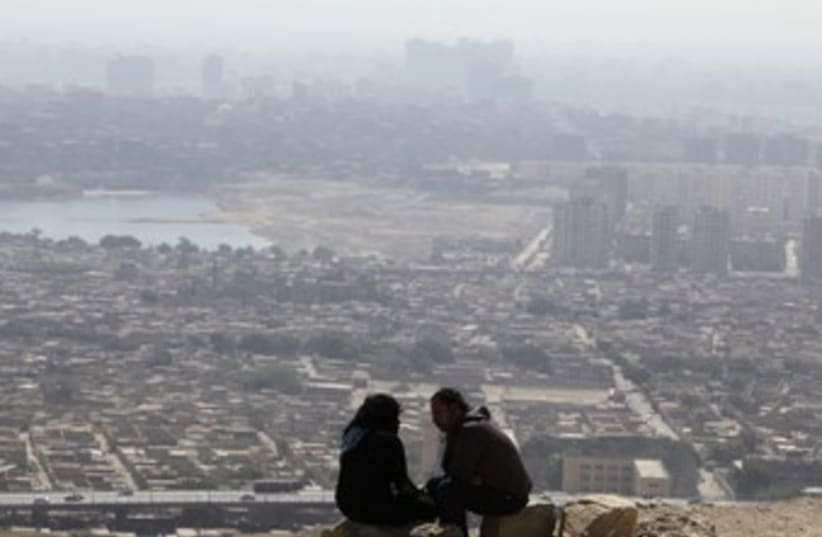
By JOANNA PARASZCZUKSmoggy-looking Egypt 370(photo credit: REUTERS/Asmaa Waguih)
Egyptian environmental and human rights activists launched a grassroots protest campaign this week against plans to construct a large-scale nuclear power plant on the country’s northwestern coast.In 1981, then-president Hosni Mubarak issued a decree to build the 55 sq.km. plant in the town of El-Dabaa in Egypt’s Matrouh governorate, as part of a push to develop the country’s civilian nuclear program.However, in the wake of the 1986 Chernobyl disaster, plans for the reactor were put on ice.Now, after years of thwarted efforts, Egypt’s nuclear energy ambitions still remain uncertain.Though the Egyptian Electricity Ministry and the Egyptian Atomic Energy Authority insist they will go ahead with the project, El-Dabaa residents and activists complain that the state has illegally confiscated land and destroyed homes in the town to pave the way for the power plant.Construction of the plant was scheduled to start in January, but was delayed following violent protests by local residents who said they had been evicted from their land.Meanwhile, international concerns about Egypt’s lax nuclear security were also raised in January, after the International Atomic Energy Agency confirmed reports that low-level radioactive material had been stolen from a laboratory at El-Dabaa.The El-Dabaa nuclear plans faced another hurdle this week, when in a united effort to combat the scheme, opponents of the power plant launched a large-scale campaign at Cairo’s Journalists Syndicate on Sunday.Present were three human rights groups: the Egyptian Initiative for Personal Rights, the Egyptian Center for Civic and Legislative Reform and Habitat International Coalition-Housing and Land Rights Network, as well as El-Dabaa Mayor Mehanna Abdel Hamid and residents of the town.Abdel Hamid called on President Mohamed Mursi to “remove the injustice” of the power plant from El-Dabaa.The mayor said that in order to build the power plant, the government had demolished 350 homes and confiscated olive, fig and wheat fields there.“The El-Dabaa nuclear project is dangerous,” he added, saying that local people were frightened about radiation from the plant.Abdel Hamid called on Mursi to implement the project in another location, such as the Red Sea area.The activists also presented a report on the plant, which they said was compiled by their own fact-finding committee. The three human rights groups accused the Mubarak administration of failing to disclose the details of the project, including its costs.Ahmed Mansour, who led the fact-finding mission, accused the Egyptian press of ignoring the plight of El-Dabaa residents while lauding Egypt’s nuclear ambitions, the Al- Masry Al-Youm daily reported.The activists have also taken their campaign online, promoting it via a Facebook page. They say the protests will continue in the upcoming months.Supporters of the peaceful nuclear program have also established a Facebook campaign. Echoing generations of Egyptian leaders, the campaign calls modern nuclear technology a source of national pride that will “place Egypt in the ranks of developed nations.”Former president Gamal Abdel Nasser established the Egyptian Atomic Energy Authority in 1955. Nasser initially pushed for the country to develop its civilian nuclear capabilities, but in the 1960s threatened to develop a military nuclear program – motivated both by intelligence that Israel was developing nuclear weapons and his own ideologies that Egypt should lead the Arab world.Egypt discarded those plans after Israel defeated it in the 1967 Six Day War. In 1968 Nasser’s successor, Anwar Sadat, signed the Nuclear Non- Proliferation Treaty, enabling the country to pursue civilian nuclear energy.Egypt currently has two nuclear research reactors.The first, a Van de Graaf type 2 megawatt reactor, is located at Inshas research facility, 60 km. from Cairo. It was built and installed in 1959 by the USSR, three years after Egypt signed a nuclear cooperation agreement with the Soviets.An Argentinean company, INVAP, installed the second reactor, a 22 megawatt ETTR-2 pool type, light water reactor, in 1997. According to INVAP, the reactor is designed for neutron physics, materials science, nuclear fuel and boron neutron capture therapy, and allows Egypt to supply domestic medical isotopes.According to a recent report by Washington-based nonprofit the Center for Arms Control and Non-Proliferation, development of civilian nuclear energy is important to Egypt, since the country’s existing power plants are unable to supply enough electricity.In 2011, Dr. Abd El Hamid Abbas El Desoky Ibrahim, head of development at Egypt’s Nuclear Power Plants Authority, said the growing demand for energy in Egypt meant the country needed to “be more concerned” with nuclear energy.Speaking at an IAEA conference on energy and nuclear power in Africa, Ibrahim said this included updating the El- Dabaa plant.
if(catID != 151){
var cont = `Take Israel home with the new Jerusalem Post Store