Airstrikes in Sheikh Zouaid follow skirmishes in el-Arish, Rafah; Amos Gilad: Egypt is acting to exert control over Sinai.
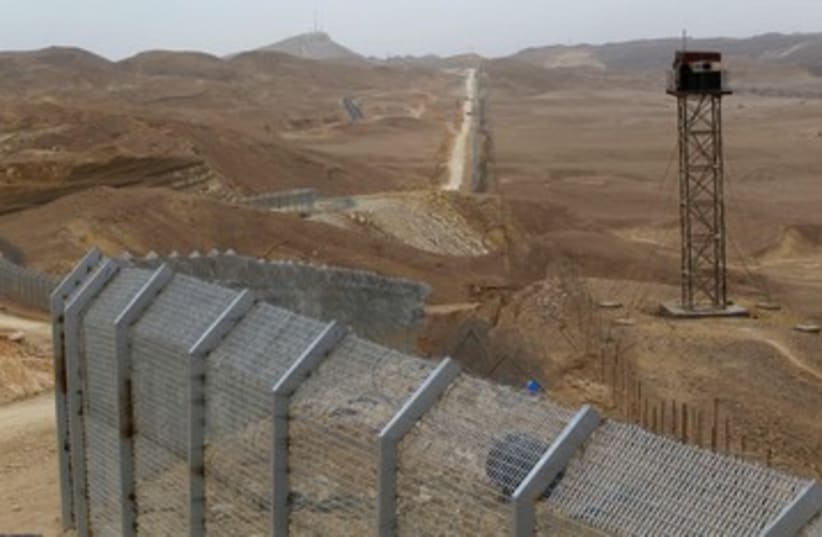
By REUTERS, JPOST.COM STAFFSinai border fence 370(photo credit: Reuters/ BAZ RATNER)
Egypt launched air strikes in the Sinai region close to the border with Israel on Wednesday, killing more than 20 suspected Islamic terrorists and marking the largest Egyptian military operation in the Sinai since the 1973 Yom Kippur War.The air strikes on positions in the town of Sheikh Zouaid followed the deaths of 16 border guards last Sunday in an attack blamed partly on Palestinian terrorists.Witnesses in Sheikh Zouaid, about 10 km (six miles) from Gaza, said they saw two military jets and heard sounds of explosions. Other witnesses in a nearby area said they saw three cars hit.The strikes followed clashes between armed men and security forces at several security checkpoints in the Sinai region.Armed men opened fire on several checkpoints in el-Arish and in the nearby town of Rafah on the border with Israel, according to a Reuters reporter and state media.A Reuters reporter said one policeman and one resident had been confirmed wounded in these attacks.Defense Ministry Diplomatic-Security Bureau chief Maj.-Gen. (res.) Amos Gilad on Wednesday expressed support for Egyptian military action aimed at uprooting terrorism in the Sinai. "If they don't remove and uproot (terrorism), it will continue to strike," he told Israel Radio following the launch of the military operation.Gilad also said Egypt is the sovereign in Sinai and does not need to coordinate with Israel on its current activities. "What we see in Egypt is a strong fury, a determination of the regime and the army to take care of it and impose order in Sinai because that is their responsibility," he said."This is an Egyptian action that is being handled by the Egyptians on the basis of the information they have," he said.Terrorism is aiming to change the world order, to harm the Egyptian regime and alter the face of the Middle East, he added, asserting that "The Egyptians have no problem understanding what's going on."Lawlessness in the rugged desert region bordering Israel has spread since the fall of autocratic leader Hosni Mubarak in an uprising 18 months ago and the election of an Islamist successor whose commitment to security cooperation with the Jerusalem has yet to be tested.One of the checkpoints attacked on Wednesday has been attacked 28 times since the uprising, the state-funded Middle East News Agency said.A few hours after the eruption of the clashes, hundreds of protesters gathered in el-Arish demanding state protection and chanting "God is Great."Security forces closed el-Arish's main highway shortly after the start of the attacks.Earlier on Tuesday, crowds of angry mourners wept at the military funeral in Cairo of the 16 guards killed in what was the deadliest assault in decades along Egypt's tense Sinai Peninsula border with Israel and Gaza.In reaction to Sunday's attacks, Egypt began to seal off smuggling tunnels into the Gaza Strip, a security source said.A Reuters reporter in Rafah said heavy equipment was brought to the Egyptian side of the tunnels, which are used to smuggle people to and from Gaza as well as scarce food and fuel for the small territory's population.
if(catID != 151){
var cont = `Take Israel home with the new Jerusalem Post Store