5 'spying settlers' to be convicted of 'war room' op
Settlers admit to running "war room" to track IDF movements in order to block any military actions to demolish illegal outposts.
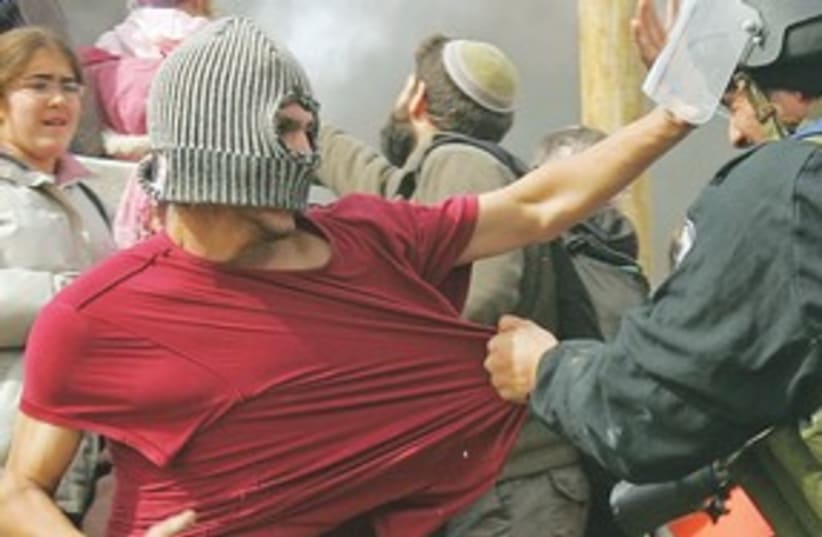
By YONAH JEREMY BOBIsraeli police scuffle with settlers_311(photo credit: Reuters)
Five “spying settlers” are to be convicted as part of a plea bargain of running a “war room” to track military movements and block any IDF actions to demolish illegal outposts, but will be given much more lenient sentences than originally expected, the state prosecutor announced on Wednesday.The actual counts that the settlers – Akiva Hacohen, Elad Meir, Ephraim Moshe Chaykin, Meir Etinger and David Eliyahu – will be charged with include: providing to others military information about the IDF, conspiracy to commit a felony, disturbing law enforcement and others.Originally, the prosecutor hoped to convict the five of spying and of masterminding and coordinating an attack against the Ephraim Brigade base in December 2011, during which 50 activists shocked the country by storming the base, attacking the deputy brigade commander, burning tires, spreading nails on a road and throwing stones and paint bottles at vehicles.Against that backdrop, the proposed sentences under the plea agreement – three to five months in prison for some of the activists and only suspended sentences and fines for others – were far more lenient than expected.Media reports expressed surprise at the lenient sentences for what many had viewed as a flagship case for the state to show toughness in the face of increased anti- IDF activity by some “price tag” activists in recent years.Asked why the sentences were more lenient than expected, the prosecutor’s office released a statement saying they had considered a series of complex factors, including the evidentiary circumstances, the expected complications in the litigation and the desire to send a clear and unequivocal message to the public that the actions were criminal and warranted a prison sentence.The settlers’ attorneys, on the other hand, said the state had seen reason, realizing it had no proof connecting the activists to the attack.According to the indictment that the settlers have admitted to as part of the plea agreement, both active soldiers from the Golani and other brigades as well as nonsoldiers passed on information to the settlers regarding military movements, via text messages and cellphones.The activists had set up a “war room” in an apartment they shared in Jerusalem, which had classified aerial maps and information about deployments and movements of troops, as well as other classified information.The men also allegedly operated a hotline for concerned activists to call whenever they saw troop movements consistent with outpost evacuations.The initiative of systematically tracking and trying to coordinate activists to block IDF actions to demolish illegal outposts began in June 2011, said the indictment.One of the men, Etinger, also plead guilty to disturbing police, when he violated the rules of his bail and attempted to resist arrest when he was caught.The incident, the most serious in a series of so-called “price tag” attacks by settlers and right-wing activists against Palestinians and the IDF at the time, came just hours after security forces evacuated about 20 activists from an abandoned building they had raided along Israel’s border with Jordan.The base was near the settlement of Kedumim.Despite not convicting the five of orchestrating the attacks on the IDF at the base, the indictment did say that the settlers’ war room was extraordinarily active during the exact time the attack was taking place and that they received reports about IDF activities from as many as 30 sources in that time period.At the time, IDF spokesman Brig.-Gen. Yoav Mordechai told Army Radio that a red line had been crossed by settlers, who he said were trying to drag the army into political affairs.Defense Minister Ehud Barak, Mordechai said, has cleared his schedule “and I expect [the West Bank settler leadership] will hear from him.”“There is no doubt that we are seeing radical actors, who have a leadership behind them – certain rabbis – who want to drag the army into political matters,” the IDF spokesman said.Yaakov Katz contributed to this report.
if(catID != 151){
var cont = `Take Israel home with the new Jerusalem Post Store