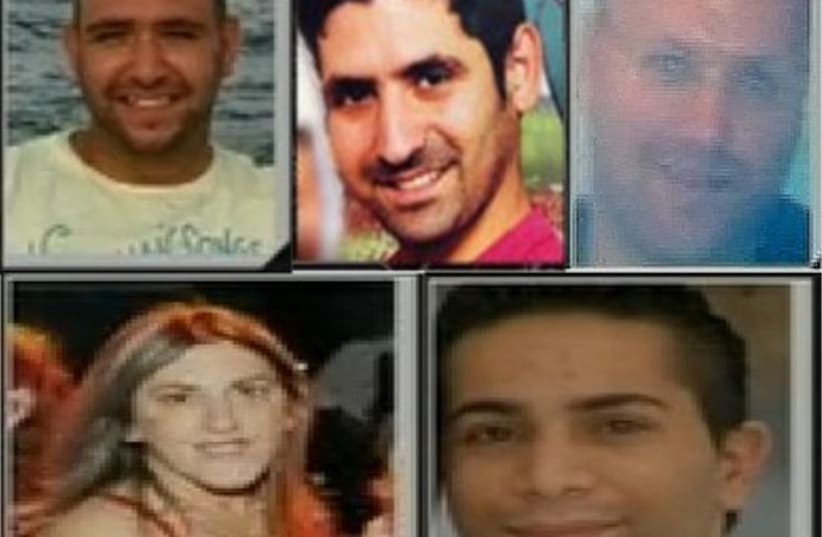
Ceremonies take place around Israel for terror victims Itzik Colangi, 28, Amir Menashe, 28, Maor Harosh, 25, Elior Price, 26, and Kochava Shriki, 44.
By TOVAH LAZAROFF, LAHAV HARKOVBulgaria Victims (370)(photo credit: Channel 10)
Victims of the Bulgaria bus bombing were buried on Friday, after their bodies were flown back to Israel by the Israel Air Force.Childhood friends Elior Price, who was a 26-year-old student, and Maor Harush, who was a 25-year-old electrician, were buried in a cemetery outside Acre.Hundreds of people, including Acre Mayor Shimon Lankari, attended each funeral.During the burial ceremony, Harush’s father broke down and called out toward the coffin, “Put me in your place.”Harush’s family members sobbed as the coffin was lowered into the grave. “You didn’t do anything. They murdered you,” said the victim’s sister.“You wrote to us from Burgas [the Bulgarian resort in which the terror attack occurred] saying that you were having a good time and that you would be back soon,” the sister said before the coffin was lowered.“You loved the sea and your friends. You loved everything you touched,” she added, before breaking down in tears.During Price’s funeral, the victim’s sister said, “Don’t worry about Yaeli, your love. We will protect her and strengthen her.”Daniel Fahima, a DJ who was also a childhood friend of the two terror victims, is in critical condition at the Sheba Medical Center in Tel Hashomer.Fahima does not yet know that his two best friends were murdered in the attack. His parents said they will notify him only when he regains some strength.Kochava Shriki, a 42-year-old woman who was in the first month of her pregnancy after years of treatment, was buried in Rishon Lezion.Shriki’s husband Yitzhak, who was wounded in the terrorist attack and searched for his wife for hours afterward, only found out she did not survive the blast after landing back in Israel. He required medical care during the funeral.Shriki’s sisters surrounded him and vowed to support him for the rest of their lives.“I found her in the end,” a broken Yitzhak said of his wife during the funeral. “Now I am taking her to her new home.”Shriki had telephoned one of her sisters before taking off for Bulgaria to notify her that she had finally become pregnant.“You called to tell me about the baby you were carrying in your womb. You were so happy then,” the sister said during the funeral.Earlier, Itzik Colangi and Amir Menashe, both 28-yearolds from Petah Tikva, were buried.Colangi’s brother-in-law said that Itzik was like his name in that he made everyone laugh.He said he was more used to giving Itzik birthday wishes and never imagined that he would eulogize him.“You innocently left for vacation and returned in a coffin.Yesterday in the airport at the state ceremony, I said to myself that only Itzik could be buried with so much emotion. You were killed the week that we mark the death of your uncle, for whom you were named,” said the brother-in-law.His brother said, “I will never forget you. You will be eternally with me.” He promised that he and the family would look after Colangi’s wife Galit and his daughter Noya.Colangi’s friends and family than marched his body in the hot sun from the small, round funeral parlor to a spot on the edge of the cemetery.After he was buried, his relatives sat on chairs or kneeled by his grave and spoke to him, as if he was still there.His funeral was followed by that of Menashe.As his body, wrapped in a prayer shawl, was brought in, his wife called out, “This is a mistake, a mistake.”“It is not logical,” she added.Someone else called out, “God, enough.”His sister eulogized him by explaining that he was always happy.“I remember the day you were born, your first steps,” she said.A friend added, “I won’t erase your number from my phone or your name from my heart.”Tovah Lazaroff contributed to this report.Click for full JPost coverage
if(catID != 151){
var cont = `Take Israel home with the new Jerusalem Post Store