Media, human rights and agendas
11/04/2012 23:13
NGO monitoring organizations and Foreign Ministry officials describe as problematic the trend for media to cover reports from human rights law organizations and officials as if they are objective.
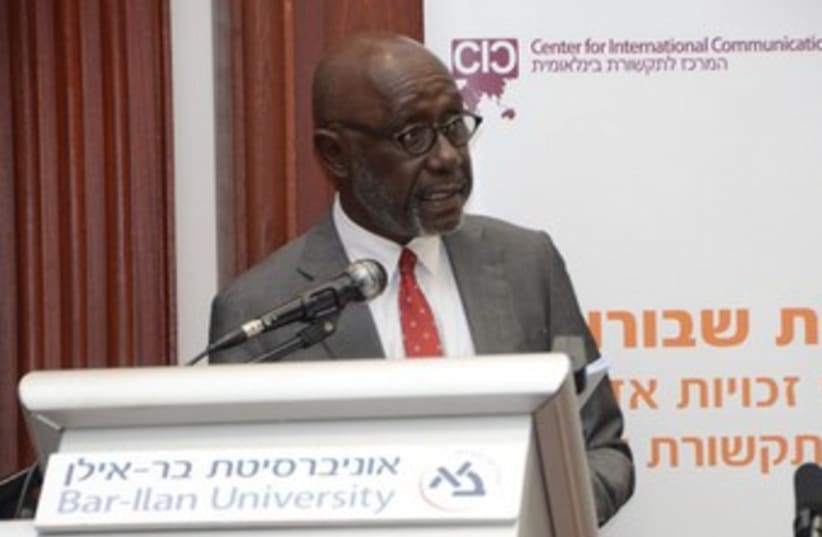
Former Amnesty International head Pierre Sane Photo: Meshoolam Levy
The trend for media to cover reports from human rights law organizations and
officials as if they are objective and have no agenda is problematic, according
to NGO monitoring organizations and Foreign Ministry officials.
The
accusations came out of Bar-Ilan University’s conference in Ramat Gan Wednesday
on human rights organizations, the media and Israel.
While praising the
honest dialogue and appraisals on both sides of the debate at the conference
itself, NGO Monitor president Gerald Steinberg said the trend is so problematic
that NGOs should have an ethical code of conduct, as the media do.
The
code of conduct should include an enforcement mechanism or ombudsman that would
combine independent observers with volunteers from the NGOs themselves to hold
them to a greater standard of objectivity, Steinberg said.
Why is this
necessary? According to Steinberg, most NGOs that cover Israel have been “taken
over by an ideological agenda.”
Despite this, he said the media do not
check the veracity of and often overly dramatize the findings of NGOs regarding
human rights law.
For example, Steinberg said the UN’s 2009 Goldstone
Report on Operation Cast Lead in the Gaza Strip was essentially an amalgamation
of reports from around 50 human rights law organizations, accepting the
organizations’ findings as objective both regarding factual and legal
issues.
While Steinberg views media coverage of these organizations as
not critical enough, he points out that at least with the media there is a
journalists association where one can file complaints.
In fact, Steinberg
said NGO Monitor has filed such complaints and they have been
adjudicated.
Daniel Meron, head of the UN and International Organizations
Bureau in the Foreign Ministry who also spoke at the conference, concurred,
focusing on noncritical reporting of UN human rights law officials.
He
noted a recent press conference given by the UN’s special rapporteur on human
rights in the Palestinian territories, Richard Falk, in which the media reported
on his statement, but did not “expose” Falk’s “hypocrisy” and
“background.”
As for that background, Meron said that Falk has shattered
any veil of neutrality by openly supporting anti-Israel divestment campaigns,
has associated Israel with Nazism, and has associated Israel’s government with
state-sponsored terrorism.
On a separate note, Meron said he found it
highly problematic that the media give so much attention to UN officials’
criticism of Israel, whereas Israel’s UN Ambassador Ron Prosor submits a
complaint after each rocket is fired into Israel, events that are generally
ignored if they are not part of a larger escalation.
Meron called on the
media, NGOs and the UN to “tell the truth,” saying that Israel gets “much more
scrutiny than the rest of the world.”
A glaring example recent example of
the phenomena could be a recent story by Ruth Pollard of the Sydney Morning
Herald covering human rights law reports on the Israeli military justice
system’s treatment of Palestinian child-offenders.
The article purports
to discuss two recent human rights reports, one by Defense of Children
International and another by a group of eminent British lawyers.
The
Defense of Children International report is entirely based on the testimonies of
Palestinian children convicted of crimes. While no justice system is perfect,
few nations would evaluate their justice system’s accepting the narratives of
those found guilty of crimes as the starting or virtually sole point of
view.
The British lawyers’ report, on the other hand, while overall not
favorable to Israel in its conclusions, cited Israeli governmental sources
alongside those of human rights law organizations, refusing in most instances to
pronounce judgment on which was correct where there were conflicting
accounts.
Thus, the British lawyers’ report cited statistics on both
sides of the argument, including noting that in interrogations in 51 criminal
cases involving Palestinian children, 48 out of the 51 interrogations were
either audio or videotaped or provided an Arabic transcript- translation to the
accused and the accused’s attorney. Of the last three, two were freed without
need for trial, and there was a mechanical failure in the third case’s recording
equipment.
Generally, the report noted that more than 70 percent of the
cases were audio or videotaped.
Despite rampant accusations in the Sydney
Morning Herald article of mistreatment of Palestinian children, it would appear
that a justice system trying to cover up abuses would not be striving for such
results in accountability.
The British lawyers’ report did not say that
Israel flagrantly ignores international law across the board, and indicated
where it believed Israel did meet international law and was making serious
efforts to do so.
Overall, the report’s criticism on this issue was that
aspirationally, the system would be better and closer to the British system if
videotaping occurred in all cases, though this is not an international law
requirement, and the report did not say it was.
This is critical, as part
of the accusation against media coverage of human rights law reports is that
both groups sometimes blur the difference between an ideal that should be
strived for and what is required to avoid violations of international
law.
This, the British lawyers’ report does not accept many
non-statistical Israeli arguments, such as the impact of anti-Israel ideology
and the hostile-environment aspect of the West Bank to Israeli law enforcement,
in making judgments, but it does not paint practices it merely disagrees with as
violating international law.
There are many such examples in the
frequently evenhanded British lawyers’ report, but none of these nuanced facts
or statistics made it into the Sydney Morning Herald article.
Rather, it
references the two reports as if they were the same, makes a conclusory
statement about a series of matter-of-fact international law violations by
Israel, and then ignores the reports, mostly telling a few stories from a third
report from the group Breaking the Silence that, like the Defense of Children
International report, is a one-sided account, although in this case the
testimony is given by approximately 30 former soldiers who, speaking
anonymously, ostensibly regret their “misdeeds.”
This returns to
Steinberg’s and Meron’s arguments in general about problematic trends in the
lack of critical coverage of NGOs, and more specifically to Steinberg’s proposal
for an ombudsman who could hold NGOs accountable for factual and legal errors,
since they are viewed as such a source of objectivity.