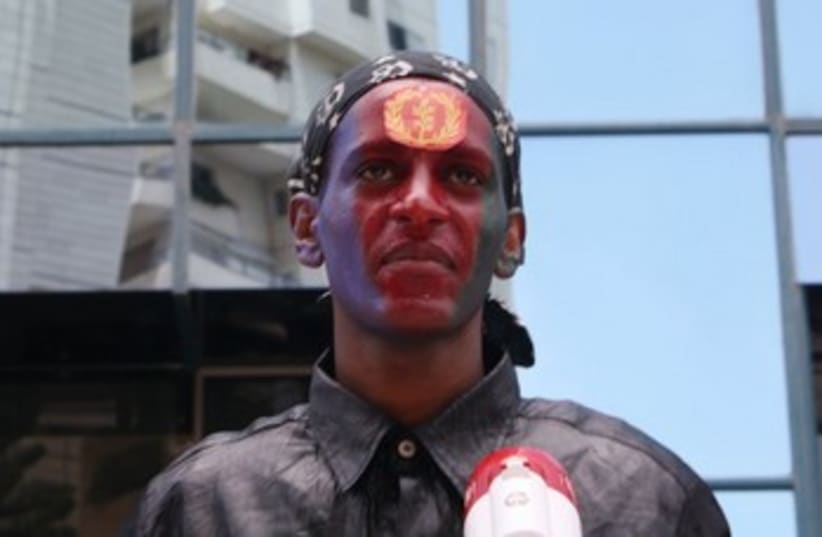
Hundreds of asylum seekers demonstrate in plea for intervention from Washington; banners read "we need protection."
By BEN HARTMANEritrean demonstrator at rally 370(photo credit: Ben Hartman)
Several hundred Eritrean asylum- seekers demonstrated outside the US Embassy in Tel Aviv on Friday, asking Washington to intervene to ease the problems they face in Israel.Carrying signs saying “No deportations of asylum-seekers” and “We need protection,” among others, the protesters said only Washington had the clout and was close enough to Israel to encourage it to accept their asylum claims and ensure their protection from violence and racism in Israel.Waving an American flag on the beachfront promenade across the street from the embassy, Eritrean activist Haile Mengistab told The Jerusalem Post that “the American government can put pressure on the Israeli government, which has stigmatized the entire Eritrean population [in Israel].”Referencing anti-migrant statements made recently by Knesset MKs, Mengistab said, “We are not cancers, we are not a national plague, we are not infected with AIDS. We want the American ambassador to help us, because they [the US] are a strong nation and they and Israel are like mother and son. They can convince the Israeli government to be hospitable to the Eritreans and give them asylum.“We’re not here to demolish Israel’s Jewish character,” he added.Eritreans make an estimated 40,000 of the more than 60,000 Africans migrants in Israel illegally. Israel cannot legally deport them to their country, because it is likely that they would face persecution.Eritrea has been ruled by a dictatorship since it gained independence from Ethiopia in 1993.Nonetheless, tension has gripped the Eritrean community in recent months, because of the escalating antimigrant rhetoric from Israeli politicians, violence directed at Africans, and recent vows by Interior Minister Eli Yishai to explore ways to deport all African migrants, including the Eritreans. Such vows come against the backdrop of the ongoing deportation of Israel’s South Sudanese and Ivorian communities, which have 700-1,500 and 500- 1,500-members, respectively.Mulugeta Tumughi, 24, said the demonstrators came to the embassy because “America is the strongest and most well-known country in world that has the power and a voice that can be heard in all of the world.”Tumughi spoke of how the US took in Eritrean refugees during the war with Ethiopia and said it could help broker an agreement to find a third country that could absorb some of Israel’s migrant population.He also spoke of recent violence against Africans in Israel, and said it no longer felt safe in the country, and that he and others were no longer confident Israel would listen to their pleas.“Israelis can help us too, but they have shut their eyes and ears to us,” he said.
if(catID != 151){
var cont = `Take Israel home with the new Jerusalem Post Store