On November 29, I realized that peace is further away from us than ever before, but we cannot lose hope.
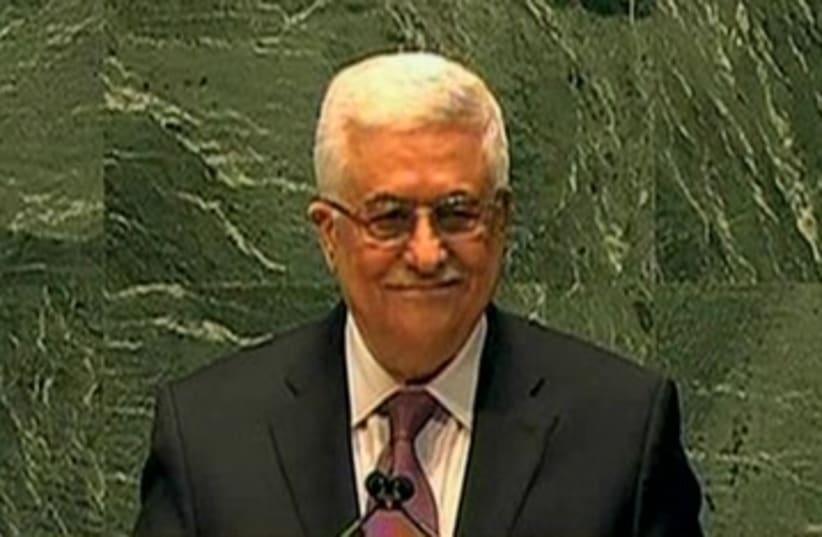
By REUVEN BEN-SHALOMAbbas at the UN 390(photo credit: Screenshot Al Jazeera)
November 29, 2012, was a very sad day for me. I was waiting for President Mahmoud Abbas to address the UN General Assembly, prior to the vote on accepting the Palestinian Authority as a “non-member observer state.”Israel strongly opposed the move, as circumventing direct negotiations is in effect negating the Oslo Accords. Also, granting the PA access to international bodies may lead to Israel’s harassment by false war-crime allegations.Quite frankly, I didn’t feel that the mostly symbolic status would have substantial negative effects. So the resolution was not what saddened me the most that day.I was hoping that the Palestinian leader would talk of reconciliation and peace. Instead I heard venomous words constructing a twisted and hateful agenda filled with false accusations.Claiming to be the sole, legitimate representative of the Palestinian people, Abbas preposterously described the latest events as a murderous spree meant to kill the children of Gaza. He did not mention the fact that Israel was defending its civilians against notorious terrorists firing thousands of rockets at Israeli cities and towns.He even brazenly claimed that Israel carried out this “barbaric and horrific” attack as a means of punishing the Palestinians for their appeal to the United Nations.Abbas slandered and accused Israel of ethnic cleansing, war crimes, racism, hatred, incitement and aggression, and called for the rescue of the Palestinian “victim” from the demonic Israeli “executioner.”It was mind boggling to hear terms connected with known Palestinian methods, used against the only democracy in the Middle East.There was nothing in his speech about blowing up buses, bombing coffee shops, or stabbing woman and children in their beds.Abbas used historical themes, promoting his ongoing narrative that the Jews have no connection to the land. At least he spared us his Holocaust theories.Abbas ludicrously described the Palestinian struggle as “harmonious” and conforming to international and humanitarian law, and even claimed that high “moral values” were upheld, all despite the “horrors” committed by Israel.In what I considered to be insinuating that terror is an acceptable tool, Abbas said that Palestinians “cling to the right to defend themselves against aggression and occupation,” and then absurdly stated that they will continue their “popular, peaceful resistance.”Peaceful. Yeah right. The audacity! In a few positive remarks, Abbas referenced the two-state solution and claimed that he did not wish to delegitimize Israel. He also expressed a need to “breathe new life into the negotiations,” and said he strove “to live in peace and security alongside the State of Israel.”Analysts on Israeli television were debating if he actually uttered the word “Israel.”It was a despicable, deplorable and contemptible speech, and supporting it by a standing ovation and approval of the resolution was shameful and hypocritical.But this was not what saddened me the most that day.Answering Abbas, Israel’s ambassador to the UN, Ron Prosor, talked about peace, good neighborliness, bonds of cooperation and mutual help. He spoke of our history and dreams for the future.It was a good speech. So what? Everybody knows that a Jewish state, with Jerusalem as its capital, existed 3,000 years ago. Listening to Abbas, one might think that the Jews came out of nowhere and stole the land from a Palestinian state. The truth is that a Palestinian state never existed.Prosor talked a lot about “the truth,” but the truth doesn’t seem to matter anymore – only artificially constructed narratives. And the Palestinian narrative of victimhood is working.We fight terror just as Great Britain, Germany and France do, but our methods are more focused at minimizing collateral damage. We use the world’s highest percentage of precision-guided munitions and achieve the lowest rate of innocent casualties.I’ve participated in endless international seminars on urban warfare, analyzing tactics, techniques, procedures and actual missions. Everyone knows how moral the IDF is.Most people know about the constant import of goods to Gaza, and that Israelis risk their lives to keep the crossings open. Israel also supplies electricity to Gaza from a power plant that is regularly targeted by Gazans.It is also obvious that with a common border with their brothers in Egypt, Hamas’s Gaza cannot be referred to as “under siege,” and the existence of the Iranian-supplied rocket stockpile clearly proves this.Contrary to Abbas’s claim to high moral values, Hamas and other terrorists use human shields, deliberately sacrificing civilians. If there aren’t enough “victims,” they stage and distort incidents or just use photos of other dead children to promote their cause. They are experts at driving the media and the international agenda, as demonstrated at the UN.It is easy to see who is the aggressor, violating all moral codes and using cowardly terror against civilians, and who is defending and protecting civilians while upholding the highest moral standards and obeying international law and norms.But who wants to see? If an Israeli child is killed, Palestinians rejoice. If a Palestinian child is harmed, Israelis regard it as a tragedy. Don’t forget who danced in the streets on 9/11.But this is not what saddened me the most that day.Listening to Abbas, I realized that he is not seeking reconciliation. It seems that he wishes to achieve internationally imposed statehood, as a phase in realizing the ultimate vision of annihilating the Jewish state.This is not a mere “territorial dispute” and has nothing to do with 1948 or 1967. They have never accepted the fact that Jews live here, and they certainly do not accept the existence of the State of Israel.So what did sadden me most that day? It was the thought that Palestinian children were listening to the speech and believing every word. It conformed to the horrific incitement they receive at school, glorifying suicide bombers and preaching the destruction of Israel. The Palestinian education system promotes and perpetuates hate and violence, not reconciliation and coexistence.So what should Israel do now? I believe we should minimize tension and refrain from harsh retaliatory measures. It is important to continue to foster good security cooperation with the PA and support their economic growth. Prosperity is a good motivator for stability.We should also carefully manage our oversensitive international relations, but consider doing what is right for Israel and not necessarily what is demanded of us.Is there still a chance for peace? The conclusion should be pessimistic, but I must say yes. Hoping and striving for peace is a moral calling for us. But peace will only be achieved if the Palestinians, as a united entity, accept the course history has taken and relinquish their dream of possessing the entire land. They must renounce terror as a means of promoting their goals, stop the incitement and commence direct negotiations with Israel.Even if all this does occur, a peace agreement must incorporate robust mechanisms and guarantees for Israel’s security, for our very existence is at stake. The last thing we need is another Iranian forward-operating- base at our door step.On November 29, I realized that peace is further away from us than ever before, but we cannot lose hope. I would say to my Palestinian neighbors: We have both suffered the horrors of war. We should let go of the past, for we have a moral obligation to build a better future.The writer is a former Israel Air Force pilot and founder of Cross-Cultural Strategies Ltd.reuven@CCSt.co.il
if(catID != 151){
var cont = `Take Israel home with the new Jerusalem Post Store