Consider This: And the centrifuges just keep on turning
The knowledge that Iran has a stockpile of 20% enriched uranium should have enraged all those who have been sitting back politely and listening to Ahmadinejad’s fairy tales all these years.
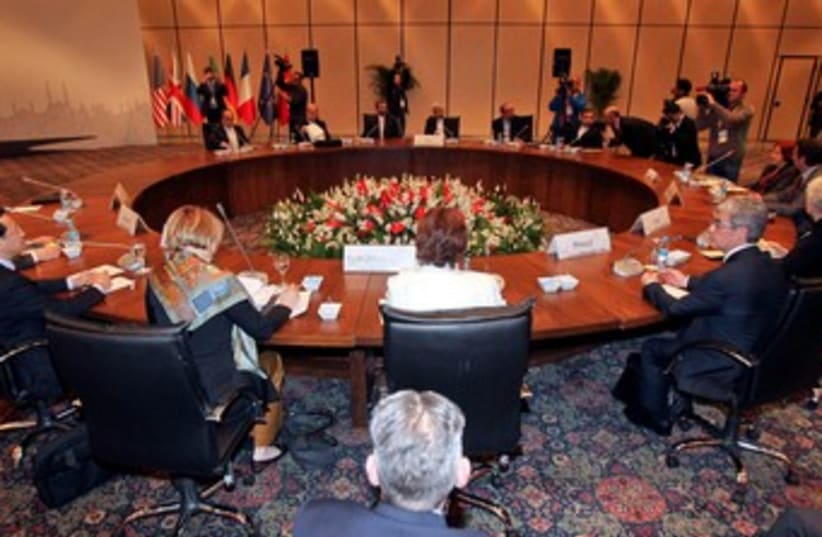
By NAOMI RAGENIran nuclear talks in Istanbul 370 (R)(photo credit: REUTERS/Tolga Adanali/Pool)
Being in my home town, New York, for the Jerusalem Post Conference was a very interesting experience.The conference speakers were all top-notch, providing many memorable anecdotes and a wealth of information.But the speech I can’t get out of my head, and which is keeping me up at night, I actually heard the day before, at the Fifth Avenue Synagogue, sandwiched between the end of the morning Shabbat service and kiddush. The speaker was Ambassador Brad Gordon, AIPAC’s director of policy and government affairs. Once an assistant director of the US Arms Control and Disarmament Agency for Non-proliferation Policy, he was responsible for all issues related to the proliferation of nuclear, chemical and biological weapons as well as the missiles to deliver them. He was also ambassador to the Conference on Non-Proliferation of Nuclear Weapons (NPT) in Geneva in 1990, and prior to that was in the CIA’s Near Eastern and South Asian office.Graying and compact, his calm demeanor belied the flabbergasting nature of his message.In short, as we in Israel merrily roll along, Iran’s centrifuges are producing uranium enriched to 20 percent – way beyond the enrichment needed for a nuclear reactor, and just a hop, skip and a jump to the 90% enrichment needed to provide fissionable material for the core of an atomic implosion bomb. While the computer bug we were all so happy about might have slowed them down slightly, the Iranians already have an enormous stockpile of the stuff.Though I hadn’t known about the stockpile, I still wasn’t unduly worried at that point in his talk. Like everyone else in Israel, I was busy telling myself that we could count on our army, navy and air force. If we had to destroy Iran’s nuclear capabilities before they did any harm, well, so be it. Our government, especially headed by no-nonsense, security-minded Binyamin Netanyahu, would absolutely step up to the plate, whatever the diplomatic cost – right? After all, we’d done it twice before.Well, it’s not that easy, according to Gordon.Unlike the attack on Saddam Hussein’s reactor, Ahmadinejad had numerous secret facilities, one of them underneath a mountain.That’s when I started to get really nervous; nervous enough to do some of my own research.Michael Rubin, writing in Commentary last February, was also aware of the mountain, but unlike me it didn’t worry him: “It would suffice to destroy the entrances and exits to such facilities.” But he was worried – very worried – about some other things I hadn’t even thought of, as was Bret Stephens of The Wall Street Journal, who wrote in his column this past February: “Put simply, an Israeli strike on Iran would not just be a larger-scale reprise of the attacks that took out Iraq’s nuclear reactor in 1981 and Syria’s in 2007. On the contrary: if it goes well, it would look somewhat like the Six Day War of 1967 and if it goes poorly like the Yom Kippur War of 1973. Nobody should think we are talking about a cakewalk.”Rubin not only agreed, he thought Stephens didn’t go far enough: “Even if Israeli pilots managed to fly into Iran with surprise, they would not be able to fly out with surprise… This means they would have to strike enemy airfields, surface-to-air missile batteries, command and control centers, and radars… more than 1,000 sorties.”Most alarming, even if Israel were to succeed in knocking out the spinning centrifuges and the weapons and missile factories, given the determination of the present insane regime, they’d be up and running again in six months, tops.SO, WHAT exactly are our options here? Before we can discuss that, let’s analyze how much time we have to dither before making a decision.The Wisconsin Project on Nuclear Arms Control, a non-profit and non-partisan organization based in Washington, believes that “the best way to stop the proliferation of weapons of mass destruction is to do so at the source: to cut off the supply of material, equipment and technology.” It has been monitoring Iran carefully and publishing its findings on its website, Iran- Watch, from which I learned the following astonishing information: Based on facts supplied by the International Atomic Energy Agency, Iran has already stockpiled enough low-grade enriched uranium to fuel five nuclear bombs. All it needs to do is put what it already has back into the appropriate spinning machines until it’s been purified to 90% from the present 20%.By the way – and not that anyone is interested – the knowledge that Iran has a stockpile of 20% enriched uranium, far past the 3.4% enrichment needed for peaceful purposes like, say, a nuclear power plant, should have enraged all those who have been sitting back politely and listening to Ahmadinejad’s fairy tales all these years.You need about 16 kilograms of 90% enriched uranium (or U-235) to produce a nuclear implosion bomb. But, if you were so inclined, you could create a bomb with only seven kilo if you were satisfied with one “only” slightly less effective than the kind dropped on Hiroshima. So, how long would it take, given what we know the Iranians already have, for them to produce that amount? According to Iran Watch, “time needed to convert this low-enriched uranium to one bomb’s worth of finished uranium metal enriched to 90 percent U-235 [that’s assuming they want the big 16-kilo one]: 3-12 months.” But, for the puny little Hiroshima- type bomb… well, you do the math.Thus, as we Jews and Israelis and decent human beings all over the world, including our children and grandchildren, lie in our beds naively asleep, Iranian centrifuges, like the wheels of the trains to Auschwitz, are turning and turning. They are making it possible for the man who has just called Israel a “pesky mosquito” and who denies the Holocaust to prepare a new one. In a month and a half, based on what the IAEA actually knows for sure, he can have a nuclear bomb. And I’d be willing to bet that the IAEA doesn’t know the half of it.What then of negotiations? Sanctions? Well, the problem with negotiations is that the present framework is simply not addressing the scope of the problem. Negotiations that took place in April between the Iranian regime and the US, Russia, China, Britain, France and Germany focused on what compromises could be reached to allow sanctions to be lifted against Iran. The conversation seems to be about getting world powers to recognize Iran’s right to enrich uranium to 3.5%, the power reactor level. Since it has already stockpiled enough uranium enriched to 20% to blow up the entire world – a bomb for the capital city of each of the negotiators – it’s hard to see how these talks can bear any fruit worth eating, except for Iran.For as the powers talk and talk and eat their dinners and fly around the world in business class, the centrifuges under the mountain are spinning and spinning. We shall not even mention the satellite photos of the cleanup underway at the secret Parchin military site to hide the evidence of what apparently was the use of an explosives containment chamber of the type needed for testing nuclear arms. Even the IAEA is upset about that. In fact, it’s even convincing the unconvinceable that Iran’s nuclear aims aren’t peaceful. As for the sanctions, you can read on Iran Watch how the US isn’t able to enforce them.So, my friends, what is the answer? Well, as far as time is concerned, we’ve basically run out. As far as bombing the nuclear facilities, I’m afraid surgical strikes that take out a few of the thousands of centrifuges hidden all over the place won’t do the trick either. The only real, long-term solution to an enemy as determined and genocidal as the present Iranian regime under Ahmadinejad is regime change.It’s something the Iranian people seem to want. It’s something the entire world needs to ensure its safety. And it’s something the Israeli people cannot survive without. The price will be brutally high, but the alternative is unimaginable.
if(catID != 151){
var cont = `Take Israel home with the new Jerusalem Post Store