Terra Incognita: Too many Israeli human rights or social causes boil down to a cult of personality.
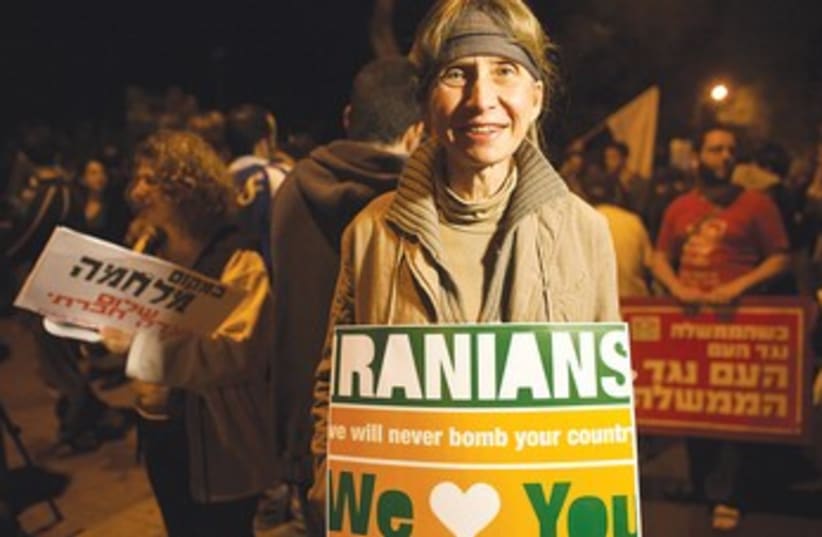
By SETH J. FRANTZMANIsrael-Loves-Iran campaign in Tel Aviv 370(photo credit: Nir Elias/Reuters)
Last week Meir Javedanfar, a lecturer at IDC, posted a link to an article about Ronny Edry and Michal Tamir, founders of the “Israel loves Iran” campaign.Javedanfar related a story about sitting at a Mexican restaurant when he saw a face he recognized. “It was Ronny Edry himself, having lunch with his family... [he] was being followed by a camera crew.”The way the author goes weak-kneed, one might assume Edry was a celebrity. That camera crews were following the celebrity might make us think that Edry has accomplished some great deed, like finding a cure for cancer. But all Edry did was make a poster. So why the hero worship? The story of Edry and Tamir’s “Iranians, we love you: We will never bomb your county” campaign is emblematic of a larger pattern in Israeli society.Ostensibly the campaign was launched at the height of fears about a war with Iran in March. The two Israelis, who are married, decided that using their graphic design skills they would try to encourage a more positive image of the Israeli-Iranian relationship. But very quickly it was clear the campaign was dominated primarily by Edry and Tamir. Their faces were in fact the faces used on some of their initial material.And it’s far from the only such case. In fact, almost every Israeli human rights or social cause boils down to a cult of personality similar to the “We love Iran” campaign.Is there an Israel Committee Against House Demolitions without Jeff Halper? Is there a social justice movement without the great leader Daphnie Leef? From 1998 to 2010, at the height of its media hype, Rabbis for Human Rights was dominated by Arik Ascherman.Take for example the Quaker American Friends Service Committee “Profiles in Peace” publication. It highlights people, not organizations, it thinks are responsible for creating peace. After listing such Palestinian peacemakers as Azmi Bishara, Hanan Ashrawi, Huawida Arraf and Naim Ateek it lists the Jewish winners such as Uri Avnery (founder of Gush Shalom), Eitan Bronstein of Zochrot, Nurit Peled-Elhanan of Parent’s Circle, Neta Golan of ISM, Yehudit Keshet of Machsom Watch and Yehuda Shaul of Breaking the Silence.This small partial list is just one example of the personality- centered nature of human rights work and social activism in Israel. Unlike in some countries where large, established human rights organizations are important regardless of (or in spite of) the individuals involved, in Israel most organizations are almost one-man bands.The Israeli organizations function this way not only because they are small; there is a conscious effort on the part of Israeli activists to found new organizations and go their own way.For instance, ICAHD was founded by Halper and Ascherman in 1997, but Ascherman became the executive director of Rabbis for Human Rights in 1998 (he had been co-director since 1995). PCATI’s (the Committee Against Torture) staff member Eliahu Abram was formerly a leader in HaMoked. Gila Svirsky, who serves on the board of B’Tselem, is also a co-founder of Women for a Just Peace. Yesh Din was founded in 2005 by members of Machsom Watch. Prof. Kenneth Mann, an academic, not only serves as chairperson of the board and legal advisor of GISHA (Freedom of Movement) but also as chairman of the board of We Are Refugees.The celebrity-style narcissism displayed by so many of Israel’s human rights activists not only begs questions about whether the focus on the individual hampers their effectiveness, but also raises the issue of whether human rights and social activism work in this country is primarily a vehicle for employment and self-aggrandizement.Do people start human rights organizations because they want to be active in human rights work or because of a cynical desire to become famous? It certainly does not appear that these individuals are modestly trying to make their organizations the center of attention.One of the most gratuitous examples is the way the organization We Are Refugees presents itself. It was initially co-founded by Itamar Mann (it is unclear if he is related to Prof. Kenneth Mann, who serves on the board of We Are Refugees) but he went off to Yale after receiving a Bernstein Fellowship in 2010. In 2012 it appeared Mann was still active in the US, although this time he was involved in speaking about the “one state solution” at a conference at Harvard.With the departure of Mann, We are Refugees fell into the capable hands of Iftah Cohen and Omer Shatz. Shatz, a former academic colleague of Mann, and Iftah had been active in providing legal assistance to Gaza flotilla activists in 2011. In 2012 they joined a petition against giving pardons to people who had protested the Disengagement from Gaza. When the Supreme Court struck down the petition, they complained to The Jerusalem Post; “Israeli democrats and humanists will not find salvation in the Supreme Court, and with the direction they see this country is taking, in the near future they will ask for refugee status abroad.”Yet Cohen and Shatz didn’t request refugee status abroad, instead going on to champion the supposed refugee status of African migrants, a cause célèbre in Israeli society. This would all be well and good – if the campaign wasn’t run in such a way as to primarily bring attention to Cohen and Shatz.The main explanatory material on their webpage is a beautifully designed PDF document called “This is how we look.” The second page of the multi-page document shows a photo of three men. Two of them are white and are identified as Iftah and Omer and in the middle is a black man with a big red arrow pointing to him indicating that he is “dry fact.”Below is the explanation: “Meet Iftah Cohen and Omer Shatz, two energetic 32 year olds. They are lawyers who represent refugees and asylum seekers. Between the two is KM, who fled a West African country and ended up in an Israeli detention center. Omer and Iftah found him there...,” etc.On succeeding pages are more photos of Africans, sometimes identified with arrows as “dry facts,” and a page showing Africans standing huddled in a line with arrows describing them as “we are refugees.”The carefully crafted, slick presentation provides a hierarchy of humanity. At the top is the chairman of the board, Kenneth Mann, who gets a whole page to himself, and then board member and famed author David Grossman, who gets another page. Then there is Iftah and Omer, the hero-lawyers who find and save the Africans. And at the bottom are the “dry facts,” the Africans. The English and Hebrew Facebook groups are replete with posts about “attorney Omer Shatz of We Are Refugees” giving quotes to the media.More disturbing is a post on We Are Refugees’ English- language Facebook on September 2 showing a pretty advertisement explaining “Things we did last week. On Monday morning Iftah and Omer drove to Ktziot prison. During the day they met with seven inmates. A young woman... a 17-year-old boy who...has the most eloquent Hebrew, a real pleasure to listen to... and for dessert we have two youngsters from Ivory Coast.”Read that again. “For dessert.”Are they comparing Africans to a seven-course meal? On the Hebrew Facebook page is a giant photo of Jews boarding cattle cars, evidently during the Holocaust.One wonders, though: If two American lawyers named Bill and Fred had founded a group to help Jewish refugees in 1941, would those Jews have wanted to be described as “dry facts” so that Bill and Fred could raise awareness and donations to help them? We Are Refugees posts things about the Holocaust in order to make us think that deporting Africans is similar to sending Jews to the camps, but it also begs the question: What is this campaign really about? Bringing glory to four Israelis or saving thousands of refugees? If it were about the Africans, would the campaign focus so much on explaining that “on Monday morning Iftah and Omer drove to Ktziot prison,” or would it focus on the victims and the organization’s overall goals? THE PERSONALITY cult of Israeli human rights organizations is one of their defining qualities, distinguishing them from robust and effective organizations abroad such as Amnesty International and the ACLU. Even social activism abroad, like America’s Tea Party and Occupy Wall Street, were known for their goals, not their leaders – or lawyers.However in Israel you just aren’t somebody unless you have created your own NGO. The human rights industry is dominated by just a handful of people, some of whom are family members, and many of whom work together in related fields. The concentration of wealth, the nepotism and the egocentrism in this small human rights fraternity harms the effectiveness of their work. It is no surprise that among the NGOs one won’t find too many Sephardi, Ethiopian or Russian Jews, or Jews from poor backgrounds.People, and foreign government funds that increasingly provide support, should consider before donating whether they are merely providing welfare for several wealthy, connected Israelis who have founded an NGO that puts them at the center of attention, or if their money is going to a real cause.For instance, are the lawyers and advisers working pro-bono for their NGO, or are they receiving a lucrative payday? The NGO may not release documents detailing employee salaries, and the websites of many Israeli NGOs notoriously lack transparency; it is important that donors ask critical questions.IN THE case of Haiti, we can see the dangers too much attention on the leader and not enough on the goal causes. Hip-hop celebrity Wyclef Jean has been shown by the New York Times to have used his charity, Yéle, for personal gain. An audit of the organization found that it paid “Mr. Jean $100,000 to perform at a Yéle fund-raiser in Monaco,” and the charity paid Jean $37,000 to rent his recording studio. Half the money the charity spent in 2010 went to travel, salaries and consultant’s fees.Returning to Israel, we should consider that sitting outside the prime minister’s residence for the past several months have been several lonely Ethiopian Jewish protestors trying to highlight racism. They evidently don’t have connections to David Grossman and they don’t have slick brochures.Israelis don’t find them interesting because there is no great leader to focus on; no one from the right side of the tracks to present as a spokesman. That is Israel’s tragedy.Prospective donors shouldn’t compound the problem but should encourage transparency, goal-oriented programming and clean transitions of power every few years.
if(catID != 151){
var cont = `Take Israel home with the new Jerusalem Post Store