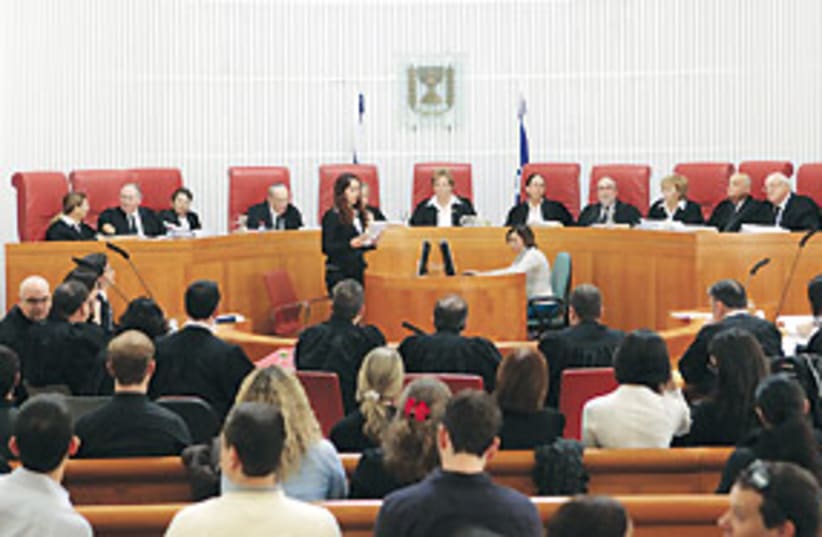
The court signaled, more unmistakably than ever, that it is climbing down from the everything-is-justicable philosophy.
By JPOST EDITORIALhigh court panel citizenship law 311(photo credit: Ariel Jerozolimski)
The High Court of Justice last week vehemently rejected a petition against granting the Israel Prize to Shimon Mizrahi, legendary chairman of Maccabi Tel Aviv’s basketball club.This wasn’t the first time the Israel Prize was contested before the High Court, nor was it the first time the court declined to intervene. What made the latest decision memorable was the sharply worded arguments that underpinned the ruling.Three Hapoel fans had petitioned the High Court, claiming a conflict of interest because the blue-ribbon panel that picked Mizrahi included Tal Brody, a past Maccabi Tel Aviv basketball star.The three justices – Asher Grunis, Edna Arbel and Hanan Meltzer – did more than just reject the petition.Grunis lamented the fact that “as sure as Independence Day rolls around each year, so it is sure that petitions would be lodged with this court against the choice of Israel Prize laureates. It is impossible in this country to receive a prize without this resulting in litigation. This is more in the realm of social psychology than of jurisprudence.”Thus the court signaled, more unmistakably than ever, that it is climbing down from the blanket everything-is-justiciable philosophy that prevailed during the court presidency of Aharon Barak.It was during the Barak years (1995-2006) that our High Court achieved its dubious reputation for ultra-intervention.In the words of Robert Bork, one of America’s prominent critics of judicial activism, “the pride of place in the international judicial deformation of democratic government goes not to the US, nor to Canada, but to the state of Israel.”IN HIS book Coercing Values: The Worldwide Rule of Judges, Bork argues that, “Israel has set a standard for judicial imperialism that can probably never be surpassed and one devoutly hopes will never be equaled elsewhere.”But without fanfare, Israel may be ever-so-slowly turning the corner. In this context the Mizrahi judgment constitutes a noteworthy landmark.The floodgates were flung wide by the court itself in 1997, when it referred the decision to confer the Israel Prize on Ma’ariv editor Shmuel Schnitzer back to the awards committee, which then predictably backtracked.Schnitzer was disqualified because of one op-ed – in a prolific 59-year career – in which he warned against the high incidence of HIV among the Falash Mura. From that precedent onward, petitions proliferated.In another controversial case in 2008, when the choice Prof. Ze’ev Sternhell – one of the bluntest spokesmen of Israel’s far Left – was contested, the court ostensibly refrained from interfering but its position was deemed political. Sternhell had recommended storming Ofra with tanks and advised the Palestinians to direct terror attacks only against settlers.But Grunis significantly focused on the justiciability issue. The High Court, he maintains, mustn’t butt in except in very rare cases – for instance, ones involving corruption.A glut of litigation will only chip away at the prize, undermine the court’s prestige and confer specious validity on begrudging narrow-mindedness.He adds: “Laureates find themselves on the defensive, as if accused of a felony, and are forced to hire legal services.”Indeed the court imposed a NIS 40,000 fine on the petitioners, half of which will compensate Mizrahi for his court expenses.The philosophy of limitless justiciability, reckons Grunis, “might well lead to a situation whereby nobody in Israel would be considered worthy of the Israel Prize.”Allowing anyone to preoccupy the court with frivolous petitions, “which must be addressed posthaste, robs the court of valuable time and forces it put on hold scheduled cases which ought to be accorded priority.”Here Grunis touches on the sensitive issue of the petitioners’ standing. Barak allowed almost anyone to appeal almost anything, even without meaningful personal involvement or sufficient connection to the case at hand.This permitted a rash of petitions about generalized or presumed grievances.The court went on to laud Mizrahi’s “voluntary work and high standard of quality management in Israeli sports.”We agree with Justice Meltzer’s bottom line: “Let potential petitioners learn two lessons: 1. Begrudging isn’t obligatory and, 2. Leave the Israel Prize and its laureates in peace.”It’s about time.
Related TagsAsher Grunis
if(catID != 151){
var cont = `Take Israel home with the new Jerusalem Post Store