Among the must-have remedies is more competition for the IEC. Only if more electricity producers emerge, will there be incentive for the IEC to improve its act.
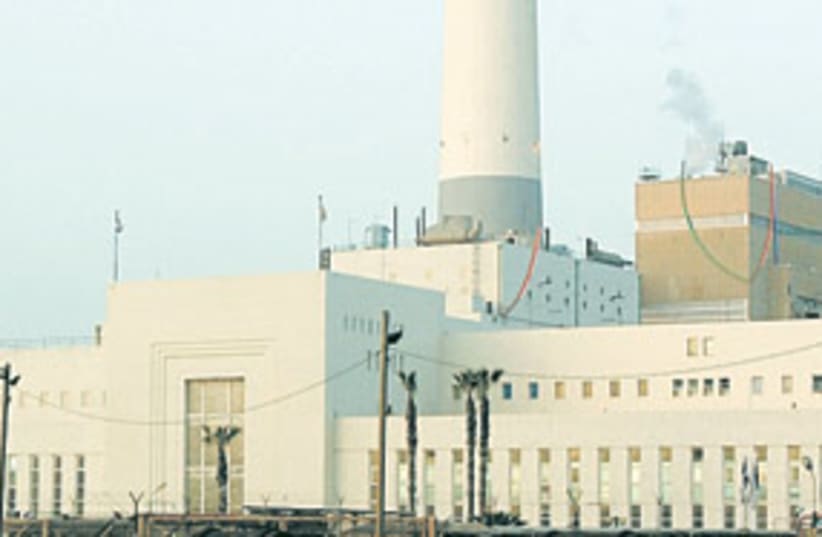
By JPOST EDITORIALreading power station 311(photo credit: Yossi Weiss)
Woe to ordinary individuals audited by the taxman if enigmatic gaps are discovered in their paperwork. But when the Israel Electric Corporation manages to mysteriously lose NIS 1.4 billion down its administrative labyrinth, it can simply increase the burden on already overburdened consumers or demand more outlays from the Treasury, thereby indirectly putting the bite once again on hapless taxpayers.The IEC’s persistent pattern was just repeated. The government has caved in to pressure and will give an additional billion shekels in new guarantees to the corporation to help it cover the shortfall. This represents a steep increase beyond the NIS 5.5b. already guaranteed this year. Without this, warns the utility, it would be unable to purchase all the fuel essential for electricity generation.The likelihood, though, is that IEC will be forced to put up assets as collateral. The company tenaciously holds on to lucrative real estate around the Reading Power Plant in north Tel Aviv and to its outdated, no longer functioning compound in central Tel Aviv.Some of the causes for the IEC’s growing deficits are clear. The cutoff from Egyptian natural gas supplies and the need to rely on far costlier fuels are incontrovertible and continuing drains on resources. The trouble, though, is that the public had already paid for that and keeps on paying. It also pays when oil prices rise. Therefore, attempts to recurrently hike fees while citing the identical pretexts are more than a bit suspicious.Something is very wrong in the IEC’s management and this extends far deeper than objective difficulties which nobody disputes. The IEC upper echelon pledges to conduct exhaustive investigations and complains about criticism already leveled at it before its probes had gotten off the ground. But the critics aren’t unfair. The “disappearance” of colossal sums isn’t an incidental accounting oversight.No matter how it’s eventually explained, the IEC’s acute financial crisis betokens either lack of transparency or outright failure to put in place elementary controls and fail-safe mechanisms that are easily available in our hi-tech environment. This is simply something which should not happen in a properly run establishment, particularly one dependent on the public coffers.The episode has sent the Finance Ministry into a veritable tizzy. The Accountant-General’s Department fears that higher guarantees will negatively impact Israel’s credit rating. The IEC’s debt – a whopping NIS 70b. – is already the state’s second-largest, outdone only by the government itself. In other words, this is extremely serious and dire business, as very distinct from the prices of cottage cheese or eggs.The Treasury is in a bind. The incumbent government cannot afford electricity supply issues pre-election.Moreover, its political prospects can only be damaged by another fee hike, especially hot on the heels of a scathing state comptroller’s report which took IEC to task for, among others, dubious bookkeeping to conceal a NIS 2.1b. stash for the anyhow overpaid employees.None of the prodigiously promised reorganization moves has yet been put in place. The IEC continues to pay the highest average salaries in Israel (NIS 21,000 monthly per employee). An IMF comparative study found the IEC’s salaries higher by 4 percent than in all other countries included in the survey. The “misplaced” NIS 1.4b. was incidentally located in a fund to bankroll future employee perks.There is much amiss when a gargantuan concern that can’t make ends meet also refrains from reforming itself. The IEC should be required to prove that it hadn’t actually colluded in defrauding the public. In a more ideal world taxpayers might rightly expect to be reimbursed, yet brazenly the IEC is intent on collecting more from us.Among the must-have remedies is more competition for the IEC. Only if more electricity producers emerge, will there be incentive for the IEC to improve its act.Some major firms like Azrieli and Strauss have already disconnected from the grid and switched to alternative power suppliers. Licensing procedures must be streamlined for private operators. Yet above all else, the message to the IEC’s top executives should be that none of them is irreplaceable, even when indispensable services are involved.
if(catID != 151){
var cont = `Take Israel home with the new Jerusalem Post Store