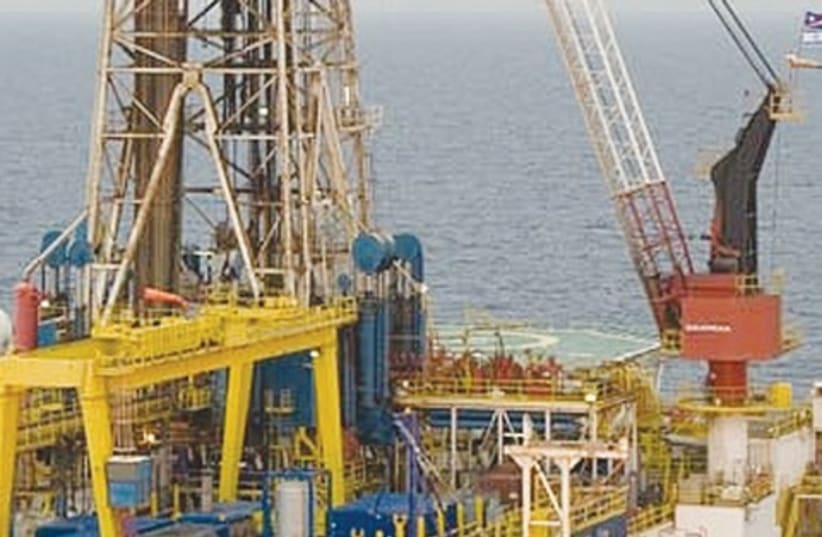
Geophysics researchers find natural active gas springs leaking on Haifa Bay sea floor, scientists don't yet know if gas is usable.
By SHARON UDASINTamar(photo credit: Courtesy)
While drilling companies focus on extracting natural gas buried deep in the Mediterranean’s core, a geophysics research team from the University of Haifa has discovered a series of active gas springs leaking on the Haifa Bay sea floor.The springs are located at relatively shallow depths, just a few dozen meters below the surface of the seabed, the researchers learned in their study, which was recently published in the journal Continental Shelf Research.After examining a sea floor map of Israel’s northern coast, the researchers first identified that there might be springs in the area, according to the university.A joint effort with the Israel Oceanographic and Limnological Research Institute then ensued, revealing around 700 spots in the floor that might be gas springs.Seismic data also showed that there were pockets of gas located beneath the seabed, university information said.“This is a natural laboratory for researching gas emissions from the sea floor – natural springs and less natural ones,” said Dr. Uri Schattner of the Leon H. Charney School of Marine Sciences at the University of Haifa, who led the research. “We are only beginning to understand their contribution to climate and ecological change.”With all of this evidence, the researchers then took to the sea – exploring four times to collect data from both on and below the floor. There, they found a gas deposit of 72 square kilometers on the continental shelf, in areas with water depths of between 37 and 112 meters, 10 meters below the sea floor. There is essentially a “cloud of gas” in the water, and then most of the gas is in pockets that extend up to 10 meters below the sea floor, in the mud, Schatter told The Jerusalem Post on Thursday.“It’s something you overlook because normally you go to the deep sea,” he said.Although deep sea drilling can cause these types of gas leaks and these have occurred in other parts of the world, the drilling in the Mediterranean did not cause these springs, which are, in fact, natural, according to Schattner. While the researchers know that there is plenty of gas down there, they do not know exactly what kind of gas it is.Thus far, scientists have no idea if this new gas will be useable, as they first must trace the source of the gas, Schattner explained.“I don’t mean only where does it come from in the subsurface, but what processes formed this gas – is it biogenic, is it thermogenic, does it say something about a very deep oil reservoir, or maybe it just comes from layers that are very rich with organic material,” he said.No matter what type of gas it is and where it comes from, however, “Its role in undermining the stability of the seabed is clear,” said Dr. Michael Lazar, a member of the research team.“This means that any discussion of marine infrastructure development must seriously relate to this shallow gas stratum,” Lazar added.The existence of this deposit becomes especially critical as the Energy and Water Ministry formulates a National Master Plan to deal with the transmission of natural gas from their deep-sea drilling sites to their pressure-reducing facilities, which will be located on the continental shelf, the researchers explained.“Now we are beginning to understand that there is no substitute for thoroughly researching the stability of the sea floor to prevent an infrastructure failure, since any leak could cause an ecological disaster,” Schattner said.There are many different causes of instability on a sea floor, but shallow gas is certainly one of them, and can have a significant impact on designing infrastructure and determining financial factors like insurance, Schattner explained.“Just think about building a hospital on quicksand,” he said. “It’s something that should be taken into concern and as we speak we are in conversation with the Energy and Water Ministry. They know about our work and we know about their concerns.”
if(catID != 151){
var cont = `Take Israel home with the new Jerusalem Post Store