Trilateral agricultural development project seeks to eradicate hunger by providing farmers with technological know-how.
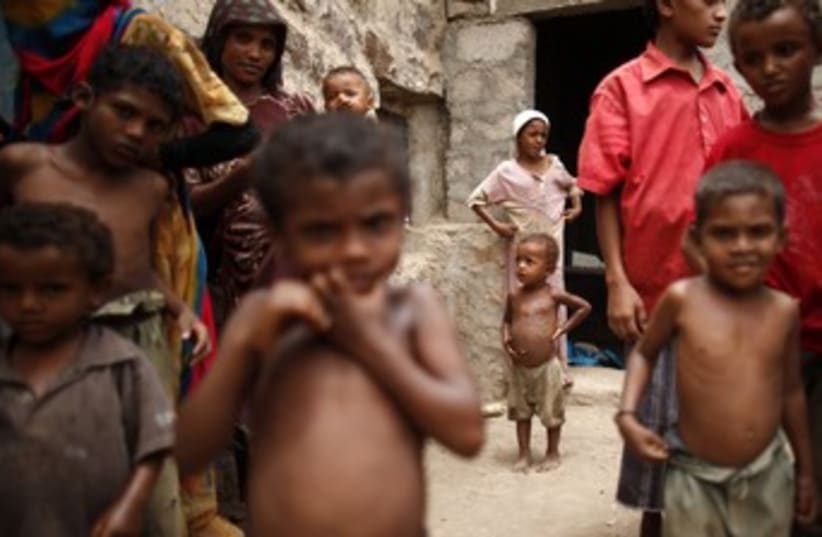
By SHARON UDASINchildren suffering from malnutrition 370(photo credit: REUTERS/Khaled Abdullah Ali Al Mahdi)
Italians and Israelis are working together to eradicate Senegalese hunger and poverty in a trilateral agricultural development project formed between the governments in recent weeks.An expansion of a project that the local Israeli Embassy launched in Senegal in 2006, the program aims to provide the country’s poorest farmers with the technological know-how for integrating irrigation technologies as well as the requisite management systems to keep them going, according to Prof.Dov Pasternak, the visionary behind the program.The bodies responsible for carrying out the program include the National Agricultural Research Institute of Italy, the National Agricultural Research Institute of Senegal, the Senegal Extension Service, the Senegal Project for Rural Development and MASHAV, through the Center for International Agriculture Development Cooperation (CINADCO).Prior to expanding to a trilateral governmental project just a few weeks ago, the program was a branch of the larger pan-African Techno- Agriculture Innovation for Poverty Alleviation (TIPA) program – administered by MASHAV, the Foreign Ministry’s agency for international development cooperation.Prior to being acquired by MASHAV, the program was called African Market Garden, developed by Ben- Gurion University’s Institutes for Applied Research in collaboration with the Netafim Company in 1999.“This is an interesting successful model that can be duplicated with adjustments to many countries within the region,” said Ilan Fluss, the director of policy planning and external relations at MASHAV.Fluss was speaking at a session on “Strategies for Development Assistance to or for Drylands” at Drylands, Deserts and Desertification – The Fourth International Conference: Implementing Rio+20 in the Drylands, held at Ben-Gurion University’s Sde Boker campus on Monday.Senegal is located in the Sudano Sahel region south of the Sahara, which is delineated by the 300-800 millimeters of rainfall that it receives annually, according to Pasternak.“It is also the poorest region on Earth,” he said.The farmers predominantly use an agro-pastoral subsistence system, in which farmers grow grains and staple crops during the short rainy seasons and animals then graze on crop residues.“People eat what they produce.They sell very little,” Pasternak said. “They don’t have any resources. So when production fails, people go hungry.”Without the means to purchase food and with ancient soils leeched of nutrients, the Senegalese small farmers need an irrigation solution that is practical for them, according to Pasternak. A drip irrigation system and its accessories act as the foundational “hardware” for this solution, with accompanying management packages serving as the “software,” he explained.Under the African Market Garden and then under TIPA, farmers in Senegal piloted four different systems for irrigation – the first being the “thrifty system” that uses 200-liter barrels for irrigating an area of 80 square meters and the second being a “commercial system” that provides water through larger reservoirs to four 500 square meter units.The first was deemed to have little economic advantage, and the second only proved useful among educated professional farmers, Pasternak said.The third mechanism – a “cluster system” – involves a number of 500-1,000 square meter plots concentrated in one field, but with individual farmers operating their own plots, fertilizer tanks and taps. This system was particularly beneficial among male farmers, whom researchers found very difficult to organize into a solid team. On the other hand, a fourth “communal system” was effective among women, who thrived on having their own plots of land concentrated in one field but their irrigation monitored by an overarching manager, Pasternak explained. Already having formed solid community groups in many places throughout Africa, female farmers benefited from such a system where they worked together with each other and could even afford to take off time from their farms after giving birth, he added.In all of Africa, there are currently 10 TIPA sites. In Senegal, two governmental organizations called ANIDA and PRODAM have already installed 900 hectares worth of drip irrigation systems for farmers, and an international NGO called World Vision is installing about 500 more hectares conforming to the TIPA model, Pasternak said.A Millennium Village program is overseeing 1,000 additional hectares of TIPA projects in two regions of Senegal, and now this official trilateral government cooperation is guiding the formation of 400 hectares in three Senegalese regions, Pasternak explained.“We are going to supply all the know-how,” he said, stressing that a service center will be at the heart of the program, in order to provide training, follow-up, demonstration and market support.Integral to the program in Israel’s mind is not only assisting Senegalese farmers but also strengthening relations with Italy, Fluss said.“This will hopefully become a model for trilateral cooperation between two donor countries and a developing country,” he added.“Cooperation with Italy is really important and the discussions were extremely productive.”To ensure that such a model is successful, however, he stressed the importance of tackling the challenges posed by adapting modern technologies to the needs of farmers in developing countries.“The role of donor is taking the smallest, the poorest and even the medium-sized, show the technology, pay for this, using them as demonstration and then more or less through osmosis the technology spreads,” added Dr. Riccardo Morpurgo of the Italian Foreign Affairs Ministry.“And while it’s spreading, it is also modified.”Most importantly, farmers must receive the know-how and then continue to have follow-up sessions and learn to employ effective management strategies, according to Pasternak.“It looks like in the near future hundreds of thousands of farmers are going to benefit,” Pasternak said.
if(catID != 151){
var cont = `Take Israel home with the new Jerusalem Post Store