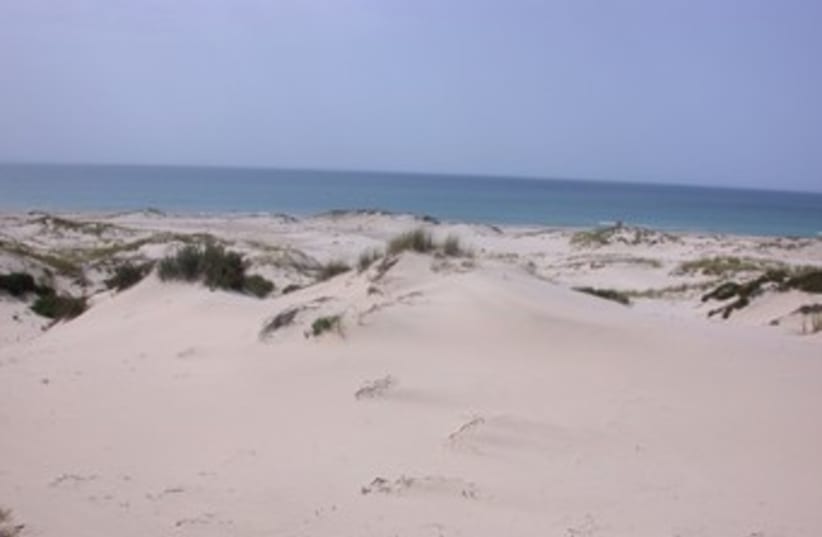
Nine-year-old battle rages over proposal to develop resort complex on site north of Ashdod.
By SHARON UDASINPalmahim Beach 370(photo credit: SPNI)
The Central District Committee for Planning and Building decided on Monday to consider transforming the controversial Palmahim Beach, linked to the kibbutz of the same name, into a national park, pending further action within the National Council for Planning and Building.The fate of Palmahim has been up in the air since 2004, when developers first signed an agreement to build a resort complex on the beach side only to be confronted by environmentalists and residents who were up in arms.In an effort to facilitate a final decision, the district committee sent a request to the National Council for Planning and Building on Monday, asking that the office rezone the area from tourism and recreation land to national park land, under Tama 13: The National Master Plan for Israel’s Coast, the Interior Ministry said. The district committee has also requested that the Tourism Ministry cancel the construction of a resort village, approved in accordance with Tama 12: The National Plan for Tourism, the Interior Ministry said.The district committee is to publish an order that no permit for building a resort village on Palmahim Beach can be issued during the coming year until a final decision on the land’s status is made, the ministry added.The initial agreement was made between the developers – the Evelon Group and Maoz Daniel – on July 5, 2004, according to an official overview of events drafted by Israel Lands Authority legal adviser Dror Aharoni. As part of the agreement signed between the developers and the ILA, the former paid NIS 8 million for the use of the land, and agreed to begin work no later than April 21, 2007 – a deadline that was quickly extended by two years, Aharoni wrote.On November 18, 2009, however, the State Comptroller’s Office published a report slamming the establishment of a resort village on Palmahim.The report called upon planning authorities to reexamine the project, in light of the passage of time, as well as enforcement both Tama 35: Integrated National Master Plan for Construction, Development and Preservation in 2005 and the Protection of the Coastal Environment Law in November 2004 – limiting building within 300 meters of the sea, Aharoni said.Meanwhile, 2010 brought with it massive public protest against the construction plans, resulting in Erdan joining the local residents and bringing the issue to the government’s attention.In response to the public unrest and the state comptroller’s determinations, the government decided on July 11, 2010, that the planning institutions must reevaluate the plans.In compensation for their losses, the developers have demanded an exemption for the years they owned the land, as well as the contractual compensation agreed upon, including a full return of expenses from the date of publication of the tender. Among these expenses are the salaries of the developers, and the financing for the project, as well as full protection against claims of third parties contracted by the developers, Aharoni wrote.Additionally, the developers requested compensation on the basis of their expected profits from the project. Aharoni noted, however, that despite explicit requirements, the developers have yet to present evidence of all their expenses and damages, beyond what he described as a “nominal amount” of NIS 39 million.Since December 2010, legal negotiations have been taking place, leading to an agreement by both sides to participate in an arbitration process, the legal adviser said. In agreeing upon an arbitrator, the parties decided that this person would not, however, be hearing claims about expected profit loss, said Aharoni.Back and forth exchanges of arbitration agreement drafts continued and led to a meeting at the State Attorney’s office in January 2012, during which the developers revealed their readiness to agree to proposed compensatory terms, he wrote.Yet when the ILA sent a final version of the arbitration agreement to the developers on April 25, 2012, the recipients rejected the version and thereby ended negotiations, Aharoni said.On December 26, ILA director Benzi Lieberman, wrote to the District Committee for Planning and Building, requesting a progress report on the arbitration process. This request has not yet been answered.While the developers of the project had claimed that the planning institutions and the Israel Lands Authority were excluding them from all discussions regarding the site’s future – including in a conversation with The Jerusalem Post on January 3 – the Environmental Protection Ministry stressed that this has not, in fact, been the case.“It is easy to see that the detailed document completely refutes the developers’ claim that we didn’t conduct negotiations with them over the past two years,” a statement from the Environment Ministry said.“It should be emphasized that those who chose to ‘blow up’ the negotiations… are actually the developers themselves.”The uncertain project was returned to the Central District Committee for Planning and Building beginning last month – a step that rattled environmental activists fighting the plan since the outset.In late December, the Society for the Protection of Nature in Israel (SPNI) launched a campaign calling upon Erdan and Prime Minister Binyamin Netanyahu to maintain their promises of preserving Palmahim. Together with other environmental organizations, such as Adam Teva V’Din (Israel Union for Environmental Defense), Green Course and others, SPNI has been able to acquire nearly 7,000 supporting signatures through the Hasdera website.Attracting politicians from the entire political spectrum, Palmahim Beach saw advocacy campaigns from Tzipi Livni and head of the Green Movement Prof. Alon Tal, on the first day of January.Just a day later, the Israel Nature and Parks Authority (INPA) and the Environmental Protection Ministry presented a plan to the committee’s steering board that called for transforming the entire Palmahim area into a combination of nature reserve and national park.Prior to Monday’s meeting – which ran overtime – Adam Teva V’Din stressed that “not only is there no legal obstacle in canceling the plan,” but that there is a legal obligation to the public to do so.After Monday’s decision to move forward with determining whether the transformation to national park land is possible for Palmahim, Adam Teva V’Din representatives said it viewed the steps taken as positive.In response to this latest decision, the developers have pledged to take the matter to the courts.
if(catID != 151){
var cont = `Take Israel home with the new Jerusalem Post Store