Canada to invest $5m. over course of three years, while Israeli government will allocate resources based on the specific needs.
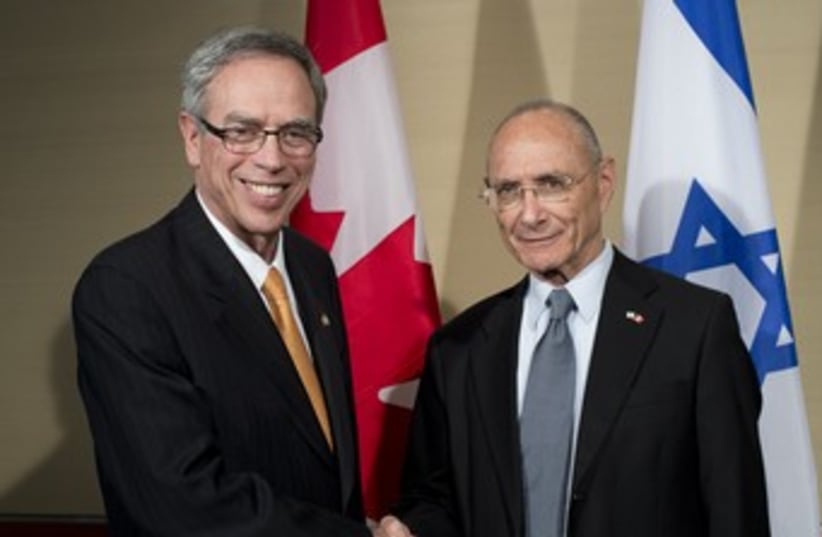
By SHARON UDASINEnergy, Water Minister Uzi Landau, Canadian counterpart 370(photo credit: Courtesy of Water and Energy Ministry)
In order to broaden the cooperative work on energy between Israel and Canada, ministers from both countries announced on Monday that they would be establishing a joint fund for bilateral research in the field.Energy and Water Minister Uzi Landau and Canadian Natural Resources Minister Joe Oliver made the announcement at a Monday Israel-Canada business seminar in Toronto, the Energy and Water Ministry reported on Tuesday. For its part, Canada will be investing $5 million over the course of three years in the fund, while Israeli government will allocate resources based on the specific needs of each project, according to the ministry.“Canada is a close friend of Israel, and we see in it a natural partner in the effort to develop natural resources,” Landau said. “Between the countries is a long-standing relationship that is warm and strong and based on beliefs and values. The new fund will contribute to the economic advancement of two countries and help strengthen ties between the business sectors.”Through the fund, the two countries aim to promote research and development in the energy field, as well as encourage innovation, improve competitiveness and productivity and enhance the quality of life of residents of both places. As per the agreement, the projects that will win financing will be those conducted by industry, as well as others from the academic realm, the ministry said.During an interview with The Jerusalem Post in Jerusalem this June, Oliver had stressed the importance of future collaborations between the two countries, in both the traditional and renewable energy fields.Specifically, Oliver pointed to Canada’s wealth of experience in offshore drilling and extraction of non-conventional oil, and Israel’s status as a “hotbed of innovation.”In June, both Oliver and Landau had promised that there would be more bilateral agreements between the two countries moving forward, particularly in the energy sector.Now, the two ministers are aiming to make this initial pledge a reality.“Together, we will find new ways to enhance the scientific capabilities of the two countries, and thus make a significant contribution to their residents,” Landau said.
if(catID != 151){
var cont = `Take Israel home with the new Jerusalem Post Store