Animal rights group campaigns against vineyard fencing
Says some species of gazelles will be more susceptible to predators, with narrower access to open areas.
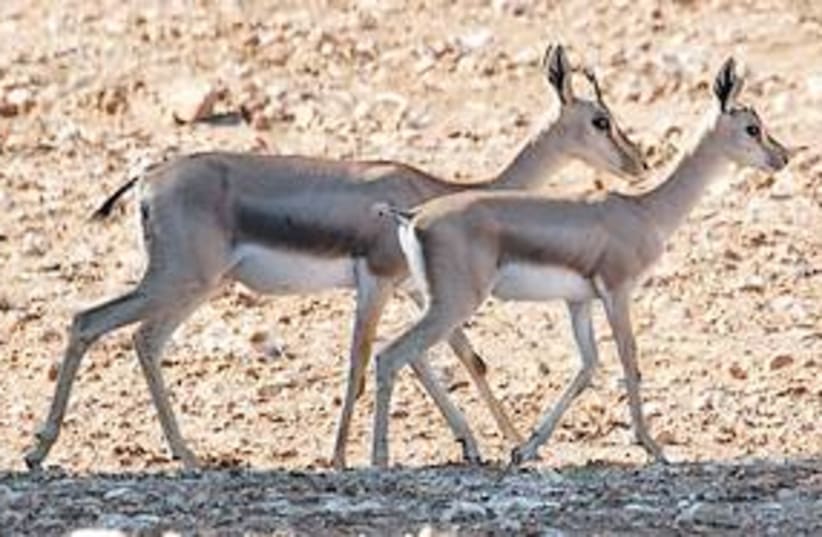
By SHARON UDASINgazelles 311(photo credit: Dov Greenblat/SPNI)
From the window of a pickup truck rumbling along a rocky dirt path and into the forest toward Har Adar, a giant statue of a gazelle came into view.“We’re afraid that this is the only thing we’ll have left,” Amir Balaban, ecologist and director of the Jerusalem Bird Observatory of the Society for the Protection of Nature in Isral, told The Jerusalem Post during a journalists’ tour of the area on Tuesday.In the distance and below the Belmont Castle area of the Crusaders and Castel National Park were in full view, as was a brand new concrete development coming from the Kiryat Anavim community and hillsides of new wineries, surrounded in barbed wire fences.The Society for the Protection of Nature in Israel (SPNI), along with an NGO called Let the Animals Live, has launched an ongoing campaign to stop the vineyard owners Barkan Wineries – from erecting fences around their grapes, which while protecting the fruit from hungry gazelles, also pose a danger to these animals and others, according to the organizations.In very recent weeks, as the wineries themselves are quite new, 16 kilometers of fencing have been laid in the Beit Nekofa and Arazim Valley areas, both located outside Jerusalem and near Abu Ghosh, a spokesman from SPNI explained. About 455 dunams of land are fenced in at Beit Nekofa, and another 150 dunams are similarly enclosed at Arazim.“SPNI is gravely concerned that fencing off some 600 dunams of previously agricultural open space obstructs the ecological corridor completely, posing a serious threat to native gazelles and many other species that live in the region,” the spokesman said in a statement.“With nowhere to run, gazelles are also falling more easily to hunters and predator species.”After examining other vineyards that were built some time ago with fences, Balaban said that SPNI experts observed “a change in the natural habitat,” a phenomenon they fear will occur here.Along the dirt road, Balaban pointed out how now both sides of the path are lined narrowly with vineyard fences.“The gazelle can only pass through here – so the hyenas and jackals know that,” Balaban said. “They have no choice – they have to pass through.”And while most pass through at night, a few gazelles were actually trotting along the road below that morning.“When a gazelle runs he runs instinctively – he simply runs,” Balaban reminded the tour group, noting that they oftentimes get injured just by running into the fencing.“The main thing is that around the world, this conflict is very known, and there are lots of solutions that don’t include this kind of harmful acts toward the animals,” Yonatan Shpigel, an advocate for Let the Animals Live, told the Post. “Here in Israel there was no discussion, no discourse – nothing. We just woke up one morning to find all these harmful objects to all the animals and to the area.”Some alternatives, according to Balaban, would be protecting individual plants with plastic barriers, or planting new, additional food sources in the area that might attract the gazelles away from the grapes.Leaders from the two groups said they met with Barkan CEO Shmuel Boxer, but received no direct response, and also unsuccessfully tried to get answers from Barkan parent company Tempo, so they will now be reaching out to international umbrella organization Heineken.
In a statement to journalists, Barkan answered that concerns regarding the wineries in the mountains near Jerusalem must be directed to the Beit Nekofa moshav, and that Barkan Wineries are simply contractors of the area, which has in the past featured olive groves that were completely consumed by gazelles. The company also said that planting vineyards in the area has been coordinated with all related bodies, including SPNI, and that the Agriculture Ministry has approved the fencing except for an area of 20 dunams. Within that area, the Barkan statement explained, experiments are being conducted to try to prevent gazelle attacks in ways beyond using fences.“If the trial does not succeed and all will be eaten by the gazelles, the Agriculture Ministry and legal bodies will pay for all the damages caused by the gazelles and the area will be newly fenced and planted,” the statement said.After hearing this response, the SPNI spokesman said in a statement that their organization had never agreed to any such fencing.“We regret that Barkan Wineries, the beneficiaries of the products of the vineyards, prefer to spin the responsibility onward – to the growers – instead of adopting an approach that takes the environment into consideration,” the spokesman said.
if(catID != 151){
var cont = `Take Israel home with the new Jerusalem Post Store