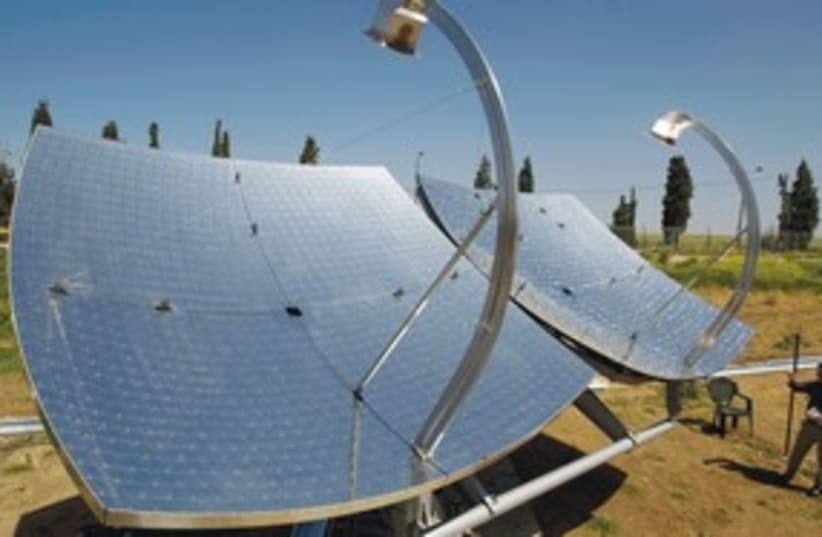
Installation of solar power systems on J’lem roofs begins
Despite acknowledged high installation costs on 48 roofs, the investment should return on itself within 10 years, development company says.
By SHARON UDASINSolar Panels 311(photo credit: REUTERS)
Installations of NIS 35 million worth of solar systems have gotten underway on the roofs of 48 capital city schools and community centers under the administration of the Moriah Jerusalem Development Company, the group announced on Monday.Despite the acknowledged high installation costs, the investment should return on itself within 10 years, and Moriah has a contract with Israel Electric Corporation for 20 years, the company said.
Thus far, the schools whose systems have already been installed include Denmark, Keshet, Beit hinuch, Gymnasia, Geulim, Paula Ben-Gurion, Darchei Noam and Neurim. All of the schools will integrate the new solar systems into their studies to enrich their knowledge of the field of renewable energy, according to a statement from Moriah.“We are talking about a ‘green’ project that improves the environment and man,” the statement said. “The production of electricity by means of solar systems doesn’t pollute or harm the environment and is completely friendly to the people in surrounding areas.”Once completed, the system is expected to generate about 2.5 megawatts of electricity per hour, and each relevant building will receive a monitor to display the mechanism’s real-time performance, according to the company.While three solar firms have won tenders to provide the actual photovoltaic systems to Moriah, the first of the three to work on the project so far has been Inbar Solar Energy, the statement said.“The solar panels significantly reduce the use of electricity that is produced by polluting means and therefore will contribute to the reduction in quantities of greenhouse gas emissions,” said Naomi Tsur, deputy mayor for planning and environment, also in the statement. “Remember, the city of Jerusalem signed the Forum-15 pact, which requires it to reduce emissions by 20 percent by the year 2020. Our role as a city is to do all that is possible in order to bring us to this destination.”Forum-15 is a group of 15 of Israel’s most populous and developed cities, all of whom signed an agreement on February 13, 2008 to meet the aforementioned standard, according to the organization’s website.“Moriah is committed to protecting the environment and is determined to promote green projects, to improve quality of life for residents of the capital city,” said Alex Weisman, CEO of Moriah.“We are happy that this important project is underway and hope to bring it to completion as soon as possible, for the benefit of the capital’s residents.”While about 25 of the school and community center roofs are already completed and connected to the grid, the rest should be completed by mid- September, and the company meanwhile is in the process of getting approval to begin an additional 40 in the beginning of 2012, Weisman told The Jerusalem Post on Monday evening.“I think it’s the biggest project in a municipality in Israel – it’s going very fast,” he said.“We started in July during the school vacation and promised we would finish it before the beginning of the educational year, and we are on target.”
if(catID != 151){
var cont = `Take Israel home with the new Jerusalem Post Store