Israeli scientists help farmers with micro-climates
Researchers use satellites to detect small-scale variations in temperature which could lead to improved yields.
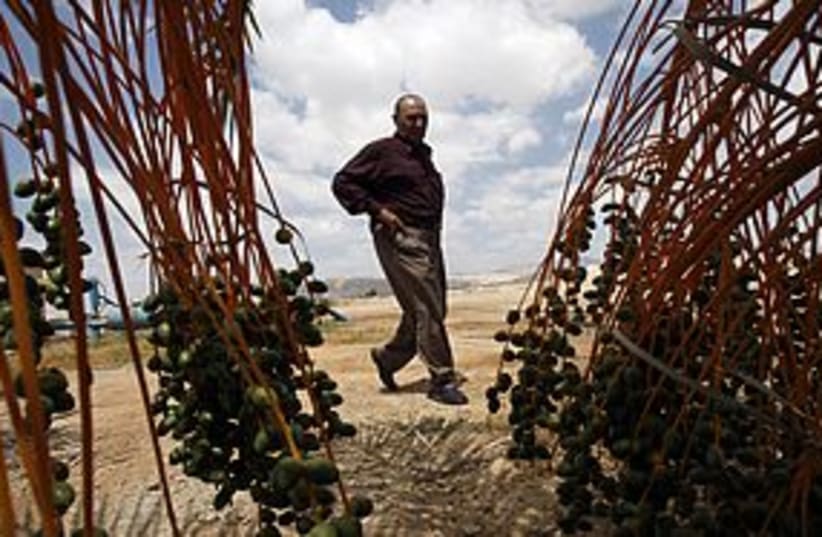
By DAVID ROSENBERG / THE MEDIA LINEpalestinian date farmer 311 REUTERS(photo credit: REUTERS)
Conventional wisdom says that Israel’s Mediterranean coast north of Haifa has a single climate. An area of only about 100 square kilometers (40 square miles), it experiences hot dry summers and cold rainy winters, like most of Israel, while all year round it’s bathed in a sea breeze.But that’s not the case at all. Its terrain ranges from 200 meters below sea level to mountain tops some 1,200 meters high. Those hills and valleys turn the area into a patchwork of miniature climate zones that have a major influence on how quickly crops grow and when infestations of pests, weeds and disease are likely to occur.RELATED:Palestinian farmers hawk wares at Israel agricultural fairAll’s well that ends well? Chasing W. Bank water piratesUntil now, those kinds of risks were either unknown or unmanageable because conventional meteorology looks at climates over very wide areas. Now, however, thanks to satellite technology and a means to analyze it developed by two Israel scientists, farmers can find the micro-climates on their land plan accordingly.“You can seed two fields a very short distance from one another at the same time. But if you have even a 40-centimeter difference in the height of the crop the result can be very different,” said Itamar Lensky, on the faculty of Bar-Ilan University near Tel Aviv and one of the two scientists to develop the new system. “The farmer may think he has a problem with irrigation or with pests, but in fact it may just be the different climate.” For farmers, the ability to identify the micro-climates could lead to big improvement in yields and go a long way toward feeding a world struggling to produce enough food for a growing population. Some 40% of the world’s harvests are lost to pests and disease, whose damage would be reduced using crop chemicals and fertilizers more effectively. Lensky and his colleague, Uri Dayan of The Hebrew University of Jerusalem, developed the system for identifying micro climates by taking data collected by the US National Aeronautics and Space Administration’s (NASA’s) Terra satellite. Launched a decade ago, the satellite collects data on the earth’s changing climate. Lensky and Dayan took 10 years of Terra data for northern Israel’s Mediterranean coast and used mathematics to break it down into temperature-based climate zones of as little as one square kilometer, based on local topography. That’s one-tenth to one-twentieth the size meteorologists conventionally examine, and Lensky says he hopes to reduce the area even more in the future. They call these micro-climates “topoclimates.” Even slight variations in temperature have a major effect on the lives of plants and cold-blooded animals such as insects. Unlike humans and other mammals, they are at the mercy of the temperature because their bodies can’t regulate it internally. Armed with maps showing these topoclimates, a farmer can, for instance, plant one field later than another, knowing that slightly favorable growing conditions will ensure it reaches harvest time earlier than other fields. It will also enable growers to cooperate to ensure better yields. Topoclimate maps would enable Farmer A, for example, to learn that his tomatoes are endangered by pests coming from a corn field owned by Farmer B because the map identifies conditions in the fields as an ideal breeding ground for them. In times past, growers might have been instinctually aware of these minute changes in their land because they sowed and harvested small areas by hand. “Today, when farms are large-scale and farmers use machinery, the farmer needs more help to manage his land, and to know why one place gives you one result and another place something different,” Lensky told The Media Line. Lensky and Dayan’s research is due to appear in the Bulletin of the American Meteorological Society shortly. They will be putting it into practical use on a trial basis in northern Israel by next year. To bring it into use worldwide would neither take very long nor involve much money, Lensky said. Topoclimates may one day give environmental scientists greater insight into global warming, but it will have to wait until the Terra satellite has been in orbit longer. The Intergovernmental Panel on Climate Change, the leading international body for reviewing and assessing scientific information on climate change, requires 18 years of data as the minimum.
if(catID != 151){
var cont = `Take Israel home with the new Jerusalem Post Store