The Friday Interview: Taking a gamble on Hapoel Jerusalem
New coach Guy Goodes admits there are many uncertainties but still expects success.
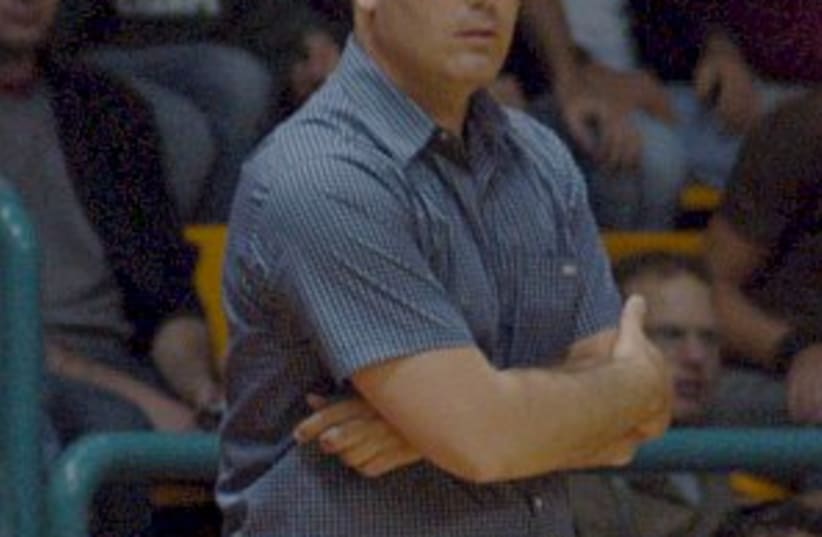
By ALLON SINAIGoodes 298.88(photo credit: Blake-Ezra Cole)
Only time will tell if Guy Goodes made the right decision by becoming Hapoel Jerusalem coach when the only thing the club can guarantee him is uncertainty.
With Arkadi Gaydamak no longer financing the team, Hapoel's budget next season will likely be almost half of what it was of late, but the level of expectation has remained unchanged.
The current situation means Goodes has to work miracles if Jerusalem is to repeat its recent success and live up to the reputation it has built as the only real alternative to Maccabi Tel Aviv in Israeli basketball.
After two consecutive second-placed finishes, last season Hapoel ended in sixth place, not even qualifying for the season-ending Final Four tournament.
Hapoel's situation is so delicate that Goodes is building the team without even knowing what he has to work with, as even he is still in the dark on the eventual size of the State Cup holder's budget.
"There's a lot of uncertainty surrounding the team," the former Maccabi Tel Aviv assistant coach, told The Jerusalem Post this week.
"I don't know what the budget will be yet. I don't know if we have enough money to keep hold of the players with big contracts and at the moment we're just taking one day at a time. Right now I can't tell you if I've got two or four million dollars to work with. I'm also waiting for answers."
Despite all the difficulties, the 37-year-old Goodes is remaining positive and believes he can still guide the team to success next season.
"Hapoel chairman Danny Klein is known as a man who eventually manages to raise money and build a good team. My job is to find the players within the budget I'm given," Goodes said.
"You can't lower the level of expectation at Hapoel. The team's goals haven't changed.
"The budget isn't the only factor in building a successful team and we are working very hard so that we make the right decisions and select the right foreign and Israeli players. Regardless of the amount you pay the players you still have to find the right people to build a winning team."
Goodes' talent as a basketball player was evident from an early age and he made his top-flight debut for Hapoel Haifa in 1986 when he was 15.
In 1990, the playmaker moved to Maccabi Tel Aviv and, despite suffering a devastating injury in each of his knees, became a yellow-and-blue fan favorite in his seven years at the club.
Goodes won seven championships and three cups with Maccabi and also played in Spain and Italy during a long career.
After announcing his retirement he became assistant coach at Rishon Lezion in the 2004/05 season .
Midway through the season he replaced head coach Hanokh Mintz and in the following season, which was his first full campaign at the club, he led Rishon to third place in the BSL.
After achieving such success at Rishon, Tel Aviv brought him back to the club as assistant to Croatian Neven Spahija and, despite the many changes at the head coach's position at Maccabi in the last two years, Goodes remained as assistant until the end of last season.
"My years as an assistant coach at Maccabi gave me a great deal," he said. "I improved and learned a lot at the club.
"A year at Maccabi is like 10 years at another team. There were amazing times and tough times, which every coach must experience during his career.
"You actually learn the most when the going gets tough. I gained a lot of experience during my time in Tel Aviv and I believe it will prove valuable in the future."
The signing of Effi Birenboim two weeks ago as Maccabi coach and his wish to bring in his own assistant left Goodes with no option but to leave.
Besides Jerusalem, Bnei Hasharon and Rishon were also keen to get their hands on Goodes, but he always felt that Hapoel was the club for him.
"It's nice to be sought-after, but it doesn't really mean anything," Goodes said modestly.
"I think Jerusalem was the best option for me. If I succeed at Hapoel my career will receive a massive boost. My success is the team's success and vice-versa.
"I will work very hard so that we do well. It wasn't difficult for me to accept Jerusalem's offer and I was never concerned to join the team in its current state. I like challenges as they just spur me on."
Goodes only signed a one-year contract at Hapoel, but said he doesn't believe the length of his deal implies anything on his eventual stay at the club.
"I don't believe in signing long-term contracts," he confessed. "If everything goes well and both sides are pleased than they will likely want to continue to work together. If both sides aren't pleased with each other than a long-term contract won't help.
"Oded Katash, for example, had a three year contract at Maccabi and was gone after six months."
Despite the financial struggles and the fact Jerusalem is still waiting to hear whether it will receive a wild-card into the ULEB Cup, Goodes remains hopeful and is already working around the clock, looking to achieve success once more.
"There's a lot of uncertainty regarding the ULEB Cup. Nevertheless, we're building a roster for two games a week," Goodes said.
"We'll have between eight and 10 players, but at the moment I really can't say how the team will end up looking.
"There's a lot of uncertainty, but there's no shame in working in uncertainty."
if(catID != 151){
var cont = `Take Israel home with the new Jerusalem Post Store