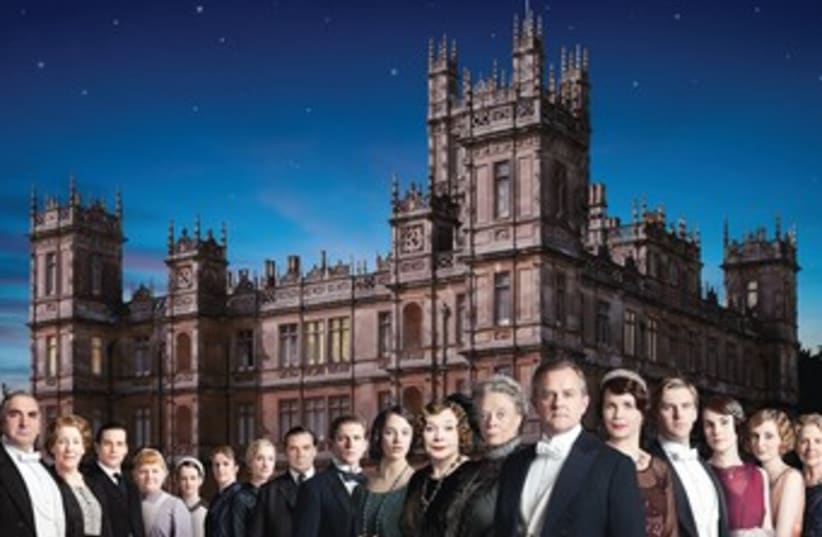
England’s Highclere Castle, the real-life Downton Abbey, has a past that’s every bit as colorful and riveting as the hit Masterpiece series filmed within its walls.
By DIANE W. STONEBACKDownton Abbey(photo credit: MCT)
England’s Highclere Castle, the reallife Downton Abbey, has a past that’s every bit as colorful and riveting as the hit Masterpiece series filmed within its walls.Besides serving as the main set for the hit PBS series that recently premiered its third season, this imposing landmark and the land it occupies has been home to generations of the Earls of Carnarvon since 1679.“It’s an amazing place to wake up in. I’ve never lost my sense of wonder for it,” says Lady Fiona, the current Countess of Carnarvon, who lives at Highclere with her husband, the Eighth Earl of Carnarvon.She has written a book about the castle, which occupies a lofty hilltop in southern England and welcomes a limited number of visitors each year.At the forefront of British high society for much of its history, the castle has sheltered some of Britain’s most privileged celebrities (including a future king) and has its own hints of intrigue, a World War I period of public service, a stunning link with ancient Egypt and the shadow of a pharaoh’s curse.At times, threads of it even have been woven into Downton Abbey.Watching all three seasons of Downton surely will stoke PBS fans’ desire to visit the castle. Happily, they can tour the grounds where Robert, Lord Grantham, walks his Labrador retriever; enjoy the gardens where Violet, the Dowager Countess, sometimes takes tea; and see the castle’s main rooms where the lives of the Crawley family and their servants unfold.But the castle opens only for 70 days a year, and its tour tickets are as hot as the PBS Masterpiece series.In case you can’t visit, or to develop an appreciation for the castle’s own history before you go, read Lady Fiona’s book, Lady Almina and the Real Downton Abbey, The Lost Legacy of Highclere Castle.Lady Almina, wife of the Fifth Earl of Carnarvon, is believed to have been the illegitimate daughter of wealthy banker Sir Alfred de Rothschild and his French mistress.Like Lord Grantham’s wife, Cora, her fortune not only kept a roof over the family’s heads but also fueled a legendary lifestyle.Her dowry paid off her future husband’s already-substantial debts. It also included a guaranteed annual income for Lady Almina of more than $10.5 million per year, in today’s dollars.Lady Almina used her money to update the castle (it was among the first to have extensive indoor plumbing and electric lights) and to entertain guests, including the future King Edward VII. For the royal weekend visit, she spent more than $500,000 for food, staffing and redecorating.Even the castle’s pool table was re-covered for his visit, according to Lady Fiona’s research.Lady Almina also used her money to turn Highclere into a World War I hospital for returning soldiers. She personally recruited the best nurses and doctors and paid for everything, including the latest medical equipment and medicines. She treated wounded men as guests and gave each a private bedroom in the castle (unlike the Downton Abbey scenes where convalescing soldiers slept on military cots lining a large room). When it outgrew Highclere, she paid to move it to a larger London facility.“I am amazed and humbled by the work Almina did,” Lady Fiona says.“Although Highclere always has done its best to make people feel welcome, Almina also made people feel better.”Lady Almina’s money also funded her husband’s many years of winter excavations for artifacts in Egypt and earned the Fifth Earl of Carnarvon his place in history as co-discoverer of Tutankhamen’s intact tomb in 1922.Still considered Egypt’s most important archaeological find, the discovery took its toll on the earl, who died shortly afterward.On the night he died in Egypt, the lights went out all over Cairo. His beloved terrier, at Highclere, left out a single howl and also died the same night. These events and other rumors fueled talk of the “Curse of the Pharaohs.”Today, three galleries in the castle’s cellars cover the Fifth Earl’s interests (which also included “fast” cars of the day and airplanes), his many years of excavations in Egypt and his amazing finds.Lady Fiona explains why threads of Highclere’s story can be found in Downton Abbey.“Julian Fellowes is a close friend of ours.He already knew the castle’s history when he began writing Downton,” she says. At times, she notes, the answers she and her husband give to Fellowes’ casual questions sometimes find their way into the episodes’ scripts.“Julian originally wanted to use Highclere for (the film) Gosford Park, but it was just a little too far out of London for that production’s demands,” she adds.If you’d like to visit the castle, know that it can’t be a spur-of-the-moment side trip.You’ve got to watch Highclere’s website (www.highclerecastle.co.uk) and snap up the online tickets as soon as they become available... even before making your plane reservations.Your Highclere ticket gets you in the door to see many rooms used for Downton Abbey scenes, including the salon, drawing room, music room, smoking room, dining room, a few bedrooms and the library (Lady Fiona’s favorite place). Guests also can pay a bit more to visit the castle’s cellars containing its Egyptian exhibition.Morning or afternoon ticket holders have 2 hours to tour the castle’s interior and the cellar rooms of the Egyptian exhibition.After that, they still can walk the grounds and hiking trails, tour the gardens, shop for gifts and have lunch in its tearoom.“Thanks to Downton Abbey, our home has an amazingly high profile and has become one of the best-known stately homes in the world,” Lady Fiona says. According to Masterpiece figures, the program garnered 17 million viewers for its second season.The castle’s bookings for large group tours already are filled for 2013. Individual tickets sell out practically as quickly as they become available.The challenge for the current earl and his wife is harnessing Downton’s popularity to support the massive house, which was built by the same architect who constructed Westminster Abbey.Income from Lady Fiona’s book, a New York Times best-seller for non-fiction, has helped. When Downton isn’t filming (about six months a year), the castle staff also books weddings, corporate events and private dinners. It also has a new online gift shop for fans who can’t visit Highclere.Just like the Downton segment where Lord Grantham tells Matthew (the next Lord Grantham) about his responsibilities, including dozens of toilets, the Eighth Earl of Carnarvon and his wife worry about maintaining miles of pipes and acres of roof.“Keeping Highclere up is a responsibility as well as a privilege,” she says. “There’s always something going wrong. We divide our tasks, with my husband taking responsibility for roof tiles, while I do the pretty curtains. But I’ve also crawled out on the roof with him to see where our money is going. It’s not that scary, if you’re wearing the right shoes.”Lady Fiona knew something about Almina and the Fifth Earl before she became the current Countess of Carnarvon. But she really delved into the couple when she injured her knee and spent hours on the library sofa.“I asked the staff to bring me things to read from the castle’s archives. It was just after ‘Downton’s’ first series had aired and its popularity gave me the chance to get Lady Almina’s story published,” she says.Now she’s writing a second book about the castle’s history, from 1923-1945.The author and her husband live in Highclere during filming. But when summer crowds arrive, they move to a smaller home “about 20 yards away. We don’t want to have to be up and out by 8 a.m.each morning,” she explains.No matter where they’re living, they watch every episode, so they can answer questions when “the press rings up and wants to know our thoughts about a scene.” A dedicated dog lover, she admits to wondering why one of her Labrador retrievers wasn’t tapped to be Lord Grantham’s dog. (When the series began, she had two Labs and now has four, in addition to three cocker spaniels).She has never wanted a Downton role for herself, however. “I see how hard the actors work and how long their days are. Most of the women spend their time in hair rollers and the men spend hours just waiting to go on. I have a very different view of what seems so glamorous from the outside. I’d rather take my dogs for a walk.”But it would be a different story, if Lady Almina still was running Highclere. “Almina would have jumped at the chance for a part. She loved life and was so outgoing that I’m sure she’d have expected a part on par with the role played by Dame Maggie Smith,” she says.– The Morning Call / MCT
if(catID != 151){
var cont = `Take Israel home with the new Jerusalem Post Store