Presidential logistics put Obama in better position than Romney to attack Iran by Netanyahu’s deadline.
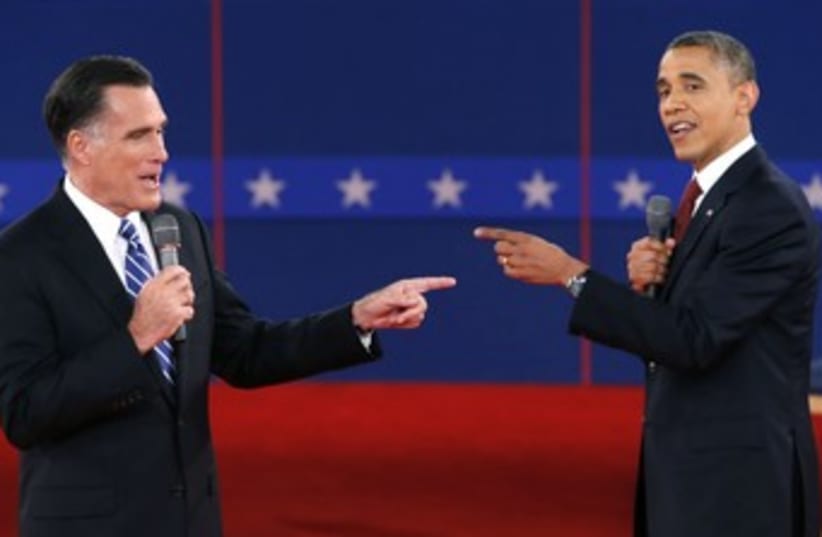
By HILARY LEILA KRIEGER, JPOST CORRESPONDENTRomney, Obama point at eachother during debate 370(photo credit: REUTERS/Mike Segar)
WASHINGTON – When Mitt Romney talks about taking aggressive action to thwart Iran’s nuclear program, there is something beyond hidden nuclear facilities and UN Security Council resolutions that could pose a challenge to his freedom of action: the presidential calendar.The Republican candidate’s stated policies on Iran align more closely with Israel’s than US President Barack Obama’s do. Romney, unlike Obama, has set nuclear “capability” as his red line on Iran’s nuclear program – just as Jerusalem has. And Romney – like Israeli officials – has expressed concern about the Obama administration sending Iran “mixed messages” about the threat of force when top US figures publicly air their doubts about the utility of an attack.But even if Romney is more willing to echo the Israeli position and say he would take military action to defend it, that doesn’t mean he would be able to do so by the deadline Prime Minister Binyamin Netanyahu set at the UN in September. Netanyahu spoke then of Iran reaching the threshold of the final stage of uranium enrichment needed for a bomb “by next spring, at most by next summer,” and declared that Tehran must be stopped before going further than that.Click here for special JPost coverageIn the end, perhaps neither Obama nor Romney would decide to take military action against Iran’s nuclear program; Obama has repeatedly made clear his misgivings about that course. Still, some (though not all) in Israeli officialdom see Obama as better positioned to lead a strike before Netanyahu’s clock runs out. As an incumbent president long involved with Iran, he wouldn’t face the structural impediments that, these voices privately assess, make it very unlikely Romney would launch an attack so quickly.Romney would have to both assemble a national security team and demonstrate to the American public, during his first few months in office, that he has exhausted every other option for ending the Iranian nuclear program.“It takes many, many months for the senior leadership to be put in place, and usually it’s not until summer that they are really fully in place,” according to Rob Danin, who experienced several periods of transition while working at the State Department and National Security Council under both Republican and Democratic administrations. “That’s a practical problem that the new team will encounter – they will still be finding their way.”Though Danin noted that Obama would also have to deal with staff turnover, it would be a “much, much shorter” process as an incumbent, particularly if the US Senate, responsible for confirming the president’s major appointments, stays Democratic.Additionally, Danin questioned whether Romney would want to start out his relationship with the international community and the American public by launching another US action in the Middle East.“It’s very difficult for the president to take proactive military action in the first few months of his administration unless events force something on him,” said Dan Schnur, an expert on the presidency at the University of Southern California and former aide to Republican Sen. John McCain. He pointed out that the use of force by new presidents in the modern era generally occurred in cases where they had inherited an ongoing war.Mehdi Khalaji, an Iran expert with the Washington Institute for Near East Policy, predicted that both politicians would need to give diplomacy one more shot before either would resort to military action – Romney because he could not win over the American people for such an attack without himself having made an effort at diplomacy, and Obama because he himself was not yet convinced that an attack was the only remaining option.Even if both men need to resume the diplomatic process, Obama could do so on a much more accelerated schedule than Romney – a significant distinction with the clock running down.Khalaji noted that the Iranians suspended negotiations in mid-summer until after the US election because they felt that political considerations would keep Obama from making a deal – or attacking – during that time.“If Obama gets reelected, the chance of resuming negotiations in November is very, very high. But if Romney gets elected, they would wait for January 20, until Romney comes to office,” he calculated.Not that it’s a given that Obama would be willing to attack even if he feels the diplomatic process has been exhausted. He has already indicated that he is opposed to Israel striking on its own, something Jerusalem assesses Romney would be much more supportive of.The preferred Israeli course if diplomacy and sanctions fail would be to have the US take military action, since it would have greater capabilities and international support.Yet Israel could feel compelled to take matters into its own hands. Netanyahu implied at the UN that that time would come in late spring or summer of 2013.Of course, that time-frame has been pushed back many times before – including during the UN speech itself. Until Netanyahu’s September address, there was speculation that Israel might attack toward the end of 2012, since Defense Minister Ehud Barak had previously hinted the deadline for action would come this fall. On Tuesday, Barak explained why the autumn deadline had been delayed, and his comments were a reminder that the time-frame is not set in stone.If the timeline does change – if Iran, or another cyber attack, slows uranium enrichment, for example – the practical constraints that could hinder Romney in his first few months in office would be removed. Then he would have more room to walk the walk as well as talk the talk.
if(catID != 151){
var cont = `Take Israel home with the new Jerusalem Post Store